Kaskaskia: A Community Resilient Against Nature’s Tide
The congregation arrived as usual, about half an hour before Mass, on a recent Saturday afternoon. The old church gradually filled with descendants and caretakers of a serene place marked by loss. Today, the space often feels empty. Nature has slowly reclaimed Kaskaskia, the founding site and first capital of Illinois, one flood at a time.
The island, named after the town, is mostly silent now, embedded in downstate Illinois. The silence amplifies the faint hum of barges on the Mississippi River. Kaskaskia is the only part of Illinois west of the Mississippi, underscoring the river’s capricious power. The river, once bringing life, has reclaimed it.
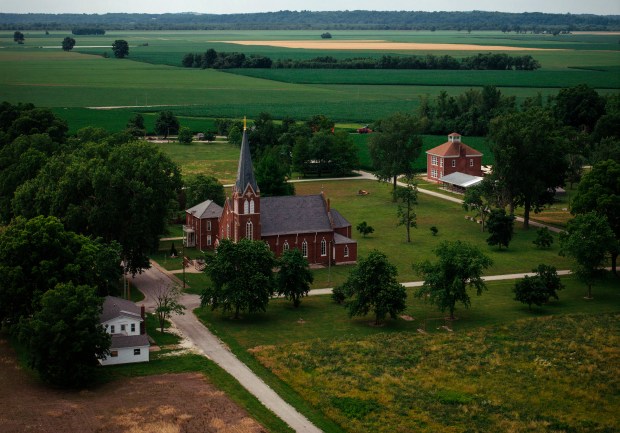
An aerial view from May 23, 2026, captures Immaculate Conception Church. Founded as a mission by Jacques Marquette in 1675. (E. Jason Wambsgans/Chicago Tribune)
History in Kaskaskia is rich, akin to the fertile soil that initially drew settlers, establishing it as Illinois’ most crucial location for a period. A Liberty Bell gifted by King Louis XV of France predates the famous one in Philadelphia. The town shares a history that began before America’s founding 250 years ago. Little remains save for the church and its surviving spirit.
The Immaculate Conception Chapel, a brick Catholic church with a prominent spire, remains a protective beacon amidst recurring floods. Both the land and the chapel withstand odds, symbols of resilience and community. Memorials to those who aspired to establish a new state and country, even in an untamable place.
In years past, over 7,000 people lived by the river in and around Kaskaskia. It served as an essential hub during America’s westward expansion, a French Colonial trading post, and a significant site during the American Revolutionary War and Lewis and Clark’s 19th-century explorations. The Illinois Territory’s capital was rooted here and housed the state’s initial constitution. However, by 1844, a major flood submerged the town in five feet of water, and by 1881, the Mississippi’s altered course rendered Kaskaskia an island.
As the population dwindled, the town withered. A memorable flood in 1993 further tested the remaining inhabitants.
Stanley Hurst, one of the few residents left, reflects on patrol near the Kaskaskia Bell State Memorial, May 23, 2026. (E. Jason Wambsgans/Chicago Tribune)
Few remained by then, including Stanley Hurst, who was raising four children on ancestral land. When the 1993 floodwaters breached the levee, Hurst realized the harsh realities of staying there. “No more of this,” he decided, stepping into Immaculate Conception church soon after. The floodwaters lifted pews and statues, reaching a depth of over nine feet.
Settling on a hill near St. Mary, Hurst nevertheless continues to return to Kaskaskia most weekends. The church hosts one Mass weekly, creating a brief resurgence of life. The congregation gathers to remember and preserve the memory of those who resided here and refused to leave.
Mary Ellen Brown and Emily Lyons, native islanders who have kept the church’s spirit alive, now tend to the past, ensuring it’s remembered. Generations of their families have called this place home, with Brown getting married on its altar just before the destructive 1993 summer. Lyons taught at the local elementary school until it shut due to a lack of students.
Emily Lyons waits for Mass in Immaculate Conception Church, May 23, 2026. (E. Jason Wambsgans/Chicago Tribune)
Brown and Lyons regard their preservation efforts as a mission, eager to pass on the island’s history. They recount stories connected to the chapel’s beams and windows, recalling the church’s early days. They hold rich memories of submerged icons and the restoration efforts post-flood.
Currently, only 22 residents are counted in Kaskaskia, but skepticism persists. Some locals doubt there are as many as recorded. Outside of Mass, isolation prevails with infrequent human activity.
Earlier on that Memorial Day weekend, Warren Gendron and his wife paid respects at a cemetery, leaving flowers on family graves dating to Kaskaskia’s first settlers. Gendron shares roots with the initial French Canadian settlers, noting family lore of intermarriage with Indigenous peoples.
A few miles from there, a gathering honored memories with a cookout, reconnecting families to the island. “Coming here is a great reset,” noted Derick DeRousse, reminiscing about family histories as his relatives recalled the island’s vast quiet.
An annual fish fry gathering in Kaskaskia on May 23, 2026, brought family and friends to honor Robby Ray Davis. (E. Jason Wambsgans/Chicago Tribune)
Kaskaskia seems set in reverse; absent of stoplights, signs, or other trappings of modernity. An absence of schools or local businesses marks its landscape, void of structures abandoned to the elements. To reach this history-laden town, visitors depart from Illinois and enter through Missouri.
Old remembrances, like the storied Liberty Bell once stored inside the church, and historical sites commemorate the town’s contributions during the American Revolution.
Recurrent flooding prompted citizens to abandon “old town,” relocating to central parts of the island. The ongoing cycle of decay and restoration preserves the church as the remaining emblem of local resilience. Nearly a century since its 1894 relocation, residents like Hurst continue rebuilding in the spirit of unity and faith.
The Rev. Vincent Obi arrived as Mass prepared to commence. The gathered congregation witnessed the ritual continuation amid dedicated leadership and lay efforts. Attendance ebbs and flows with the seasons and holidays, displaying local commitment.
Saturday Mass at Immaculate Conception Church, held on May 23, 2026. (E. Jason Wambsgans/Chicago Tribune)
Post-1993, prolonged discussions about the church’s uncertain future resolved toward preservation thanks to community advocacy and labor, alongside diocesan support. Yet questions linger about the long-term sustainability faced with both declining population and geographical challenges.
While the church’s numbers dwindle, survivors like Hurst maintain fellowship out of love and legacy. “It’s my church,” he insists, a conviction echoed by fellow members.
Despite concerns over eventual relinquishment to successive disasters, congregation members trust in their shared destiny, acknowledging little can be done against natural forces.
The Rev. Vincent Obi greets parishioners post-service at Immaculate Conception Church, May 23, 2026. (E. Jason Wambsgans/Chicago Tribune)
Persistent unease remains, overshadowed by a spirit of endurance. Members continually rally to safeguard their historical and spiritual home even as others see nothing left there. Yet, for the devoted few, the island holds three hundred years of resilient history, symbolically renewed each week at Mass.