The History and Significance of the FIFA World Cup Trophy
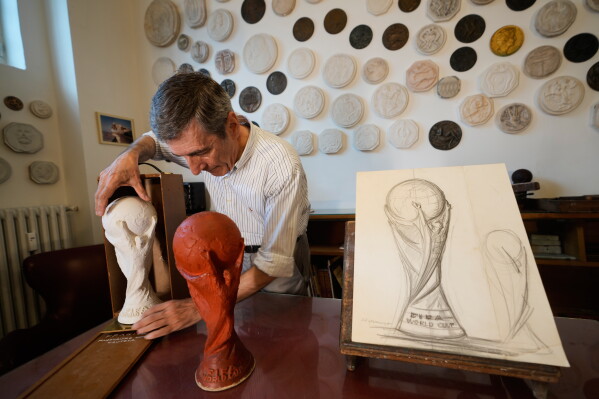
The FIFA World Cup trophy, crafted by Italian sculptor Silvio Gazzaniga, embodies the emotions of athletic struggle, fan jubilation, and victory. On Sunday, either Spain or Argentina will lift the trophy after the 2026 World Cup final. Here’s an insight into this prestigious prize in soccer.
Design and Origin
Gazzaniga designed the trophy in his Milan studio after FIFA called for a new design in the 1970s. This was prompted when Brazil permanently claimed the original trophy upon winning their third World Cup in 1970. The current design shows two figures rising towards a globe, symbolizing Earth. Giorgio Gazzaniga, Silvio’s son, recalled his father developing the trophy design from numerous sketches, ultimately representing the spiraling motion akin to DNA strands.
“When he started to design the cup, he was sketching a huge number of drawings and finally started to develop the idea to have the world and this symbol that it is like two DNA spirals, that are moving up,” said Giorgio Gazzaniga.
The elder Gazzaniga, who passed away in 2016, contributed significantly to the world of trophy design, also creating the UEFA Cup and European Super-Cup. His work for G.D.E. Bertoni Srl covered some of the most renowned trophies globally.
Previous Trophy’s Disappearance
The first World Cup Trophy was introduced at the inaugural 1930 tournament, depicting the Greek goddess Nike. It was named the Jules Rimet Trophy after the tournament’s founder. FIFA sought a replacement after Brazil won permanent ownership by securing three World Cup victories. The Jules Rimet Trophy was infamously stolen twice; once in 1966 while on display in England, where it was recovered by a dog named Pickles, and another time from the Brazilian Football Confederation headquarters in 1983. It was never recovered and is suspected to have been melted down.
Symbolism in Gazzaniga’s Design
Gazzaniga’s design emerged as the winner from over 50 proposals. His son explained that the model allowed judges to appreciate its narrative. The trophy’s elements embody the struggle for victory through a rugged athlete’s form, accentuated by movement and exertion. The design expresses triumph with arms resembling Victory’s wings, capturing both the athlete’s success and the fan’s joy.
“There is the world, which stands above all else, there is the athlete’s exertion, there is the athlete’s movement within the metal, and the athlete’s body is rough, rugged, for it has suffered, had to fight, and struggled for victory,” Giorgio Gazzaniga explained.
The elder Gazzaniga’s office, now relocated outside Milan, keeps his original sketches, prototype, and a wax cast.
Custody of the Trophy
The official World Cup trophy stands at 36 centimeters tall and is cast in 18-carat gold, with a base featuring green malachite rings. After the World Cup, the original returns to FIFA’s Swiss headquarters. Winning teams receive a gold-plated replica instead. FIFA’s policy no longer allows teams to retain the trophy after three wins.
This design will be used until at least the 2038 tournament. Giorgio Gazzaniga recalled witnessing the 1974 World Cup final at home when the trophy was first awarded, noting the moment it became iconic as West Germany lifted it in Munich.
“The real explosion of joy came when the German team raised the cup in Munich and the whole stadium erupted,” he stated. “That was the moment an object became an icon.”