Justice Alito Affirms Commitment to Legal Interpretation Amid Criticism
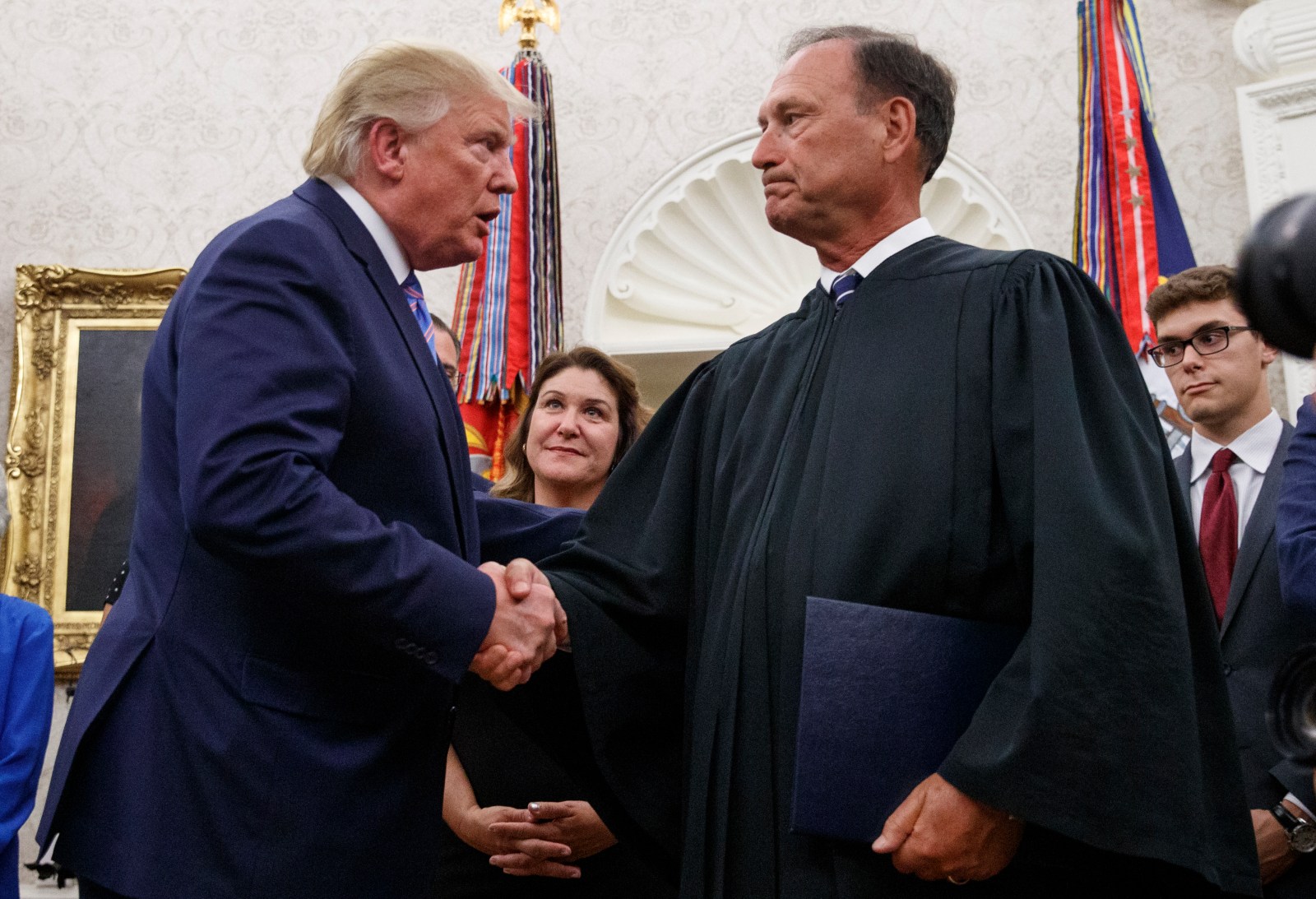
Supreme Court Justice Samuel Alito recently reiterated his dedication to making decisions based on his legal interpretation, rather than aligning with President Donald Trump or responding to public opinions on the Supreme Court’s neutrality. In an interview with The Wall Street Journal, Alito dismissed the idea of changing his judicial approach to avoid political alignment. “I vote in every case the way I think the case should be decided,” Alito stated. “If that means a high correlation with what Trump wants, fine. If it means zero correlation with what Trump wants, fine as well.”
Alito explained that it would be “absolutely wrong” to intentionally change his rulings for appearances. “There have been people who’ve recommended to me that I do that,” he mentioned. “I’m not going to do that. I’m going to decide them all the way that I think they should be decided. I explain why I’ve done it. People can agree, people can disagree.”
His comments are part of the ongoing scrutiny of the Supreme Court and speculation about its future. Earlier this year, NPR incorrectly reported Alito’s potential retirement, which led to debates about the possibility of President Trump nominating a new justice during his administration.
Discussing his tenure, Alito told the Journal, “Obviously, I’m here for another term.” When asked if calls for his retirement bothered him, he admitted, “It’s not pleasant, in the sense that it’s a reminder of mortality,” likening it to vultures circling but acknowledging it’s a part of having life tenure.
Renowned constitutional lawyer Alan Dershowitz expressed support for Alito in an email to Newsweek, saying, “I agree with Alito’s answer, and I hope he stays on the Court.” Meanwhile, President Trump praised Alito on Fox Business, calling him a “great justice” and expressing readiness to nominate a successor if needed.
Alito’s comments emphasize his stance against letting outside political views influence his judgments. He argues each case should be determined by what he perceives the law requires. Recent polls indicate varied perceptions of the Supreme Court’s performance and individual justices based on political affiliations.
A Marquette Law School Poll showed that 47% of adults approve of the Supreme Court’s actions, while 53% disapprove. The poll reflects party-line divisions, with 74% of Republicans approving, compared to 35% of independents and 22% of Democrats. Furthermore, a February 2025 poll showed an 84% approval rate among Republicans, indicating a 10% drop.
The survey also highlighted contrasting views between parties, with Democrats more likely to believe justices favor Trump in their decisions.
Alito describes his “practical originalist” method as staying true to the Constitution’s original meaning without expanding its principles beyond what the framers intended. “You can take an important principle that is in the Constitution, like equal treatment,” Alito explained, “and if you view it at a very high level of generality, you can say that the Constitution requires equal treatment in a context that never occurred to, or never could have occurred to, those who adopted the provision.”