China Mourns Former Premier Zhu Rongji, Reflecting on His Legacy
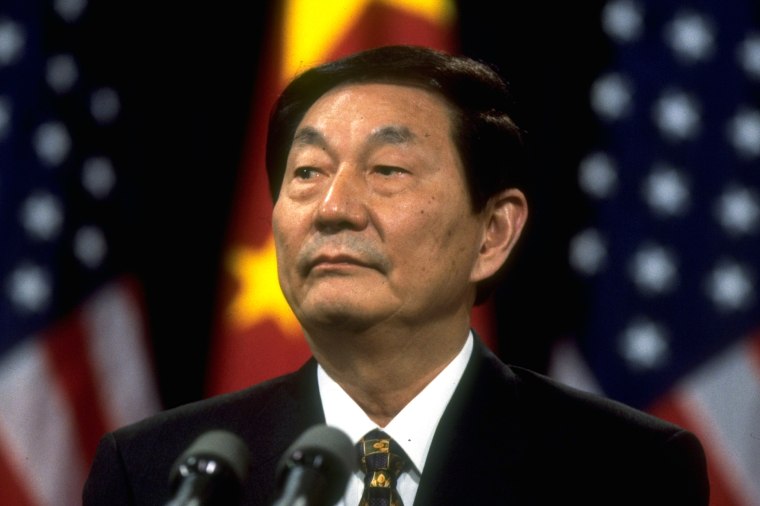
In Beijing, the body of former Premier Zhu Rongji was cremated on Tuesday, marking the end of an era for the reformer who passed away at 97. Zhu was remembered as a significant figure in China’s economic transformation during the 1990s. The nation observed mourning by lowering the national flag.
Security across the city was heightened, especially near Tiananmen Square and Zhongnanhai, the epicenter of Chinese political power. These locations lie en route to Babaoshan, the crematorium for top officials and national heroes.
President Xi Jinping, along with the Politburo standing committee, paid their respects with a moment of silence and symbolic bows before Zhu’s cremation. According to Xinhua, the state-run news agency, they expressed condolences for Zhu’s passing.
Former President Hu Jintao, who has kept a low public profile recently, sent a wreath in memory of Zhu, who served as vice premier from 1991 to 1998 and as premier from 1998 to 2003. Zhu’s contributions to China’s economic policies were pivotal during this period.
During his tenure, Zhu tackled rampant inflation, reformed the tax and banking systems, and restructured the state sector by closing inefficient enterprises. These measures were instrumental in China’s admission to the World Trade Organization in 2001, a significant move for the country’s global economic integration.
Reflecting on his leadership style, Zhu once stated, My defining trait — my guiding principle — is independent thinking. I believe I should say what I truly think.
This was a guiding principle throughout his political career, despite facing challenges such as losing his Communist Party membership in the late 1950s due to a controversial speech. It took nearly two decades for it to be reinstated.
His death sparked a wave of mourning on Chinese social media, although reactions varied. Some criticized his policies for causing unemployment, while others defended his tough decisions. Zhu acknowledged these mixed sentiments, acknowledging in 2001 that not everyone was fond of him. How could one possibly make everyone love him?
he remarked.
The authorities managed Zhu’s posthumous commemoration with cautious observation, aware of the potential for public emotion to spill over, as it had in previous instances involving popular leaders. In 1976, Zhou Enlai’s death saw mass protests, and in 1989, Hu Yaobang’s death led to the Tiananmen Square demonstrations.
Memories of Zhu continue to resonate with many, as people recall a time when China embraced reforms and rapidly integrated into the global economy. Zhao, a technology worker in his late thirties, observed that the remembrance of Zhu brought back nostalgia for the period of openness and economic growth that followed his leadership.