Cascadia High-Speed Rail Plan Unveiled to Connect Portland, Seattle, and Vancouver
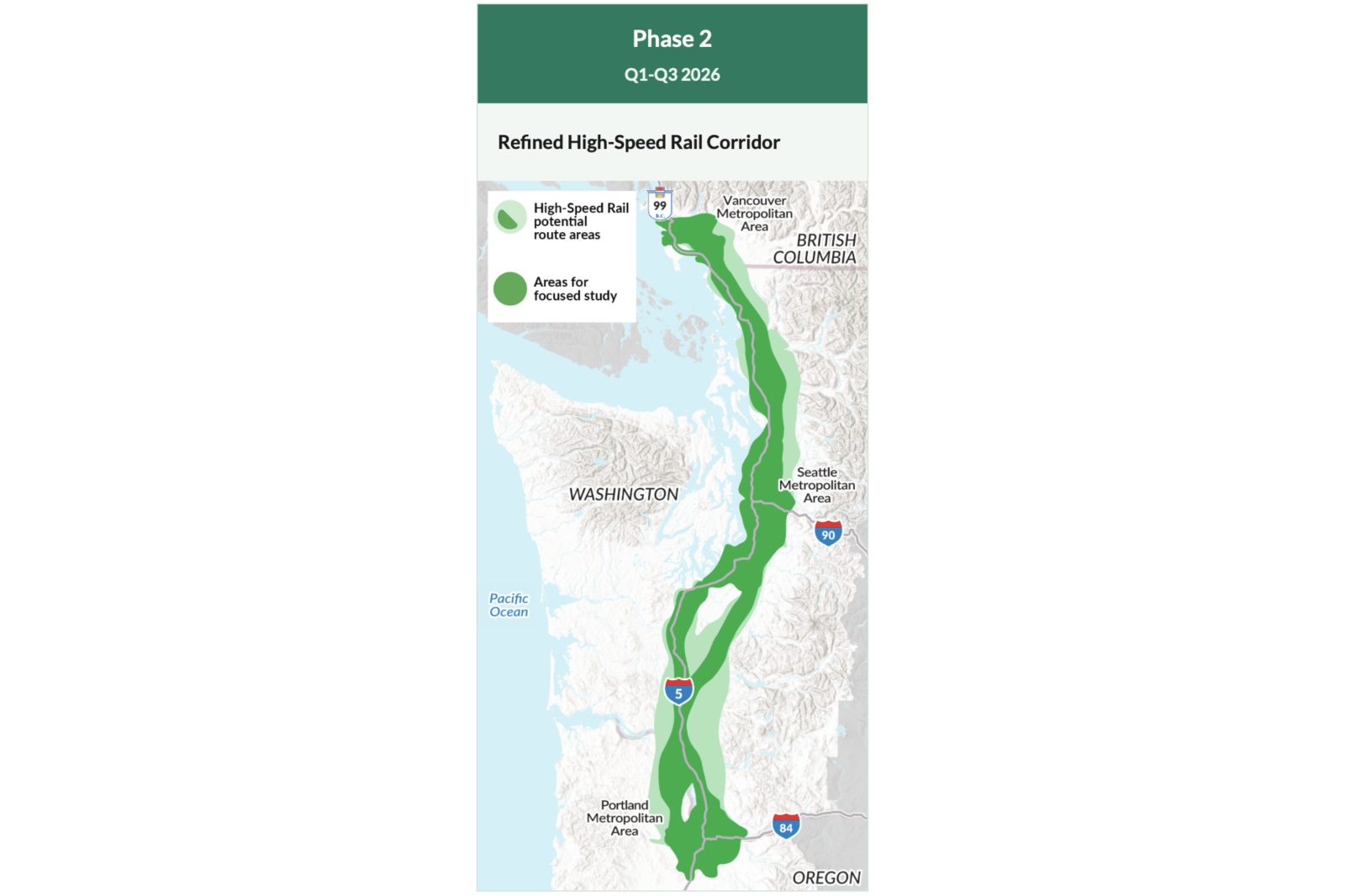
A new high-speed railway proposal aims to connect three major cities in the Pacific Northwest: Portland, Oregon; Seattle, Washington; and Vancouver, British Columbia. This long-term plan, known as the Cascadia High-Speed Rail system, seeks to enhance transportation across the wider Cascadia region, linking these metropolitan areas which span two U.S. states and Canada.
The Washington State Department of Transportation (WSDOT) released a conceptual map showing the proposed corridor from Portland through Washington to Vancouver. The project is in its early stages, and no final route or station locations have been finalized. WSDOT encourages public feedback through an online survey available until November 13, with responses guiding the future planning of the transportation system in the region.
Details of the Cascadia High-Speed Rail Plan
This high-speed railway aims to improve connectivity between key cities in the Pacific Northwest, accommodating expected regional growth. The network would establish a north-south connection across the U.S.-Canada border, involving collaboration between WSDOT, the Oregon Department of Transportation, Oregon Metro, and British Columbia’s Ministry of Transportation and Transit.
The proposal is part of WSDOT’s broader Cascadia High-Speed Rail and I-5 Program, which focuses on enhancing Interstate 5 alongside the planned railway. This initiative also seeks to integrate road, rail, airports, transit, and other transportation modes into a cohesive regional system.
A $49.7 million grant from the Federal Railroad Administration was awarded to WSDOT in December 2024 for a Service Development Plan; the Washington State Legislature provided an additional $5.5 million. This stage of planning is expected to last until 2028.
Potential Stops and Routes
While Portland, Seattle, and Vancouver are earmarked as primary metropolitan areas for connection, specific station stops have not yet been decided. WSDOT’s Service Development Plan will explore potential routes and service options, considering factors such as the number and frequency of stops. It will also look into governance and financing models. However, the development plan will not determine a preferred route or confirm station locations by its completion in 2028.
Reasons for Implementation
One of the main motivations for the rail plan is projected population growth in the Pacific Northwest. WSDOT forecasts the Cascadia megaregion will grow by 3.4 million people by 2050, along with expansion in industries like technology, aerospace, healthcare, and logistics. Existing transportation systems are expected to face increased demand.
Projections for Washington indicate that the percentage of Interstate 5 experiencing medium or high congestion will rise from 59 percent to 80 percent by 2050. Meanwhile, in Portland, severe congestion on I-5 is expected to jump from 33 percent in 2019 to 78 percent by 2045. It is evident that no single mode of transportation can meet the region’s future needs, necessitating a combination of highways, rail, transit, aviation, and other forms.
Challenges in High-Speed Rail Construction
While the Cascadia project is still years from construction, California’s high-speed rail endeavor illustrates the challenges involved in realizing such ambitious plans. California has struggled with cost and complexity, despite ongoing construction in the Central Valley. The full vision from San Francisco to Los Angeles/Anaheim has not been completed, and the first segment’s passenger service launch is anticipated for 2033.
By July 31, 2026, California’s high-speed rail expenditures totaled $8.10 billion on Central Valley packages, with significant progress reported but many structures still under construction. Revisions to station designs and infrastructure have been made to control costs and advance the initial operating segment.
For the Cascadia project, economic and technical feasibility assessments are underway, along with exploration of routes and service patterns. Public input is crucial for shaping the future of transportation in the region.