Interstellar Comet 3I/ATLAS: A Cosmic Ancient
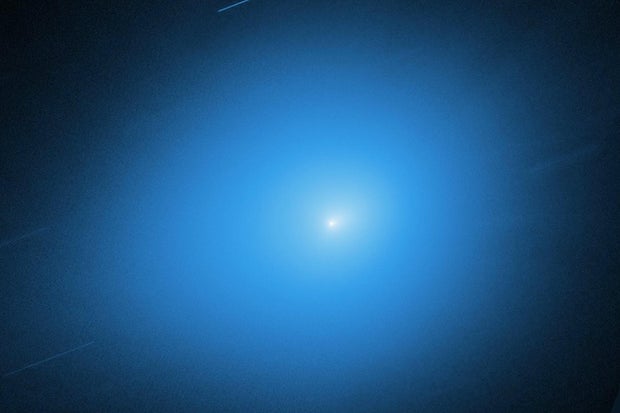
An interstellar comet, 3I/ATLAS, passed by the sun and Earth last year, and astronomers believe it may be nearly three times older than our solar system. This celestial object offers a unique glimpse into our galaxy.
3I/ATLAS is the third known comet to originate from outside our solar system. Its uncommon brightness allowed researchers to study it thoroughly. The comet’s discovery in July sparked online interest, with speculation ranging from scientific to alien spacecraft theories. However, NASA dismissed any extraterrestrial links.
A recent study published in Nature reveals that 3I/ATLAS might be up to 12 billion years old, while our solar system is approximately 4.5 billion years old. Lead researcher Martin Cordiner from NASA’s Goddard Space Flight Center mentioned the possibility of it being the oldest observed object in our solar system.
“The elemental composition provides insights unlike any solar system body,” the study states.
Chemical analyses were carried out using the James Webb Space Telescope and the ALMA observatory in Chile. These instruments revealed an unusual abundance of deuterium, indicating the comet formed in extremely cold conditions. The comet’s formation likely occurred in an environment around minus 243 degrees Celsius.
While the origin within the Milky Way remains unclear, such interstellar comets are thought to form similarly to solar system comets during planetary formation. 3I/ATLAS likely traveled vast distances in the galaxy before entering our solar system.
The comet’s lack of chemical enrichment suggests it originated near birthing stars. Astronomers propose it might be a relic from the era known as “cosmic noon”—a time of intense star formation roughly 10 billion years ago.
Previous interstellar visitors, 1I/’Oumuamua and 2I/Borisov, lacked sufficient brightness for similar analysis. Multiple images of 3I/ATLAS, including one from Hubble showing the comet’s journey at 277 million miles from Earth, highlight its passage.
Harvard professor Avi Loeb speculated about its origin. Despite various possibilities, SETI has found no evidence of extraterrestrial technology in the comet.
Astronomers hail the findings as revolutionary. Darryl Seligman from Michigan State University and Peter Veres from the International Astronomical Union emphasize the importance and complexity of the observations.
Although 3I/ATLAS is leaving our solar system, making future observations challenging, astronomers anticipate discovering more interstellar objects. Particularly, the upcoming Vera C. Rubin Observatory in Chile promises to expand this research field.
Martin Cordiner concludes that this discovery merely marks the start of an exciting field. Researchers expect these celestial objects to reveal more about our galaxy in the years to come.