Supreme Court’s Originalism Approach to Gun Laws
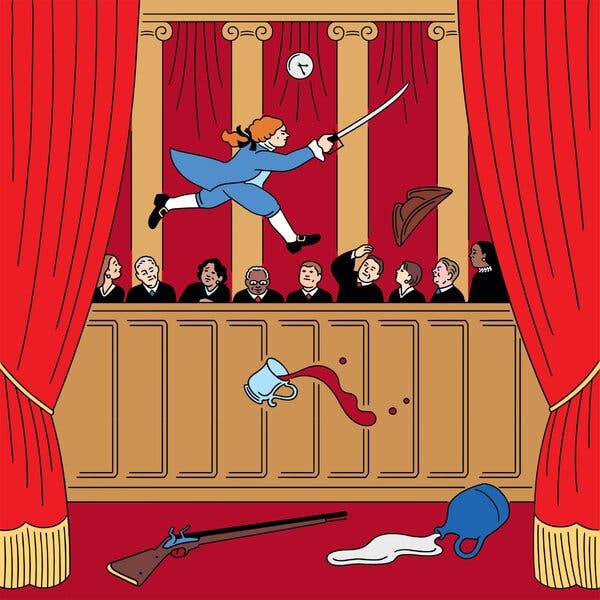
Linda Greenhouse, the recipient of a 1998 Pulitzer Prize, reported on the Supreme Court for The Times from 1978 to 2008. She examines a significant event from a recent Supreme Court term that has not garnered the attention it should. This term highlighted the court’s deep-seated commitment to ‘originalism,’ which has become almost comedic.
Originalism emerged as a method of constitutional interpretation during the Reagan era. It aimed to restrict judges by grounding them in historical context. Justice Brett Kavanaugh explained the idea behind originalism a few years ago, stating, ‘History is far less subjective than policy.’ In a concurring opinion on a gun rights case, he emphasized that ‘history and tradition,’ not contemporary situations, should guide restrictions on the Second Amendment right to ‘keep and bear arms.’
However, a closer look challenges the objectivity of history. Consider an example of how ‘history and tradition’ influenced legal actions today. A young man in Dallas, living with his parents and holding a steady job, also owns a gun, like many Texans. He occasionally uses marijuana. Here, a federal law, Section 922(g)(3), comes into play. It criminalizes gun ownership for anyone deemed an ‘unlawful user’ of a ‘controlled substance.’ Violating this law carries a prison sentence of up to 15 years.
The government moves to prosecute him. With Supreme Court precedent demanding ‘history and tradition,’ prosecutors search for historical justification against the young man’s Second Amendment defense. The Bruen decision from 2022 clarifies that ‘historical tradition’ excludes the context when the regulation was first introduced, such as in 1986 for this particular law.
Instead, the government must find a similar regulation from the country’s founding era or from 1868, when the 14th Amendment extended the Bill of Rights to the states. Given that marijuana was not widely consumed in America in 1791 or 1868, the government’s challenge is clear.
Government lawyers creatively reference ‘habitual drunkard’ laws from the 18th and 19th centuries. These state laws targeted severely intoxicated individuals, sending them to workhouses or jails where they could not access firearms. This is the best analogy the federal government, with extensive resources, can present to support modern gun regulations.