Discovery of Atmosphere on Potentially Habitable Exoplanet LHS 1140b
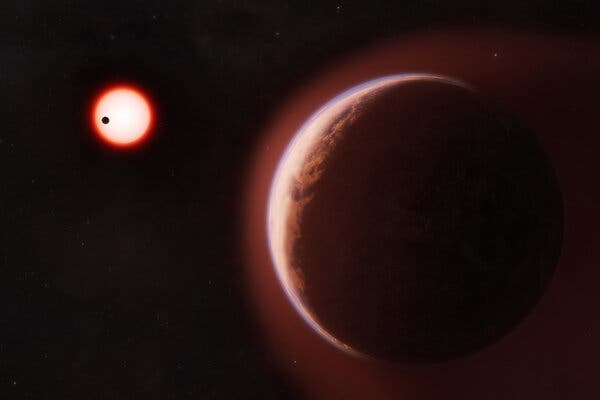
Scientists have identified a distant planet that could potentially support life. This finding marks a significant step in the search for life beyond our solar system. The exoplanet, LHS 1140b, is the first known rocky planet with an atmosphere, providing an environment where life might exist.
The discovery was announced by a group of astronomers who highlighted three essential features of the planet: it is rocky, located in a habitable zone where liquid water can exist, and it possesses an atmosphere. These characteristics are crucial for any form of life familiar to us on Earth.
LHS 1140b is positioned a few dozen light-years away. It orbits a cool red dwarf star within a zone that is neither too hot nor too cold for liquid water. The planet, discovered in 2017, is cooler than Earth but larger in size and mass.
Collin Cherubim, a planetary scientist with a Ph.D. from Harvard University, expressed optimism about the potential for life. Although there is no direct evidence of life, the existence of necessary elements fuels scientific interest.
Recent data published in the journal Science suggests that LHS 1140b has a helium-rich atmosphere. This is the first definitive evidence of a habitable rocky planet with an atmosphere. The find enhances the concept that other such worlds could support life.
“When there’s one, there’s more in exoplanets,”
said Sara Seager, an M.I.T. astrophysicist, indicating the potential for future discoveries.
Atmospheres are critical for life because they maintain water, regulate climate, and shield the planet from space radiation. While atmospheres have been observed on large gas giants, there was doubt about the ability of smaller rocky planets to keep them. LHS 1140b demonstrates that rocky worlds might retain their atmospheres as well.