Moms Rediscover Athletic Passions Through Tennis
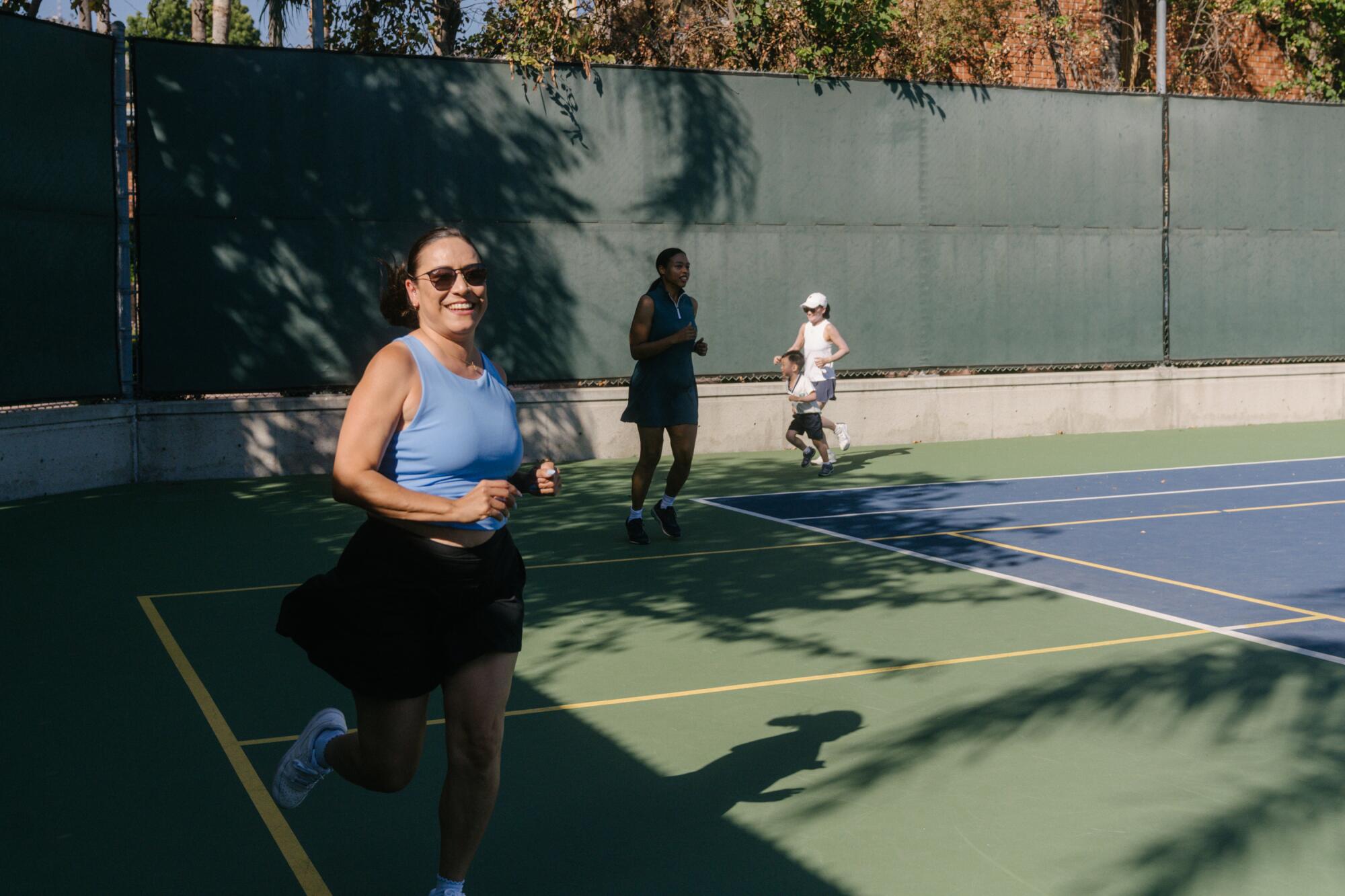
Ruby Griffin is the family’s most experienced tennis player, practicing the game for a significant part of her life. At the Burbank Tennis Center, Ruby, age 5, confidently demonstrates the correct forehand technique to her mom, Castro. As per the coach’s guidance, she maintains a stance similar to a surfer balancing on a board. ‘She’s the tennis girly,’ Castro, 42, from Toluca Lake, remarks. ‘I’m stepping back, allowing her to lead.’
The new Mommy and Me tennis class encourages caretakers to actively participate rather than merely drop off their children. For Castro, who once danced and cheered, turning fully to motherhood changed her identity. Gradually, she’s finding her way back to herself. Castro leads warm-up drills, stating, ‘Here I am, taking baby steps.’
In this class, outfits featuring Hello Kitty and small Dodgers hats define tennis fashion. Some participants are as young as 3 and can hardly see over the net. When Coach Chessa Mehlman asks a young player to exhibit his forehand, he humorously sits on the racket. This setting is not Wimbledon, yet it shares an unexpected connection with the prestigious tournament. Mothers are expanding their athletic identities.
This year, six mothers competed in Wimbledon’s women’s singles draw, including Serena Williams and Naomi Osaka, along with Elina Svitolina, Taylor Townsend, Belinda Bencic, and Tatjana Maria. On her return to Wimbledon, Williams shared her motivation: motherhood. ‘If I did return, it would be about experience, about sharing the moment with my kids,’ she wrote in an essay.
Wimbledon highlights a question many caregivers face: reclaiming or expanding athletic life post-children. Women often want to engage in sports, but life’s demands create obstacles. Childcare, time, money, bodily recovery, and finding a space to practice while rusty add challenges. Williams displayed powerful serves during her first-round Wimbledon loss as her daughters watched. Although a knee injury ended her run, she hinted at a potential return.
Kimberly Foon returned to tennis after a long break, balancing family and career in Pasadena. The Mommy and Me class offers a compromise, as Foon, 49, plays alongside her son, Ian, 4. They enjoy hitting water balloons on a hot day, bringing laughter and joy.
In Los Angeles, many parent-child classes exist, but Mehlman’s class uniquely focuses on involving parents. The class emerged from observing mothers who wished to play. Mehlman, 31, aware of comebacks due to her own injury, lowered the barriers for mothers to join. Her goal is monthly sessions for the Burbank class. ‘Moms often are more engaged than the kids,’ she notes. Participants RSVP via Instagram. High-fives, tennis, and conversations about dance classes and eateries are common. Many find satisfaction in moving and gripping a racket again.
The class caters to a significant need. Society often shifts the focus from mothers once parenthood begins. Victoria L. Jackson, a sports historian, notes how athletes historically face a motherhood ‘expiration date.’ Williams discussed this issue while choosing to focus on family, a decision less scrutinized for male athletes. Female participation in track and field began at the 1928 Olympics, but false reports on women’s exhaustion led to exclusion until 1960. That year, Wilma Rudolph, a mother, won three Olympic gold medals.
Jackson relates the Mommy and Me class to a historical struggle for women in sports. Local solutions contribute to systemic change, often starting with people addressing immediate challenges. Alysia Montaño, a champion and mother, challenged the notion that pregnancy devalues female athletes. Montaño, who raced while pregnant twice, founded For All Mothers+, a nonprofit supporting mothers with grants and resources.
The next grant recipients, announced July 20, will receive childcare funds and training gear. In recent years, 75 mothers received help crucial for their athletic persistence. Sports reflect societal issues, Montaño explains, and childcare assistance supports women’s careers.
The ‘motherhood penalty’ describes the perceived decline in ambition or capability linked to motherhood. It affects work and sports, pressuring women to achieve despite barriers. Stephanie Johannesmeyer faces this while balancing motherhood and social services work. Running helped her earn a childcare grant and run a marathon. Despite personal challenges, she celebrates her accomplishments.
At the tennis class, many mothers echo the idea that self-time enhances motherhood. Nicole LeVine takes pride in her son Roman’s tennis lessons, pondering their mutual athletic futures. After re-engaging with tennis, she reflects on being recognized as an athlete, embracing her newfound identity alongside motherhood.