Air Quality Challenges in McKinley Park: Community Efforts and Monitoring
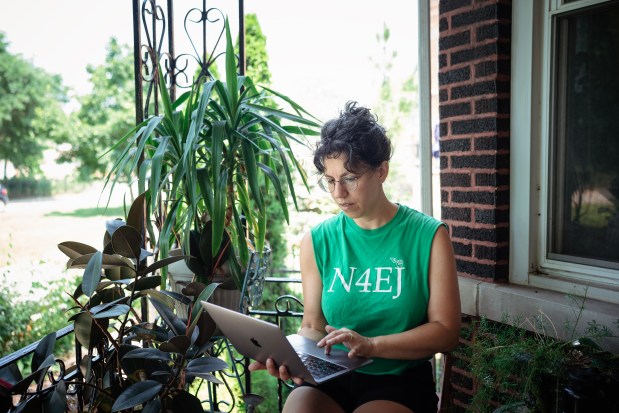
Sonia Monet Saxon frequently greets the day at 4 a.m. with the unpleasant smell of burning asphalt. Her residence in McKinley Park is sufficiently close to an asphalt plant, causing an overpowering odor that sometimes makes outdoor activities challenging. Pollution has long plagued various communities, including this one, even before the influx of wildfire smoke from Canada and Minnesota brought high PM2.5 levels to Chicago.
Determined to track pollution, Saxon recently secured an air quality sensor on the railing of a local house using zip ties. This marked her fifteenth such installation, part of her ongoing efforts over recent years to monitor emissions from the nearby asphalt plant. “I love this neighborhood, but the smell can be overwhelming,” she shared.
Air Quality Monitoring in Chicago
Air quality in Chicago is monitored through various methods. Simpler sensors like Saxon’s provide affordable insights, while the city and University of Illinois Chicago have set up more advanced monitors. Regulatory monitors, which are more costly, offer comprehensive data.
Sonia Monet Saxon, community science organizer at Neighbors for Environmental Justice, installs an air quality monitor at a home in the McKinley Park neighborhood on July 15, 2026.
Professor Serap Erdal from UIC leads the Open Air Chicago project, the second-largest air monitoring network globally, following London. However, gaps remain, as current sensors measure static points across the city. Recent research suggests that satellites could enhance coverage nationwide.
Despite technological advancements, some argue that tracking quality isn’t enough. “Our goal is clean air,” emphasizes Anthony Moser, president of Neighbors for Environmental Justice.
Monitoring Efforts and Impact
Saxon, a community science organizer, is on the frontline of monitoring efforts. She targets the MAT Asphalt plant, a source of ongoing concern since its 2018 opening, due to its location near schools and homes. Saxon has set up PurpleAir sensors costing $289 each, using grants for funding. These sensors measure critical factors, including PM2.5.
On July 15, a newly installed sensor recorded PM2.5 levels rising from 58 to 71. Although within acceptable limits, prolonged exposure poses risks. Wildfire smoke elevated these levels dramatically on July 16.
Chicago and UIC’s Open Air Chicago network, with solar-powered sensors on city light poles, aims to track pollution. The network resulted from collaboration with various organizations, focusing on industrial areas burdened with pollution. While not for enforcement, these sensors provide real-time data, informing citizens about their local air quality.
An air quality sensor part of the citywide network Open Air Chicago hangs on a pole on July 24, 2026.
Angela Tovar, the city’s chief sustainability officer, notes the network’s value in identifying pollution patterns and informing future strategies.
Community-Led Initiatives
Despite city efforts, Neighbors for Environmental Justice continues to deploy their sensors. The city’s network covers broad areas, but Moser explains that smaller, local data makes pollution more tangible to people. Engaging citizens with neighborhood-specific readings can highlight the issue’s reality.
Criticism of zoning laws and planning practices adds complexity. Community leaders argue these practices lead to higher pollution levels in low-income and racially diverse neighborhoods.
Joe Haughey, MAT Asphalt’s facility manager, maintains compliance with legal emission limits. Tests by CleanAir Engineering reported negligible emissions from the plant. Haughey challenges the validity of odor complaints, attributing them to arbitrary perceptions.
Broader Pollution Concerns
Pollution sources aren’t limited to plants. Industrial corridors and truck traffic contribute significantly. The Little Village Community Council advocates for improved air quality and has set up PurpleAir sensors, though technical and calibration issues persist.
Chicago employs six federal air monitoring sites with sophisticated regulatory monitors, unlike the simpler community sensors. These monitors require skilled operators but provide accurate data essential for federal air quality compliance. Their expense limits widespread use, enhancing the appeal of affordable community sensors.
While these sensors provide valuable insights, challenges persist. Environmental conditions can affect sensor accuracy. Placement considerations also impact data reliability, as sensors can potentially reflect local anomalies.
The Role of Satellite Monitoring
Nationwide, monitoring gaps exist due to limited regulatory monitors. Satellite data could address these gaps, allowing comprehensive coverage. While promising, this method faces challenges with interpretation and environmental factors.
Kevin Stewart from the American Lung Association notes that many U.S. counties lack air pollution monitors. Satellite data helps bridge these gaps by assessing areas between monitors and over varied terrains. Despite its challenges, it complements other monitoring methods.
With the increasing sensor readings on July 16, McKinley Park residents became acutely aware of air quality concerns. Some residents, like Moser, remain focused on advocating for better environmental policies and awareness, urging the city to act strongly against ongoing issues.