Illinois GOP Struggles to Leverage Speaker Welch’s Handling of Harassment Allegations
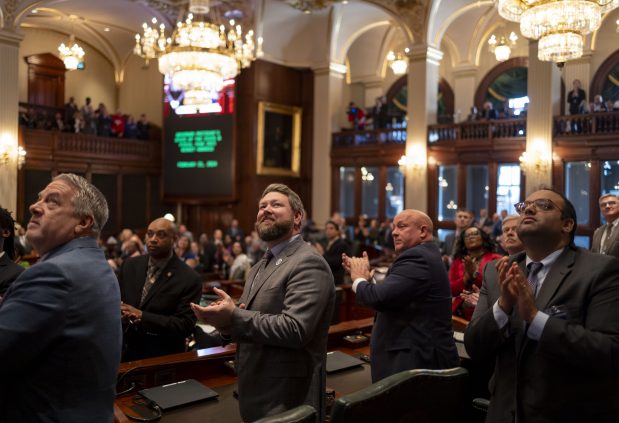
With only 100 days until the November 3 general election, questions surrounding Democratic House Speaker Emanuel “Chris” Welch’s handling of sexual harassment allegations against former state Rep. Harry Benton could seem ripe for Republican exploitation. However, the situation presents complexities for Republicans, especially as they remain a superminority in the chamber.
Several factors hinder the GOP’s ability to capitalize on the issue. The party has seen its influence wane in Illinois. Traditional big-money donors have diminished as the former suburban power base has become more ideologically, racially, and ethnically diverse. Competing in Democrat-drawn, gerrymandered districts poses further challenges.
Further complicating matters is the current political climate characterized by Republicans’ loyalty to President Donald Trump, who lacks support in the state’s most populous counties. Kent Redfield, a professor emeritus of politics at the University of Illinois Springfield, underscores the Republican Party’s difficulties in leveraging the issue. He suggests that the situation may be different if the state were competitive, if there was less fundraising disparity, or if there were officeholders from both parties in state constitutional positions.
Instead, Redfield speaks to the danger of the GOP becoming a regional, downstate conservative organization, aligned with Trump’s “Make America Great Again” slogan. Democrats could counter Republican attempts to gain political advantage by referencing Trump’s payout to writer E. Jean Carroll, after being found liable for sexual abuse and defamation.
Redfield notes Democrats’ ability to use Trump as a diversion, given their strong position in a largely one-party state. This strength allows them to deflect, partly due to the weak opposition. He adds that Republican lawmakers may hesitate to challenge Welch, fearing they might become targets of well-funded Democratic opponents.
“The Republican Party is in danger of becoming just kind of a regional, downstate conservative MAGA kind of organization,” Redfield says.
The Legislative Ethics Commission, including four Democratic and four Republican lawmakers, voted unanimously to release Inspector General Michael McCuskey’s investigatory report on Benton, who resigned his legislative seat on July 3. Nonetheless, Redfield cautions that the report may not be public until Benton responds to the findings and the commission redacts personal information.
A months-long Tribune investigation revealed Welch’s office was aware of Benton’s questionable behavior since a young staffer filed a list of harassment allegations in 2023. Welch’s office delayed contacting Benton until months after the staffer had quit due to mental health concerns. Critically, Welch contended that the staffer did not want action taken until her departure, a claim she disputes.
Welch’s defense included the assertion that the staffer didn’t want to pursue actions against Benton. However, she suggests this referred to declining Welch’s office’s encouragement to file a complaint with the legislative inspector general’s office. Her attempt was to address Benton’s behavior internally, but no disciplinary action occurred at the time.
Welch supported Benton’s reelection campaign with $1.4 million despite known accusations. Benton faced no discipline until this year, following another incident involving a female lobbyist. Her complaints led Welch’s office to prompt an inspector general investigation.
McCuskey appeared on local radio, suggesting knowledge gaps about the investigation details, with criticism mounting against Welch. Despite this, Welch expects the inspector general’s report to confirm his proper handling. Yet, due to elapsed statutes of limitations, the report likely won’t explore the former staffer’s 2023 complaints or Welch’s actions.
Democratic Governor JB Pritzker has called for transparency from Welch, who faces additional scrutiny from the House Democratic Women’s Caucus. Welch has not addressed detailed questions about his conduct, nor confirmed any direct conversation with Benton after the staffer’s complaint.
State Rep. Kelly Cassidy expressed concerns about Welch’s explanation concerning the allegations, calling for systemic improvements. Despite the speaker’s majority in the chamber, Redfield remains skeptical about Welch’s political jeopardy.
Redfield asks, “Is this the hill I want to die on?” considering Welch’s significant Democratic majority.
Jessica Dixon Heitman, chosen to replace Benton, has openly welcomed Welch’s backing ahead of the upcoming election, while voicing commitment to making Illinois more affordable.
Legislators like Alisa Kaplan urge for ethics reform, noting challenges due to Democratic supermajorities’ implications. Kaplan suggests that balance and competition between parties are catalysts for accountability and change.
“When lawmakers get together and really want to … affect change, they can do it,” Kaplan remarks.
Redfield critiques Welch’s historical handling of the Benton case, deeming it detrimental for multiple parties involved, feeding narratives of legislative corruption and incompetence.