Multiple Wildfires and Helicopter Collision Challenge European Firefighters
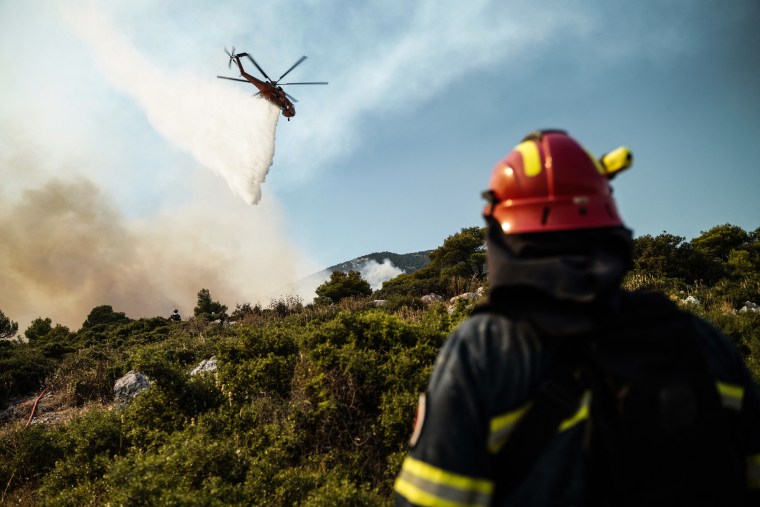
In Greece, a significant incident occurred as two firefighting helicopters collided mid-air while tackling a wildfire near Athens. One of the helicopters crashed, and all four crew members were rescued. Among them, two were safe, while the other two were found unconscious. Details regarding their condition are pending.
The collision highlights the dangers faced by firefighters amid Europe’s escalating wildfire crisis. Strong winds have exacerbated the wildfires, pushing flames further into regions surrounding the Greek capital and prompting more evacuations. Meanwhile, France is dealing with a massive fire four times the size of Paris, and Spain has managed to halt the progression of major fires.
In Western Attica, Greece, firefighters and Civil Protection personnel are contending with advancing flames. The helicopters involved were Bell models operating near Psatha, west of Athens. The crews comprised both Greek and foreign nationals, though their nationalities remain undisclosed.
The fires in western Attica have rapidly spread, endangering communities and industrial areas close to Megara. The situation is reminiscent of the devastating Mati wildfire in 2018, which resulted in 104 fatalities, marking it as Europe’s deadliest blaze of the century.
Further west, containment efforts in France have not eased the emergency. The largest French wildfire remains confined to its perimeter, having displaced 224,000 people, possibly the country’s largest peacetime evacuation. Hot spots persist within a 420-square-kilometer area, with thousands still unable to return home.
Around 3,000 firefighters are committed to tackling the Gironde megafire alongside another uncontained blaze in Provence. In total, fires in France and Spain have resulted in the displacement of roughly 333,000 people, affecting communities at the peak of summer and straining emergency services.
The year 2025 marked Europe’s worst on record for fires, with over 10,000 square kilometers destroyed. Over four decades, wildfires have caused nearly 800 deaths throughout Europe, according to the European Environment Agency. The Copernicus Climate Change Service states that Europe is warming at over twice the global average since the 1980s. Human-induced climate change has at least doubled the probability of extreme fire conditions, according to rapid analyses by World Weather Attribution.
In Athens, gale-force winds have hampered firefighting efforts, preventing aircraft from collecting water from the sea. Authorities ordered evacuations from locations including Kandili and Agia Skepi, as smoke spread over mountains. The seaside community of Porto Germeno remains a significant concern.
The fires, which started on Friday near Agios Vasileios, have impacted an estimated 40-50 square kilometers. Evacuations have been conducted by sea, with 254 people moved on Friday and another 12 on Saturday.
Elsewhere in Greece, wildfires threaten Kefalonia, forcing evacuations from inland communities, with aircraft conducting water drops. In Halkidiki, a fire near Nea Tenedos presented additional challenges. Earlier this week, Greece mourned the loss of three firefighters, two in Crete and one in the Peloponnese.
In France, the Gironde megafire continues to burn, having scorched 420 square kilometers. Although the fire’s spread has stopped, the situation remains unstable, as dry conditions and high temperatures could reignite flames.
Firefighters from Ukraine, Lithuania, and French Polynesia are expected to bolster efforts in the affected areas. In Provence, the fire in the Var department threatened communities, resulting in the evacuation of 2,500 people. Authorities identified it as the fourth major fire in the Var since July 19.
Spain’s wildfires have also seen a reduction, with major fires no longer spreading. In Zamora province, crews are working to prevent flare-ups. Prime Minister Pedro Sánchez has called for a national response to wildfires, emphasizing the growing threat posed by climate change.