Implications of China’s Influence on U.S. AI Infrastructure Debate
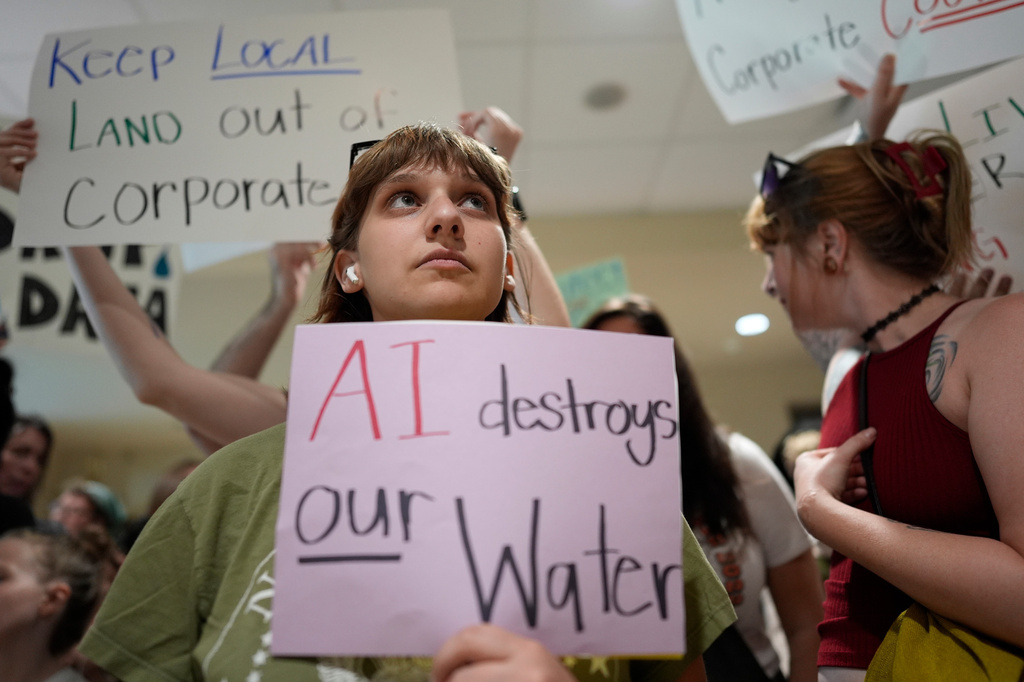
Alexandra Crawford held a sign outside a planning commission meeting on June 11, 2026, in Nashville, Tennessee. The commission was considering an ordinance to regulate data centers. This is increasingly relevant as the race for artificial intelligence not only revolves around semiconductors and talent but also around electricity, transmission lines, and data centers.
This shift affects industrial policy and changes how China influences public dialogue in the U.S. Historically, U.S. policymakers have focused on Chinese cyber espionage, intellectual property theft, and influence campaigns targeting Washington. As federal targets become tougher, China’s approach appears to evolve. Recent evidence indicates a strategy shift towards amplifying existing U.S. disagreements on critical industries.
OpenAI reported disrupting a Chinese-linked influence operation using ChatGPT. It generated fake social media posts opposing U.S. AI data centers. This campaign, called ‘Data Center Bandwagon,’ created false personas claiming that data centers would hike electricity bills and harm communities. OpenAI traced these activities to a Chinese tech company with ties to provincial government clients. Though modest, the operation reflects China’s strategic shift. They amplify existing debates instead of promoting overt pro-Beijing messages, embedding fake voices in contentious U.S. discussions.
This trend aligns with investigations by Graphika and Microsoft Threat Intelligence, which revealed increasingly sophisticated Chinese operations. These operations use fabricated personas, targeting politically relevant issues. OpenAI’s findings indicate similar techniques in domestic debate on AI infrastructure development.
Data centers are pivotal national infrastructure, supporting AI development, cloud computing, manufacturing, military, and research. Both the U.S. and China see AI leadership as key to economic and military strength. Chinese state media criticizes U.S. data centers, yet China subsidizes its own AI infrastructure, with projected doubled electricity demand by 2030 for its data centers.
While China hasn’t singularly created the U.S. debate over AI infrastructure, they exploit authentic social tensions to serve strategic goals. Communities legitimately voice concerns about energy, water use, land, and quality of life. Chinese influence operations don’t need to create new tensions; they intensify existing ones.
Mandiant’s 2022 documentation of Operation Dragonbridge revealed Chinese manipulations posing as Texans against a Pentagon-backed rare earth facility. Google has since removed over 175,000 related accounts. This manipulation targets various debates, from rare earth processing to transmission lines and semiconductor facilities. The focus lies in embedding China’s desired outcomes within American discourse.
The U.S. must differentiate genuine democratic debate from foreign-coordinated efforts amplifying divisions. Democracy thrives on public discussion, especially for major projects reshaping communities. Nonetheless, China’s inauthentic influence on anti-data center sentiment, while promoting its own infrastructure, aims to hinder U.S. progress and foster policy disagreements.
The challenge is not to eliminate disagreement but to better identify foreign strategies designed to deepen divisions around key technologies.
Nikolas Foster, a nonresident fellow with the Atlantic Council’s Global China Hub and former deputy China advisor to the USAID administrator, provides insight into this issue.