JCB Hydromax Sets New Land Speed Record with Hydrogen-Powered Car
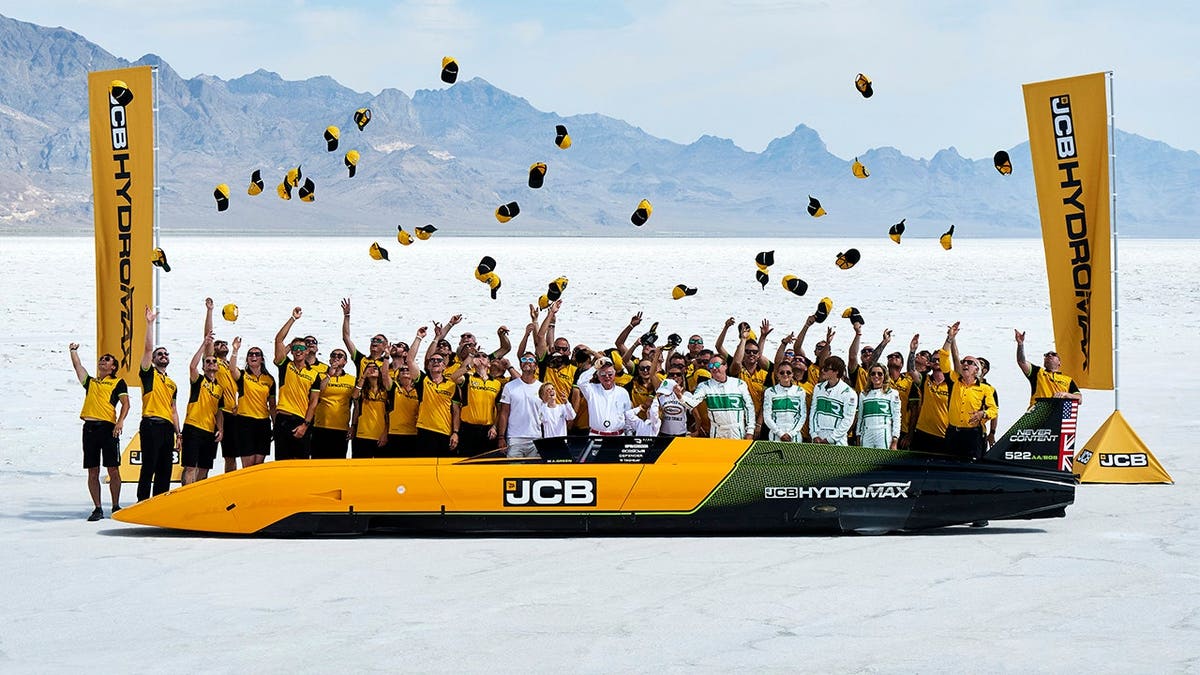
JCB Hydromax has achieved an unprecedented feat with its hydrogen-powered car, setting a world land speed record at the Bonneville Salt Flats. On Tuesday, the vehicle, which is 32 feet long and equipped with twin engines, recorded an average speed of 406.320 mph across two runs. The first run logged 400.623 mph, while the second reached 412.135 mph. This accomplishment surpasses the previous record of 185.5 mph set by BMW’s H2R in 2004. The record awaits confirmation by the Fédération Internationale de l’Automobile (FIA).
“This is the first of a new breed,” said Wing Commander Andy Green, who drove the car. “They have created a new class at Bonneville Speed Week for hydrogen racing, the internal combustion engine. The record blows every other hydrogen car out of the water.”
Green highlighted the rapid timeline for developing the car, noting that such projects typically span three to five years, yet JCB Hydromax completed it in just over a year. The team began design discussions around a year ago, allocating nine months for component design and manufacturing. After building the car in five weeks and testing it in the UK for three weeks, they successfully set the record on their first visit to Bonneville.
The vehicle’s engineering posed several challenges due to high altitudes and extreme temperatures at the Salt Flats, requiring innovative solutions, such as using approximately 400 pounds of ice and water for engine and air cooling. The unique hydrogen engine operates at a precise fuel ratio previously unexplored by hydrogen engines.
Green mentioned, “Instead of five or six years, they did it in five or six days.” He praised the team’s capability in overcoming numerous hurdles, including packaging high-energy output engines into a small space and maintaining performance under extreme conditions.
The car’s speed necessitates a specialized parachute system to slow it safely. Precise oil temperature management was critical to prevent engine damage from water ingress and ensure the oil stayed within optimal operating temperatures.
After achieving a successful run, renewed confidence allowed the team to push the car further on the second attempt, resulting in a new potential world record. “Absolutely amazing achievement,” Green said after recording the second run.
Referring to the challenge of maintaining control at high speeds, Green described the visual distortion caused by rapidly approaching track marker boards. He further elaborated on the importance of safe deceleration, ensuring the car stopped as planned on both occasions.
Green’s extensive background as a Royal Air Force fighter pilot and his previous experience setting the absolute world land-speed record of 763.035 mph in 1997 provided a perfect foundation for this project. He expressed enthusiasm for the future of hydrogen technology in motorsports, emphasizing its potential for zero-carbon solutions.
“This is showcasing the genuine zero-carbon technology of the future,” Green stated. He acknowledged that advancements like using hydrogen from sunlight and water to power vehicles capable of such speeds could significantly impact motorsport’s future.