Russia Develops Secret Drone Launch Sites Targeting NATO
Russia has established at least 10 covert locations equipped to deploy long-range drones into NATO territories, as disclosed by a recent report. This follows concerns from alliance officials about a potential limited attack on NATO soil by Russia, possibly this fall.
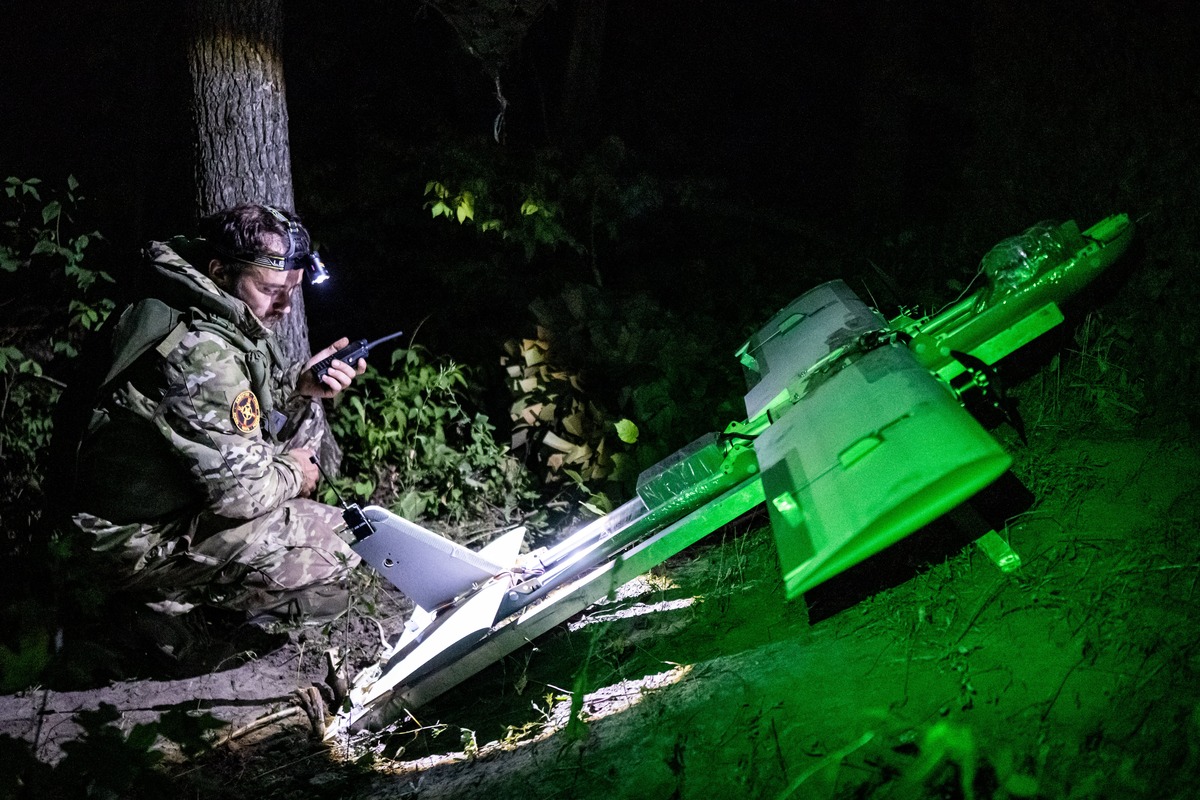
According to The Telegraph, Russia has constructed numerous “launch rails” at bases near Belarus and Ukraine. These are designed to launch fixed-wing drones for missions or attacks. Analysts from DroneSec, who analyzed satellite images of these sites, indicate that at least 20 of these rails are capable of launching Russia’s advanced long-range attack drones.
Most of the 10 identified sites are either situated in rural areas or integrated into military bases or airports. These sites have reportedly been used to strike Kyiv, Ukraine’s capital, in recent weeks. Russia continues to deny any plans to attack NATO, dismissing such claims as ‘nonsense.’ Newsweek reached out to the Russian Defense Ministry for comments via email.
Drone Warfare Evolution
Drone warfare has evolved significantly over the past four and a half years of intense conflict in Ukraine. Kyiv and Moscow vie not only for territorial gains but also for supremacy in drone capabilities, with NATO keenly observing this competition.
Russia frequently uses Iranian-designed Shahed drones against Ukraine, alongside its domestically produced Geran-2 model. Ukrainian intelligence reports that the Kremlin is accelerating production of jet-powered variants capable of striking distant targets. Russian factories now produce approximately 3,000 improved Geran-4 and Geran-5 aerial drones monthly, primarily at a facility in Yelabuga, Tatarstan.
According to both Russian and Ukrainian sources, the Geran-5 has a range of about 1,000 kilometers, or over 600 miles. This extends the threat range to hundreds of miles beyond NATO’s eastern frontier when launched from Russian territory near Ukraine or Belarus.
DroneSec CEO Mike Monnik stated that the expansion of launch sites demonstrates Russia’s growing capacity to deploy an increased number of drones while enhancing their technological sophistication, making interception more difficult.
Airspace Violations and NATO Concerns
Drones and missiles have frequently breached NATO airspace since Russia’s full-scale invasion of Ukraine began in February 2022. These incidents often prompt fighter jets stationed in border nations to respond, occasionally shooting down unmanned vehicles that spill over from ongoing conflicts.
In September 2025, at least 20 drones entered Polish airspace, after which NATO accused Russia of testing the alliance’s response to such provocations. Concerns heightened when a Russian cruise missile crashed in eastern Poland last month, near the Ukrainian border.
Russia’s Hybrid Warfare Tactics
These violations occur during a challenging period for Europe amidst questions about U.S. dedication to the continent’s security. President Donald Trump’s administration has criticized Europe for minimal defense efforts and reliance on U.S. military presence, prompting reviews of Pentagon deployments in Europe.
Germany’s military chief, General Carsten Breuer, stated that Moscow uses drones to test NATO’s air defense reactions. He mentioned that “hybrid attacks”—a term covering cyberattacks, misinformation campaigns, arson, and infrastructure targeting—happen daily in NATO nations.
NATO asserts that Russia has engaged in hybrid warfare with the alliance for years. A full-scale NATO attack seems improbable, but smaller exploratory maneuvers by Russia against the Baltic states or Poland, or intensified hybrid assaults, could occur soon.
The Kremlin might aim to occupy limited NATO areas or launch severe hybrid assaults by September, as suggested by U.S. intelligence. Meanwhile, NATO members are rehearsing potential responses if Russian forces invade a Baltic country.
For further information on this story, contact Newsweek editors John Fitzpatrick and Shakeema Edwards.