Chevron Expands in Venezuela Amid Controversial U.S. Deal
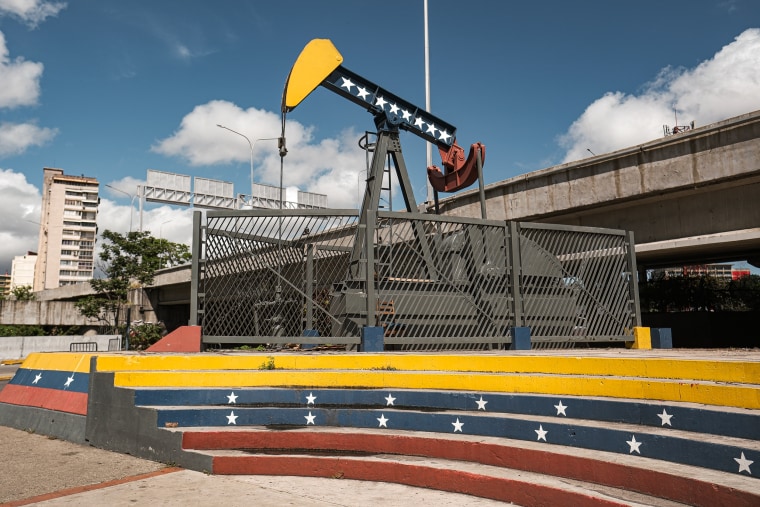
Oil giant Chevron has confirmed an expansion of its operations in Venezuela following a significant agreement announced by President Donald Trump. This deal aims to develop the nation’s oil reserves while involving the Pentagon in the profits. Chevron, the sole major U.S. oil company operating in Venezuela, will acquire additional acreage in the Orinoco Belt. The company intends to invest over $7 billion in the next five years to boost its production to approximately 600,000 barrels daily.
Chevron CEO Mike Wirth stated, “Chevron’s history in Venezuela spans more than a century, and our expanded position reflects our confidence in the country’s deep resource potential.” The Organization of the Petroleum Exporting Countries (OPEC) details that Venezuela holds the largest proven oil reserves globally, with over 303 billion barrels. This contrasts with Saudi Arabia’s 267 billion barrels.
Despite these reserves, Venezuela struggles with production due to its deteriorating energy infrastructure and international sanctions, producing just over 1 million barrels a day. In contrast, the U.S. produces nearly 14 million barrels daily. U.S. Energy Secretary Chris Wright attended a ceremony in Caracas where agreements were signed between Chevron, Italian oil company Eni, and the Venezuelan government.
Wright emphasized the U.S. mission to promote peace and prosperity for Venezuelans, citing significant investments and job creation as essential elements of this vision. The White House has partnered with North American Blue Energy Partners (NABEP) to engage in the Venezuelan oil sector, though skepticism remains among energy experts about the feasibility of reviving the industry quickly.
Concerns also arise regarding whether Venezuela’s acting president, Delcy Rodríguez, has the authority to grant NABEP extensive rights over oil fields. The Venezuelan constitution requires legislative approval for such deals, a step that remains unfulfilled. Ian Vásquez of the Cato Institute criticized the legitimacy of the agreement, citing the lack of democratic processes in Venezuela.
Wright defended the agreement, describing it as beneficial for both nations, aiming to enhance energy supply and economic conditions. Trump’s administration has shown a keen interest in accessing Venezuela’s oil, mentioning other U.S. oil majors’ potential involvement. However, Exxon Mobil CEO Darren Woods labeled Venezuela as “uninvestable,” with no indication of Exxon or others planning to resume operations there.
The history of nationalization in Venezuela underlies U.S. oil companies’ cautious approach. Venezuela nationalized its oil industry in 1976 and reassigned control in 2007 under President Hugo Chávez, seizing assets from non-compliant foreign companies. Analysts caution that restoring Venezuela’s oil infrastructure will need substantial investments and time, potentially spanning several years.
Meanwhile, U.S. gasoline prices have risen sharply, with the national average reaching $4.12 per gallon, significantly higher than the previous year.