Controversy Surrounds Trump’s Proposed Military Arch in D.C.
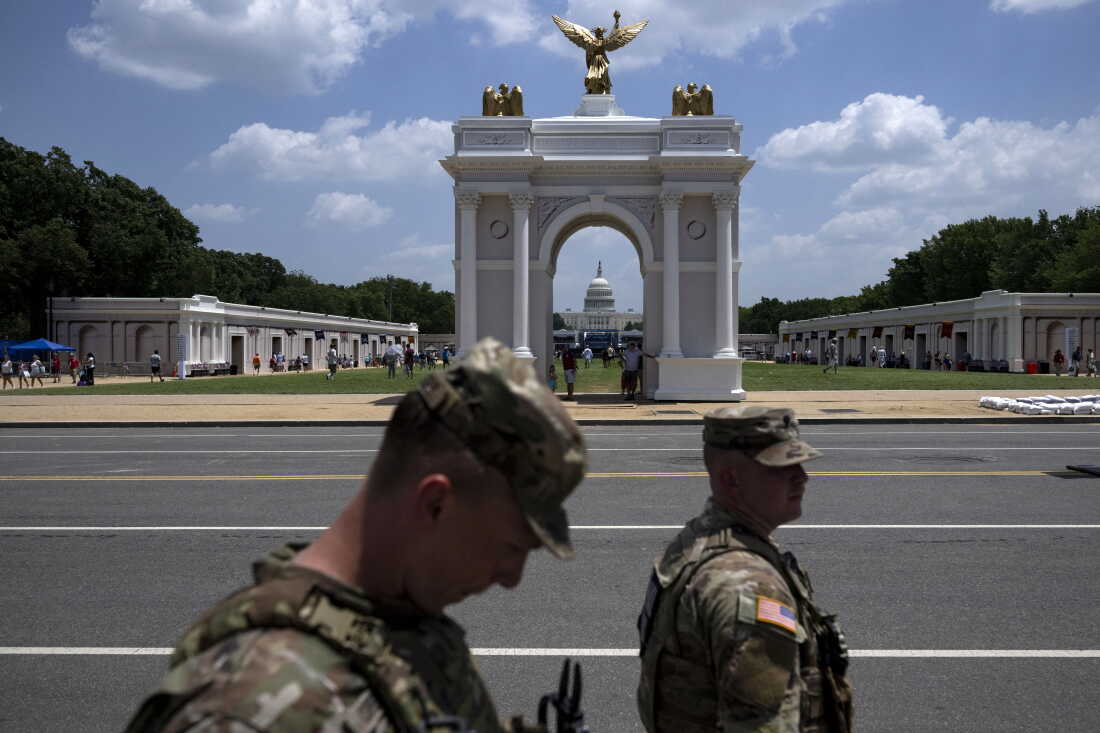
National Guard members walked near a replica of the proposed arch by President Trump at the Great American State Fair on the National Mall in Washington, DC. This happened in July, under the observation of Kent Nishimura from AFP via Getty Images.
President Trump announced over the weekend that the controversial arch will serve as a “top grade Military Complex.” This decision has sparked more questions about the structure and the approval process. Trump’s announcement on Truth Social claimed the 250-foot structure will “house, store, and rapidly deploy large numbers of drones, along with snipers, on the roof and plaza areas.”
This is a significant shift from the initial vision when Trump first revealed the project last October. Originally, he stated it would honor “me.” Since then, the administration reframed the arch as a tribute to the United States’ 250th anniversary and a tourist attraction.
According to the White House, the Triumphal Arch in Memorial Circle is expected to become one of the most iconic landmarks, not just in Washington, D.C., but globally. National Park Service presentations have highlighted features such as an observation deck with views of Arlington National Cemetery and the National Mall, with possibilities of including a cafe and gift shop. These elements were approved by the Commission of Fine Arts in May. However, the mention of “military” did not arise until Interior Secretary Doug Burgum’s announcement about upcoming excavation at the “Great Triumphal Arch and Military Observation Deck.”
This development met immediate resistance, leading to a judicial intervention necessary for completing federally required historic preservation reviews. Historic preservation advocates are puzzled by Trump’s sudden shift in the project’s purpose.
Charles Birnbaum, CEO of the Cultural Landscape Foundation, reacted to the shift saying, “We are back to square one since what is being reviewed seems different from what was originally proposed.”
Last week, the National Park Service sought feedback on its “Memorandum of Agreement” from preservation groups, aiming to advance the arch project. Birnbaum expressed skepticism, labeling the MOA as “dead on arrival.” The process feels chaotic and uncertain for those involved.
The White House, Interior Department, and National Park Service did not respond to inquiries from NPR regarding new proposal submissions. The Federal Aviation Administration (FAA) concluded recently that the arch includes airspace safety risks despite its proximity to D.C.’s main airport. The FAA findings omitted assessments regarding military drones. Rep. Don Beyer of Virginia criticized the location of the drone site in approach paths.
The arch faces challenges concerning legal compliance, including D.C. building height limits. A lawsuit is ongoing regarding the arch’s lack of Congressional approval. An older law from 1925 allowed for columns at the planned site, but they remained unconstructed. The veterans’ lawyer, Nicolas Sansone, argues the administration’s rationale fails to address the project’s legal issues.
Trump stated the arch conversion to a military complex came ‘at the strong request of the United States Military.’ Legal experts like Harold Koh, former State Department legal advisor, dismissed Trump’s defense, suggesting practical alternatives if national security were genuinely a concern.
Koh alleged Trump’s national security claim is strategic legal positioning, citing instances where Trump applied such reasoning across disparate matters.
The Trump administration argued the necessity of building a White House ballroom for national security purposes, similarly citing planned military facilities underneath.
The Supreme Court permitted continued construction of the ballroom noting plaintiffs’ legal standing, not project legality. Skepticism remains over national security justification for the arch due to its proximity to existing strategic locations.
Mark Cancian, retired Marine Corps colonel and military expert from the Center for Strategic International Studies, contrasts the arch with protective requirements perceived for the president.
Urgence in construction appears influenced by imminent midterm elections as they could reshape Congress affecting project continuance. Lawmakers penned a demand for a halt on the arch proceeding, highlighting its threatened legality and historic site impacts.
They wrote, “The President’s ego is prioritized over memorials, adding damage to the administration’s legacy.”