Impact of Trump’s Election Claims on GOP Candidates
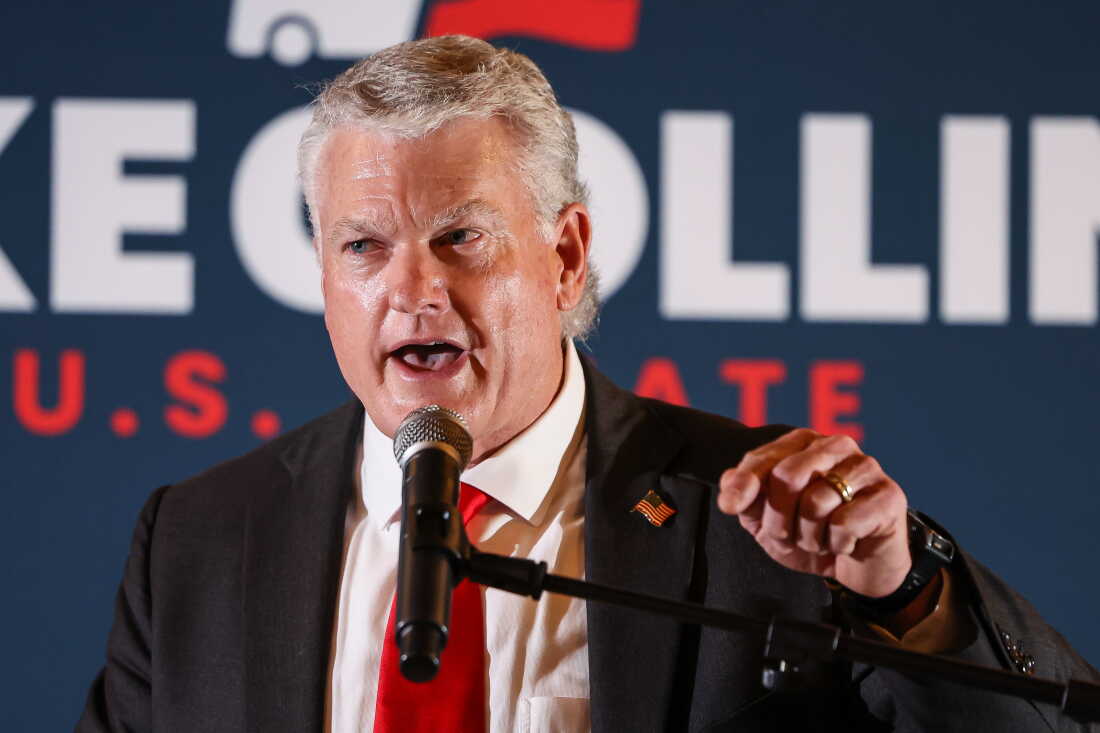
Georgia Republican U.S. Senate nominee Mike Collins is seen on June 16 in Jackson, Ga. Colin Hubbard/AP hide caption toggle caption Colin Hubbard/AP. President Trump remains focused on the 2020 election, creating ripple effects in the ongoing midterm election cycle, with Republican Congressional majorities at risk. Despite some Republican candidates supporting Trump’s controversial election claims, a portion of the GOP voter base is ready to leave the past behind.
In Georgia, Rep. Mike Collins launched his first congressional campaign shortly after Trump pressed Georgia’s secretary of state to reverse the 2020 election results. One campaign ad falsely claimed that Trump won Georgia, stating, “Georgians are tired of weak-kneed, spineless politicians who won’t fight for Trump, get to the bottom of 2020 and fix our elections.” The advertisement ended with Collins firing a weapon into a bin labeled “voting machine.” As Collins runs for Senate, he continues to assert that the 2020 election was stolen from Trump. He has also voiced support for compensating individuals prosecuted for storming the Capitol on January 6.
Lynn, a lifelong Republican in Georgia, expressed her discomfort with Collins’ focus on the 2020 election. “It bothers me a lot,” Lynn said, concerned about potential ostracization from her peers for her views. While she could consider other Republican candidates in the primary, she hasn’t ruled out voting for Democratic Sen. Jon Ossoff due to Collins’ stance.
At Alpharetta’s farmers market, voter Austin Sapp stated he regularly supports Republican candidates and believes election fraud occurs. Sapp favored Trump’s attempt to implement a strict voter ID law, but he wishes Trump would stop focusing on the 2020 election. “It is what it is,” Sapp remarked. “Beating a dead horse serves no purpose. What is your platform? What are you going to do for me?”
Just 1% of voters in a September New York Times-Siena College poll cited election integrity as their top issue for the November vote. Gabe Sterling, an official in Georgia’s secretary of state office, observed that discussions on 2020 election fraud interest only the media and the fringe elements within both parties. “Regular humans have given this up a long time ago,” Sterling stated.
Sterling was a visible figure disputing Trump’s claims after the 2020 election and warned of potential violence before January 6. While claims about fraud persist as fundraising tools, Sterling feels the obsession remains mainly among committed activists, who still wield influence on election boards and vote reliably in Republican primaries.
Sterling interacted with GOP voters during his run for the secretary of state, persuading some but ultimately falling short in the primary. “Georgia has the cleanest voter list in America,” Sterling asserted, facing boos and hisses but determined to explain the data.
Elsewhere, former critics of Trump’s claims now embrace them. In Michigan, GOP Senate nominee Mike Rogers, previously critical of Trump, refused to clarify the 2020 election outcome during his 2024 Senate bid. At a local meeting, Rogers alleged that ballots surfacing at odd hours implied a stolen Senate seat, later expressing gratitude to Trump for his address resurrecting debunked claims.
Michigan Republican strategist Jason Roe explained that candidates echo Trump’s claims for his support, often insincerely, attempting to appease the party’s base. “Throwing red meat to the base,” Roe described, but acknowledged that such strategy wasn’t viable for November elections.
Trump’s continued discourse on the election potentially undermines the GOP’s efforts to maintain majorities. In Georgia, Trump refused to endorse an alternative to Collins favored by GOP Gov. Brian Kemp due to the candidate’s accurate statement on Trump’s loss. A similar scenario unfolded in the Texas primary, where Trump-backed candidates ousted perceived stronger general election contenders.
Georgia’s Sterling believes Trump’s fixation on election claims serves as a distraction from current issues like the Iran conflict and other controversies. According to a University of California San Diego poll, 49% of Americans anticipate fair midterm elections, indicating reduced confidence compared to pre-2020.
Sterling suspects Trump is preparing to mitigate blame in case Republicans face defeats. Claims about election rigging could resurface, finding an audience once more.