Trump’s Ambitious Construction Plans in Washington, D.C.
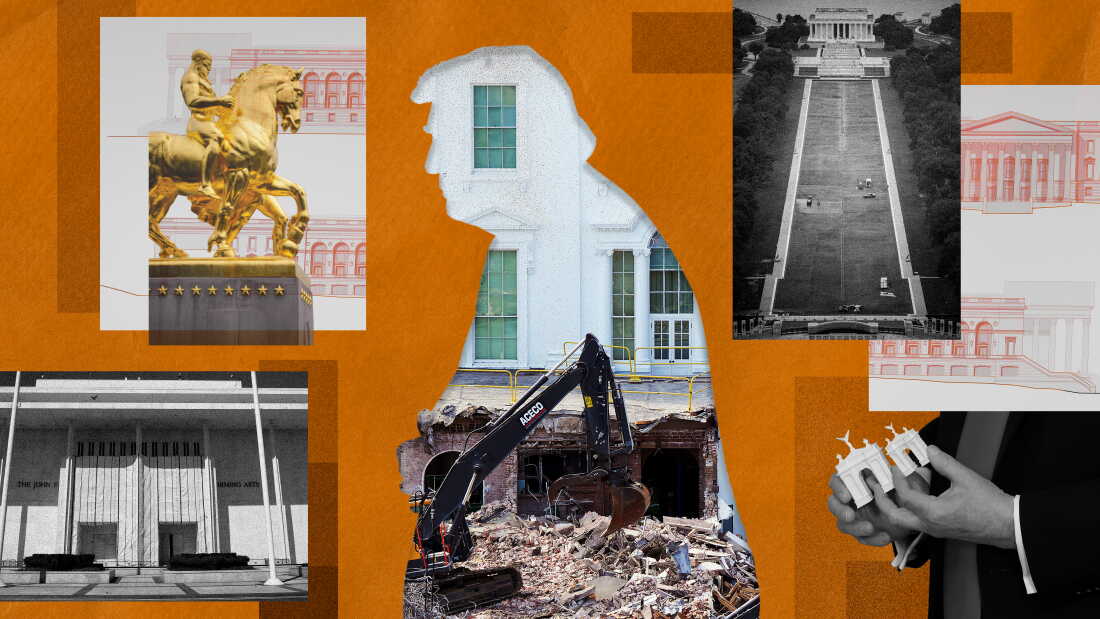
President Trump aims to leave a tangible legacy in Washington, D.C., earning the self-titled nickname “builder-in-chief.” His extensive building plans have spurred heated debates and legal challenges. In May, he stated, “The best thing I do in life is build.” His projects include tearing down the East Wing of the White House to construct a larger ballroom and adding a military complex beneath it. He paved over the Rose Garden to build a helipad on the South Lawn and repaved the Lincoln Memorial Reflecting Pool with “American flag blue.” Nevertheless, this project remains unfinished after months due to installation issues and controversial arrests.
Trump has installed new statues and restored existing ones. He transformed two equestrian statues with glaring gold finishes in the summer. His proposal includes a sculpture garden of “national heroes” in West Potomac Park and upgrading the East Potomac Golf Links. Trump considers adding his name to the Kennedy Center building and fast-tracking a 250-foot arch near Arlington National Cemetery.
Greg Werkheiser, from Cultural Heritage Partners, a firm involved in multiple lawsuits against Trump’s projects, commented, “It would appear that much of his self-worth is tied to this mythology of Trump as a builder.” White House spokesperson Davis Ingle stated that “President Trump can walk and chew gum at the same time,” fulfilling campaign promises, while ensuring “the People’s House and our Nation’s Capital will be properly glorified.” He added, “Thanks to the Builder-in-Chief, no other president has done more to beautify our Nation’s interior.”
Trump’s endeavors have sparked protests and numerous public comments, predominantly opposing these initiatives. Critics accuse Trump of rushing projects to memorialize himself due to concerns that no one else will in the future. Trump himself acknowledged this sentiment in a New York Magazine interview, saying, “Nobody will do it once I’m gone.” People in Trump’s circle assert that his real estate development experience qualifies him for shaping D.C.
However, former colleagues caution about Trump’s early business practices, which involved financial maneuvers and legal disputes. Historians and legal experts express concerns about setting a precedent by treating D.C. as a personal playground. Barbara Res, former head of construction for the Trump Organization, criticizes Trump’s tendency to cut corners and disregard laws.
A History of Disregard for Historic Preservation
Trump’s involvement in real estate has sometimes conflicted with preserving historic sites. Res highlighted the difference between developers and builders, saying Trump’s father was a builder and while Trump oversaw large decisions, he often complicated projects with demands like reusing old equipment.
An incident in 1980 illustrates Trump’s conflict with preservation: buying the Bonwit Teller building and demolishing its facade sculptures despite opposition from Penelope Hunter-Stiebel of the Metropolitan Museum of Art. Trump had agreed to donate these to the museum, but they were destroyed, inciting controversy and negative press.
Tim Naftali, Columbia University historian, contrasts Trump’s approach with past presidents who acted as custodians of public spaces, securing congressional approval before major projects. Experts argue Trump’s unilateral actions set a troubling precedent for future leaders. Naftali observes that while shaping legacy, Trump defies norms with projects that emphasize his personal influence.
Charles Birnbaum reflects on Trump’s actions ignoring social norms and appointing allies to arts panels with no relevant experience. These moves have sparked concerns over legal protections for historic sites nationwide. Birnbaum describes a widespread trend in destroying rather than preserving significant places.
Trump’s approach, including naming places and currency after himself, diverges from the practices of previous presidents who emphasize their work and legacy post-presidency. Alarmingly, this trend poses risks for preserving the separation of powers doctrine—a concern amplified as Trump seeks to cement his legacy amidst shifting political landscapes.