Serbian Leader Concedes to Student-Led Movement in Pivotal Election
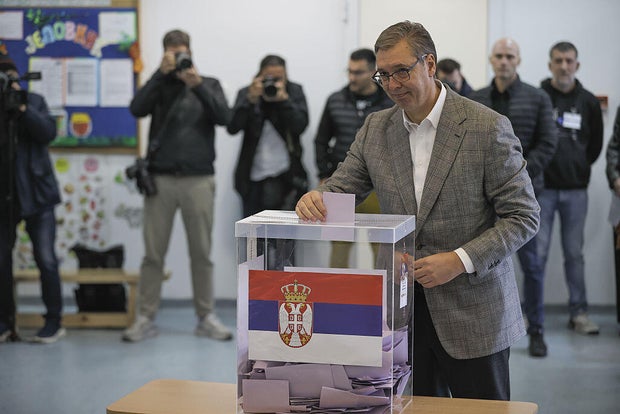
On October 25, 2026, Aleksandar Vucic, Serbia’s long-term leader, acknowledged defeat in a significant election. This election opposed his right-wing party against a diverse student-led opposition. The students had been protesting his administration for two years. This marks a considerable political shift in Serbia, where Vucic, endorsed by Russian President Vladimir Putin, had held near-absolute power for 14 years.
The election was notable for high voter turnout and intense tensions, with 6.4 million Serbian voters electing members to the 250-seat Parliament. Vucic’s Serbian Progressive Party clashed with the Student-led Students’ List, amid allegations of corruption and democracy erosion.
Vucic admitted his party’s defeat, projecting that the Students’ List would secure between 135 and 140 seats, while his party would hold about 105. He attributed the loss to independent media criticism and alleged interference from unnamed European nations and an “American deep state.”
“The Students’ List has won,” Vucic stated at his party’s election gathering.
Vucic reported that his party gathered around 1.7 million votes, whereas the Students’ List achieved approximately 2.2 million. Following the announcement, supporters of the Students’ List celebrated throughout Belgrade and other cities, chanting, “Aleksandar is gone.”
The election outcome, declared just an hour and a half after polls closed, came after a day filled with voting tension. Anti-riot police secured central Belgrade near election commission headquarters, with special police units stationed in sensitive areas.
Vucic aimed to transition into the prime minister role after nearly two terms as president, having resigned to lead the election campaign. His popularity waned, particularly following the 2024 tragedy in Novi Sad, where a train station collapse killed 16 amid accusations of ongoing high-level corruption.
Despite ongoing youth protests, Vucic maintained significant support as a leader believed capable of navigating global uncertainties. His image was strongly supported by mainstream media. Nonetheless, the student movement, without a central leader, presented a formidable challenge to his authority.
The Students’ List comprised not university students but a mix of experts, athletes, farmers, and artists. Their objective was to counteract Vucic’s centralized control, encouraging community and solidarity to rejuvenate Serbia’s economy and democracy.
The student-led campaign connected with disenfranchised voters, navigating rural strongholds traditionally loyal to Vucic by engaging directly with citizens through cycling and walking tours.
This political shift mirrors the recent Hungarian elections, where youth involvement saw the ousting of Viktor Orbán, hinting at broader European trends of dissatisfaction among young populations. International observers noted the turnout might reach 70%, a figure not seen in Serbia since 2000.
Long lines at polling stations in Serbia and globally testified to the intense engagement in this electoral process. Challenges arose for diaspora voters who cast ballots during inconvenient hours due to time zone alignments with Serbia. Past Serbian elections were marred by accusations of irregularities, which prompted the European Union to closely monitor this election in the EU candidate nation.
Reports from independent monitors cited numerous irregularities, including the photographing of ballots—indicative of possible voter coercion—and attempts at vote-buying. Concerns about the election’s integrity extended to arrest incidents, media control, and surveillance accusations.
Earlier local elections in Serbia witnessed violent incidents against media and activists, raising questions about the democratic process. Past legislative elections were also met with opposition claims of fraud, further highlighting the current election’s groundbreaking significance.