Visual Forensics: Examining Trump’s Proposed Arch and Its Impact
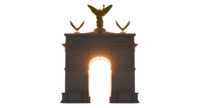
Washington D.C.’s monumental core reflects a study in careful geometry and deliberate sight lines. Arlington National Cemetery stands prominently in the distance from the Lincoln Memorial. President Donald Trump plans to introduce a new feature, a 250-foot-tall arch, in this area. The Washington Post constructed a to-scale digital 3D model to understand its impact.
According to analysis by The Post, the arch would cast a shadow on burial sites in Arlington National Cemetery on 284 days in a year. It would briefly cover Kennedy’s eternal flame on 18 days and affect the former president’s memorial on 50 days. The Military Women’s Memorial would experience shade on 109 days. The model shows the shadow moving across graves of veterans, their next of kin from various wars, and formerly enslaved people. More than 75,000 graves in total would be affected.
Most days, the shadow would recede by the time the cemetery opens at 8 a.m. On 26 days, it would remain past opening hours. In response to The Post’s findings, White House spokesman Davis Ingle suggested the arch would “enhance the visitor experience.” He claimed the Triumphal Arch would be globally iconic.
The Interior Department stated that its analysis found only a small section affected after opening, less than an hour after sunrise. They provided simulations depicting shadows mostly after the cemetery’s opening time but did not explain methodologies used. The shadow locations in The Post’s analysis largely aligned with these simulations.
The arch’s size and planned location, about a quarter-mile from the cemetery, concern historians and preservationists. They argue it might disrupt carefully planned compositions of the nation’s capital city. Architect Neil Flanagan noted the significance of open spaces between structures, asserting that the arch does not align with established visions.
History professor Micki McElya highlights the symbolism of Trump’s arch casting shadows over a military cemetery, suggesting discomfort even if the effects are brief. McElya’s book on Arlington was a Pulitzer Prize finalist.
The Post’s analysis indicates that at sunset, the arch’s shadow would extend across the Arlington Memorial Bridge to monuments in the east. While its morning shadow covers Kennedy’s grave during spring and summer, its evening shadow crosses the Lincoln Memorial in fall and winter. On 110 days a year, one of the monuments to assassinated presidents would be shadowed.
The arch would cast shadows on parts of the Martin Luther King Jr. Memorial over 30 days, including the Reflecting Pool. At sunset, shadows would occasionally extend to memorials for Vietnam and Korean war veterans.
Shadows from trees and other structures are excluded from the depiction to provide clarity in understanding the shadow cast solely by the arch.
Paul Eaton, retired U.S. Army major general, described the shadow on veterans’ graves as sacrilege. He and VoteVets, an advocacy group, oppose the project. The group conducted analysis using AI, prompting The Post’s further examination with 3D models and considerable real-world data.
Eaton emphasized the impact on families visiting loved ones, affected by what he termed as Trump’s vanity project. He referenced the president’s comment on building the monument to honor his presidency.
Karla Rothstein of Columbia University’s Graduate School of Architecture mused that while shadows aren’t inherently negative, their source bears significance both politically and experientially. She questions the imposition of triumph’s shadow on landscapes of sacrifice.
Despite criticisms, Trump remains unmoved, planning to place an eternal flame atop the arch. The administration envisages breaking ground soon after federal approval, intent on making the arch one of Washington’s towering landmarks.
Shadow would notably affect the cemetery with potential changes to daylight saving time, which would shift clocks one hour forward in winter. Concerns are heightened over Kennedy’s memorial, particularly his eternal flame.
Presidential historians recount Jacqueline Kennedy’s wish for her husband’s grave to be a visible feature around Washington. The eternal flame holds deep significance, recognized by their daughter, Caroline.
Trump plans to add an eternal flame to his arch, promising visibility even when shadows cover Kennedy’s flame and grave.
Methodology
The Post created a 3D model using triumphal arch plans submitted to the National Capital Planning Commission. Terrain data from the U.S. Geological Survey combined with NOAA sun position simulations provided accurate shadow mapping. Verification was conducted using real-world satellite images. Shade from trees was not considered to clearly demarcate shadow borders. Mapping revealed which cemetery sections the shadow covered, utilizing data from the Arlington National Cemetery Explorer.
This analysis involved editing by Nadine Ajaka, Maureen Linke, and Eric Rich; video editing by Peter Stevenson, and copy editing by Alli Hausman. Video produced by Luis Velarde for The Washington Post.