Historical Parallels and Modern Diplomacy: The Shenzhen Summit
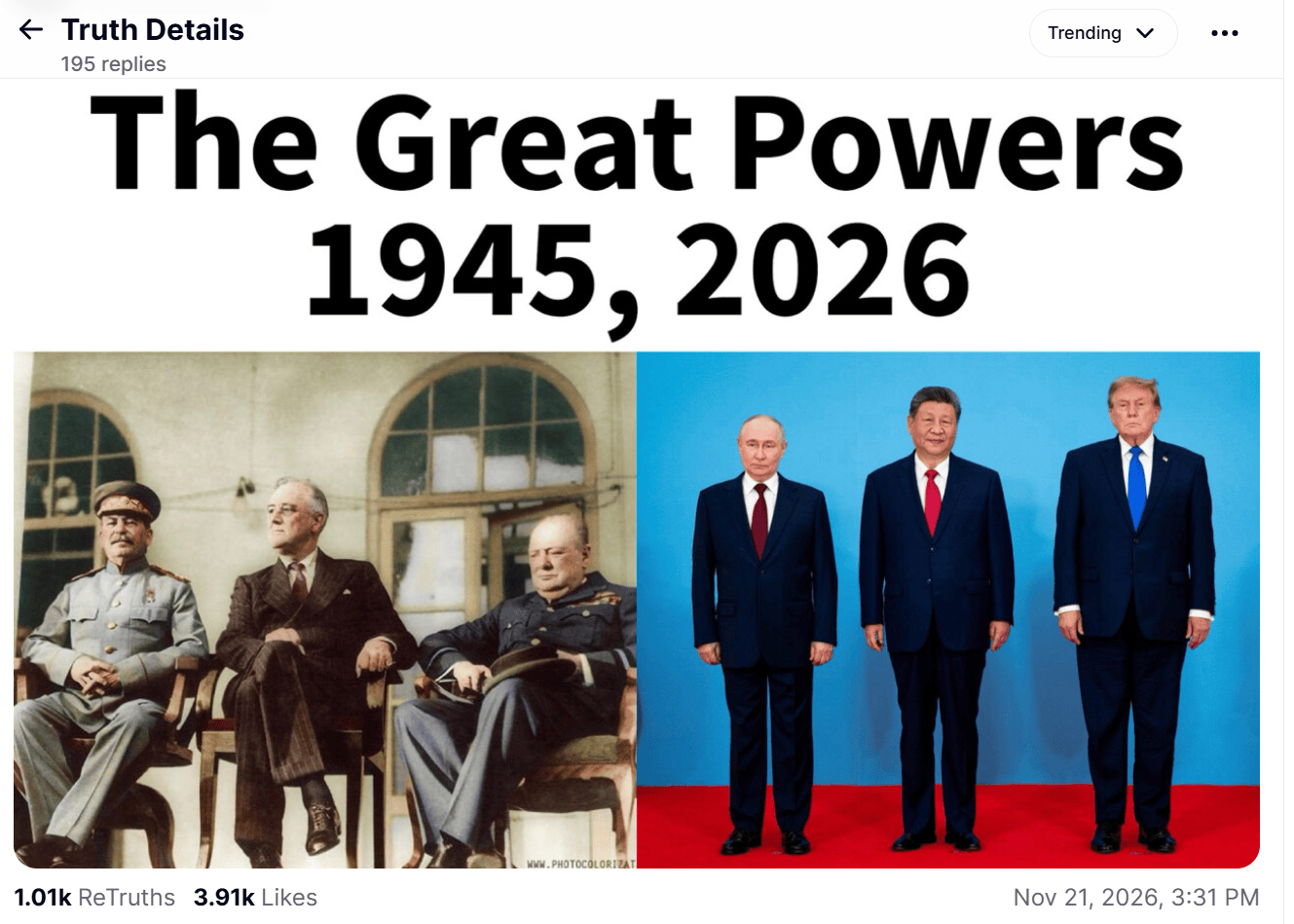
President Donald Trump recently posted a comparison on social media that has drawn significant attention. He shared an image juxtaposing himself, Chinese President Xi Jinping, and Russian President Vladimir Putin with the leaders who participated in the Yalta Conference in 1945. This came after an unprecedented summit was held by the three leaders in China.
The image shared on Trump’s Truth Social account depicted the World War II-era photograph of U.S. President Franklin D. Roosevelt, British Prime Minister Winston Churchill, and Soviet leader Joseph Stalin at Yalta. It was paired alongside a current photo of Putin, Xi, and Trump, with the caption noting “The Great Powers 1945, 2026.” Trump had already embraced this historical comparison, describing Thursday’s meeting in Shenzhen as “bigger than Yalta.”
The imagery holds significant weight in Ukraine and Eastern Europe, where the Yalta Conference of 1945 is often seen as the time when Western powers conceded the region to Soviet domination. In 1945, negotiations focused on postwar Europe’s map, the formation of the United Nations, and the Soviet entry into the war against Japan. However, Thursday’s meeting in Shenzhen took place under very different circumstances.
A New Yalta?
Concerns about a potential “Yalta 2.0” arose among Ukraine and some European allies before the summit at Shenzhen’s Kylin Villa. The gathering was the first formal summit among the leaders of the United States, China, and Russia and lasted 90 minutes.
During the meeting, the leaders issued a joint “peace declaration.” This document stressed that nuclear war cannot be won and should never be fought, with commitments to dialogue aimed at reducing nuclear risks. However, specifics like a timeline for negotiations on an arms-reduction treaty were absent. Beijing has previously resisted these frameworks, citing the smaller size of its nuclear arsenal compared to those of Washington and Moscow.
The leaders also agreed on pursuing reforms in the United Nations, increasing the production of refined petroleum products, and supporting state consent and immunity in international courts. There was no resolution offered for conflicts such as Russia’s war in Ukraine or U.S. tensions with Iran. Nonetheless, Trump described the summit as a significant success, rating it highly in an interview with NBC News.
After the talks, Trump joined a meeting in Berlin through a call, interacting with U.S. envoys Jared Kushner and Steve Witkoff, Ukrainian President Volodymyr Zelensky, and over 40 European leaders. He shared that he discussed with Xi and Putin a peaceful resolution for the Ukraine war.
“A Yalta format will not bring peace,” German Chancellor Friedrich Merz stated, highlighting the division Europe experienced post-Yalta.
How the Leaders Framed the Summit
During the Shenzhen talks, Trump underscored the historical significance, stating that the meeting represented a crucial moment in history. Xi emphasized the importance of cooperation among the three nations for international stability, as reported by China’s foreign ministry.
Putin, speaking to reporters, clarified that Yalta did not divide the world into spheres but acknowledged wartime realities. He pointed out the inevitability of recognizing these present realities, particularly relevant with Russian forces occupying significant portions of Ukraine.
Ukrainian Foreign Minister Andrii Sybiha refuted any historical parallels. He stated on social media that the Shenzhen summit did not fulfill Putin’s Yalta aspirations and insisted that Moscow should recognize Ukraine’s resistance to imposed peace terms.
What Happens Next
With no definitive resolutions on Ukraine or other significant disputes, the Shenzhen declaration left many diplomatic issues unresolved. Xi called for ongoing high-level exchanges and dialogue mechanisms, although no follow-up schedule was shared by any involved government.
The Newsweek team used Martyn, their AI assistant, to compile this story.