Robotics Revolution: The Impact of Soccer-Playing Robots on Future Technology
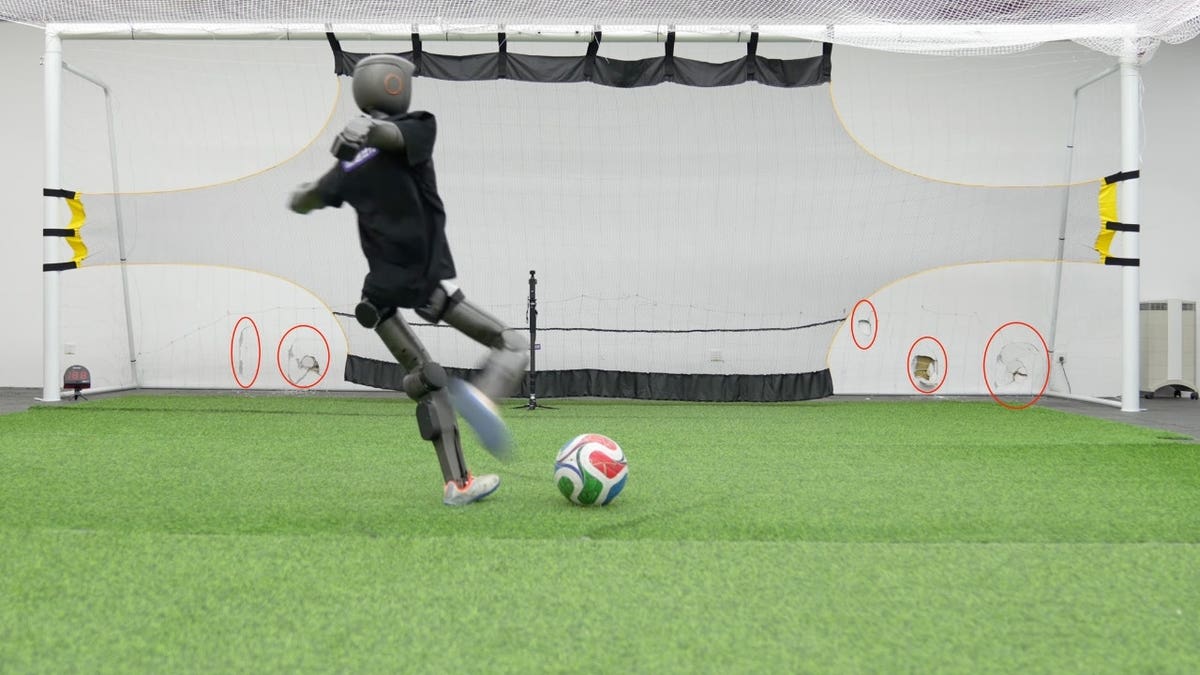
Fox News articles now include audio options for enhancing accessibility. A recent video from Booster Robotics has brought significant attention to their T1 humanoid robot. The video titled “Try Stopping This Robot” showcases the T1’s impressive ability to kick soccer balls with considerable force. Many viewers are stunned by the sight of the robot not just hitting a target but occasionally leaving visible dents on the wall behind the goal.
This extends beyond being a viral sensation. There are valid concerns about the potential risks if someone were to stand in the path of these powerful kicks. Booster Robotics, based in Beijing, showcased their T1 humanoid performing in a lab environment where the sheer impact of the kicks was evident.
The T1 from Booster Robotics stands about 3 feet, 10 inches tall, and weighs around 66 pounds. Its configuration supports 23 to 41 degrees of freedom, promising agility and versatility.
The T1 can walk for up to two hours and remain standing for four hours on a full charge. It accommodates open-source tools and APIs, allowing developers and researchers to train and adapt it for various tasks. Currently, more than 50 robotics teams utilize this platform.
Robot Soccer as a Training Ground for Humanoids
Testing robots through soccer is crucial for evaluating and enhancing their balance, agility, and response to split-second changes. Soccer’s dynamic nature forces robots to adjust their movement quickly, a valuable skill set for real-world applications beyond sports.
A robot adept in soccer can be expected to perform well in more practical settings like warehouses and disaster areas. The ability to recover from falls and adjust to moving obstacles is a testament to the potential utility of these machines.
Booster T1: A Developer’s Platform
The T1 robot is designed for developers and researchers. Booster offers RoboCup tools such as an open-source reinforcement learning framework and a demonstration system. These tools aid in testing perception, localization, and decision-making.
The T1 video illustrates the robot’s power and balance. While this showcased capability is impressive, it also raises safety concerns. A strong robot must have stringent safety protocols before being introduced to public spaces.
RoboCup’s Broader Mission
As part of the RoboCup competition, the T1 represents a broader mission. RoboCup’s aim is for autonomous humanoid robots to one day compete and win against human World Cup champions under official rules. This ambitious objective requires intensive development to enhance robots’ balance, vision, and decision-making capabilities.
Robot soccer thus serves as a critical stepping stone for broader developments, potentially paving the way for robots to assist in diverse fields, from logistics to healthcare.
Implications for Everyday Life
The implications of advancing robot soccer are significant. Humanoid robots are not only becoming more agile but adopt roles that could support industries like elder care or disaster response. However, stronger robots mean new safety protocols are essential. It is crucial to establish regulations and testing to ensure safety.
Robotics development often raises questions about safety oversight and accountability, especially with the potential for accidents in public or private spaces.
Understanding Advancement in Robotics
This development makes us consider the future of robotics. As machines become more powerful, companies must ensure these innovations are safely integrated into society. The video from Booster Robotics provides a clear example of the power these robots wield and the importance of developing comprehensive safety measures alongside technological advancements.