American Flag: Symbol of Unity or Division?
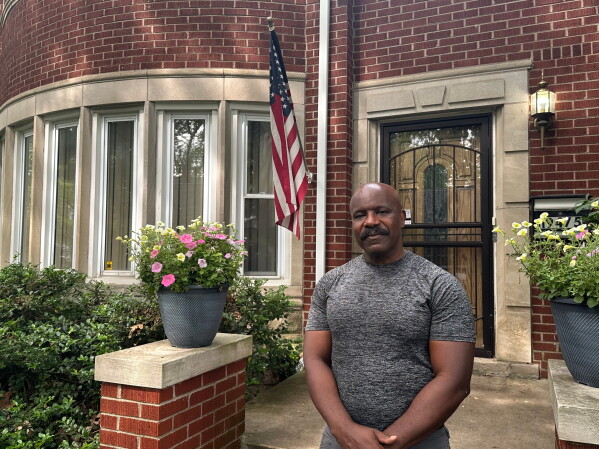
DETROIT (AP) – Jerry Esters proudly displays the American flag each day at his Detroit home. Meanwhile, not far away, Yvonne Pistochini insists that the Stars and Stripes will never grace her residence. Both individuals are Black.
For Esters, the flag symbolizes the opportunities that allowed the great-great-grandson of slaves to prosper. In contrast, Pistochini, 79, believes that the America represented by the flag is not the same country she experienced during her youth.
A new survey by The Associated Press-NORC Center for Public Affairs Research reveals that Americans’ views on ‘Old Glory’ are influenced by politics, age, and race, highlighting divisions as the nation approaches its 250th anniversary. According to the survey, conducted April 16-20 among 2,596 adults, older, white Republicans are more likely to display the American flag, while younger Democrats and Black adults are less inclined to do so.
‘A lot of Black Americans see the flag as a symbol of both inclusion and exclusion,’ explained Matthew Delmont, a professor of American history at Dartmouth College. ‘Black Americans, more than white Americans, understand that the flag can justify a version of patriotism rooted in exclusion.’
About half of U.S. adults display the flag either year-round or during holidays. Around 70% of Republicans and 60% of Americans aged 60 and older fly the flag at least during holidays. However, approximately 60% of Democrats and independents report never flying the flag. Among Democrats under 45, 75% say they never display it.
Opportunities Worth Fighting For
Jerry Esters, a 64-year-old retired sculptor for a Detroit automaker, proudly flies three American flags at his Sherwood Forest home on the city’s west side. Reflecting on past barriers, he notes, ‘When these homes were built, Black individuals like me couldn’t even buy these homes. To me, that’s one reason I fly the flag. We fought hard to own nice homes, and this is what we achieved.’
Esters attributes his pride to his great-great-grandmother, Moriah Martin, who was born into slavery. He says, ‘I’m kind of living out her dreams — having a business, a nice home. It’s the American way, but we have to fight for it.’
Esters is among the minority of Black adults who display the flag, with the survey indicating roughly 30% of Black adults doing so, versus about 50% of white and Hispanic adults.
Pistochini critiques current divisions, asserting that inequality of opportunities for the poor and people of color is not what the flag should represent. ‘Flying it doesn’t make you a patriot,’ she says, ‘If there was patriotism, we wouldn’t have this. We can’t say this is America.’
For Country and Freedom
Ben Gaskins, political science chair at Lewis & Clark College, highlights the flag’s importance to many Americans. ‘It is central to the identity of older people, white individuals, and conservatives.’
Nancy Hansen, a 73-year-old retired Customs broker in Culvertson, Montana, believes ‘you have to be for the country, no matter what’ and sees the flag representing ‘freedom.’
Each July 4, the American Legion positions flags at homes and businesses in Culvertson, including Hansen’s home. Linda and Greg Cunningham, a conservative couple in Pontiac, Michigan, equate the flag with freedom, with their home displaying vibrant red, white, and blue decorations. ‘It’s no political thing, at all,’ remarks Linda Cunningham, ‘It’s our freedom.’
Flag as a ‘Painful Reminder’
The survey found that 47% view the flag as unifying, 16% see it as divisive, and 36% say it’s neither. Only 22% of Black adults see the flag as unifying, compared to 55% of white adults and 42% of Hispanic adults.
‘It’s a painful symbol. A reminder of what we could be and how it’s failed people of color,’ says Allison Wiltz, a Black author and founder of Writers and Editors of Color.
Paul Walthour, a 71-year-old in Minneapolis, flies the flag on special occasions. At his cabin, the flag is displayed daily. While proud to be American, Walthour laments, ‘It’s more divisive than unifying.’
Williams, part of AP’s Race & Ethnicity team, contributed to this report from Washington.
The AP-NORC poll was conducted using the AmeriSpeak Panel, accurately representing the U.S. population, with a margin of error of 2.6 percentage points.