Amy Sherald: Celebrated American Painter and Her Journey
Amy Sherald has become a prominent name in American art. Known for painting Michelle Obama’s official portrait nine years ago, Sherald’s reputation has grown significantly. At 52, she is recognized as one of America’s top painters, marked by her three major museum retrospectives last year.
One of her notable exhibitions, scheduled for the Smithsonian’s National Portrait Gallery, was canceled. Sherald feared censorship from museum officials who were reportedly pressured by the Trump administration.
In Sherald’s work, Black Americans gaze directly from her canvases. Their eyes invite the viewer in with an undeniable presence. They are depicted unapologetically, against simple backgrounds or vibrant settings. For instance, one painting features a farmer on a spotless John Deere tractor under a blue sky.
Anderson Cooper on Sherald’s Work
Sherald’s art demands engagement. The subjects in her paintings are real people performing their roles, yet their presence asks for dialogue. Sherald describes that presence as crucial, noting that even without words, a portrait can evoke reactions in viewers.
Her portraits hang in prestigious museums and collectors’ homes, including a private showing at the Whitney Museum of American Art with her exhibition “American Sublime.” Sherald envisioned and aspired to this moment for years.
Sherald’s portraits aren’t traditional. Subjects are unnamed, presented in a narrative created by Sherald. Her process begins with a photograph, capturing people she feels a connection to. She uses friends, models, and even strangers, with their attire often sourced from thrift stores.
Two notable pieces from her exhibitions include Breonna Taylor’s portrait and the famous “Michelle LaVaughn Robinson Obama.” The latter made global headlines upon its 2018 unveiling. Although Sherald was aware of its potential impact, she focused intensely on the painting itself during its creation.
Sherald’s technique elevates her work with a luminescent quality difficult to capture in reproductions. Her realism style embodies ordinary life in America while also challenging and expanding on traditional American themes.
The Inspiration Behind Sherald’s Journey
As a teenager, Sherald was inspired by a painting featuring a Black figure, prompting her to pursue art passionately. Despite her parents’ hopes for her medical career, Sherald followed her calling in art, combining creativity with persistence.
In 2004, her dreams were nearly halted by a rare heart condition. Trained as a triathlete, she faced significant health challenges before receiving a heart transplant in 2012, thanks to donor Kristin Lin Smith. Sherald honors Smith by acknowledging her presence in her achievements and art.
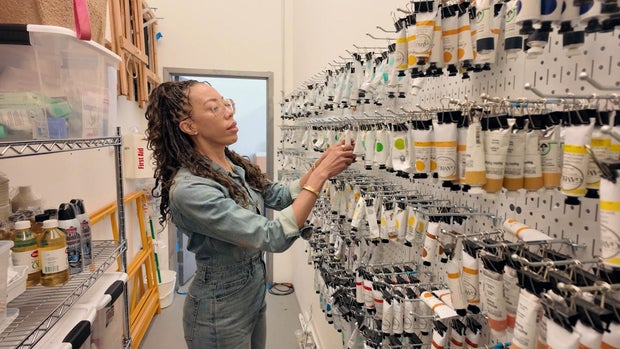
In her New Jersey studio, Sherald creates six portraits a year. She uses a grayscale palette for skin tones, a choice that invites viewers to see beyond race initially and relate to the human aspects of her subjects.
At one point, Sherald struggled with the notion that using traditional brown skin tones could marginalize her work, confining it to a niche category within the broader art discourse.
Recent Challenges and Exhibitions
With paintings selling for millions, Sherald’s work ranks alongside greats like Hopper and Rockwell. Her recent “American Sublime” exhibition faced scrutiny. When a piece was challenged for being potentially divisive, Sherald withdrew from the Smithsonian show.
The disputed painting portrayed a trans person as the Statue of Liberty, which led to discussions on representation and narrative integrity. Ultimately, Sherald decided to cancel the exhibition to retain her work’s intended message without unwanted contextual adjustments.
Following the cancellation, the Baltimore Museum of Art hosted “American Sublime.” The exhibition has moved to the High Museum in Atlanta.
Do you consider your work patriotic?
For Sherald, her work embodies patriotism. She sees Black Americans as integral to the country’s history and identity, firmly claiming a place in its narrative.