Astronomers Witness Star Explosion in Nearby Galaxy
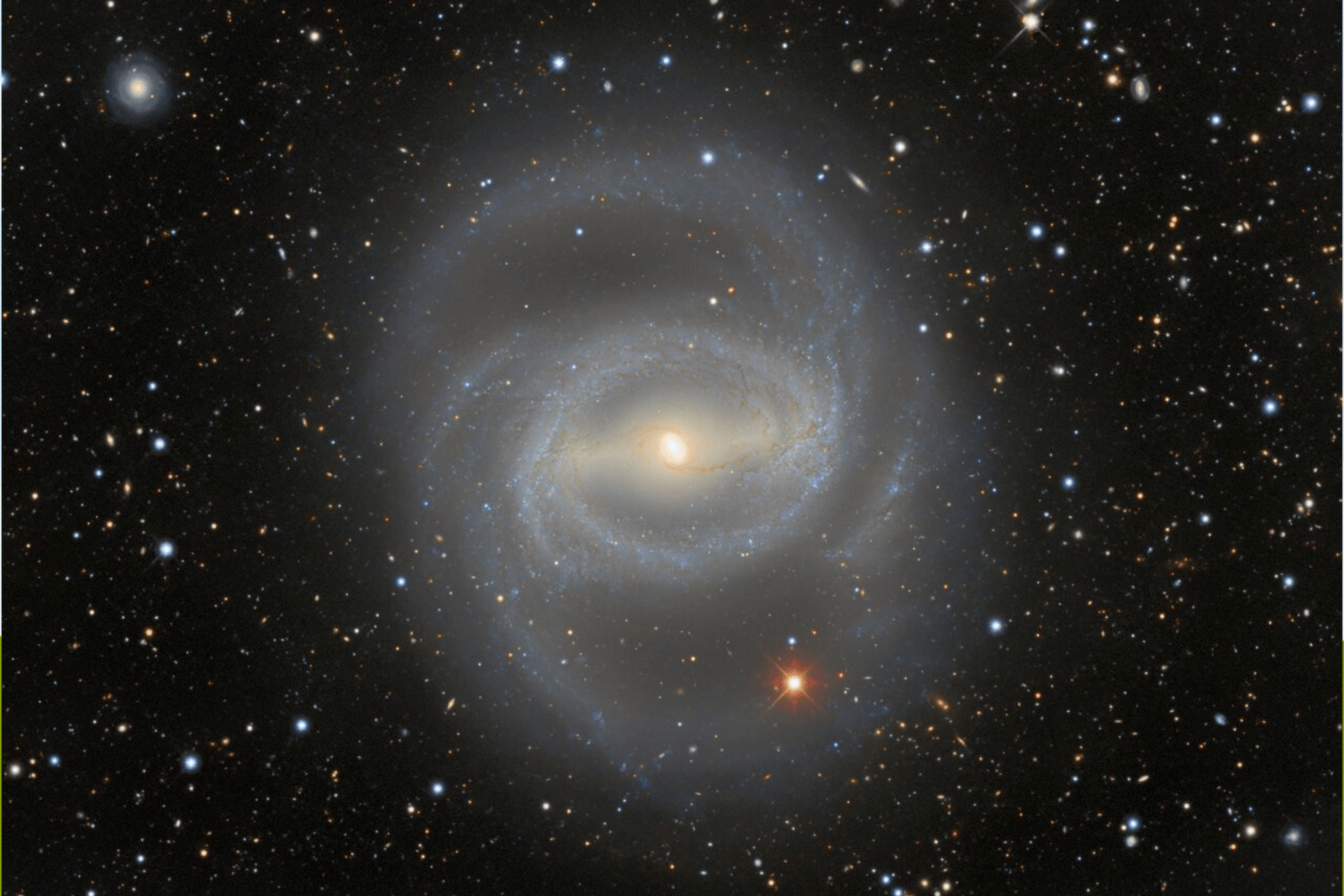
Astronomers are closely observing a newly discovered star explosion, termed a supernova, in a galaxy approximately 50 million light-years away. This distance indicates the explosion’s light started its journey to Earth around 50 million years ago, shortly after the dinosaur era ended. Notably, this supernova was detected early, providing scientists with a rare insight into the explosion’s development.
Details of the Discovery
The supernova, labeled SN 2026ahvu, occurred in NGC 1433, a spiral galaxy in the Horologium constellation, also known as the Pendulum Clock. Detection occurred on November 2 by the Asteroid Terrestrial-impact Last Alert System (ATLAS), per the International Astronomical Union’s Transient Name Server.
ATLAS initially recorded the supernova at an apparent magnitude of approximately 17. Apparent magnitude is an astronomical measure of how bright an object appears from Earth — a lower number indicates a brighter appearance. For example, the sun has a magnitude of about -27, and a full moon ranks around -12.6.
Within days, the supernova brightened to a magnitude of 13.5, according to the National Science Foundation’s NOIRLab, signaling its increasing brightness.
Type and Cause of the Explosion
Subsequent observations confirmed SN 2026ahvu is a “Type Ia supernova,” a major explosion involving a “white dwarf.” NASA describes a white dwarf as a small, hot core left after a sun-like star ends its life.
Type Ia supernovas represent the “thermonuclear destruction of white dwarfs,” according to NOIRLab. This phenomenon occurs when a white dwarf undergoes an uncontrollable nuclear reaction, often sparked by material ingestion from a nearby companion star.
However, the precise conditions triggering SN 2026ahvu’s explosion are not yet identified.
Importance of this Supernova
This supernova’s significance lies partially in its proximity. At 50 million light-years, it is relatively near by cosmic scales. NOIRLab classifies SN 2026ahvu as one of the closest Type Ia supernovae observed since SN 2011fe in the Pinwheel Galaxy in 2011.
Astronomers’ early detection of this supernova is crucial. ATLAS’s observations showed that the explosion was young and still brightening when discovered. This timing offers astronomers the chance to monitor the changes throughout the explosion’s progression.
Future Observations
Researchers have already captured images using the Dark Energy Camera, situated on the Víctor M. Blanco 4-meter telescope in Chile, and the Gemini South telescope. NOIRLab anticipates the supernova reaching peak brightness between November 18 and 23, with an apparent magnitude around 10.5 to 12.1.
Astronomers will track the supernova’s fading in the weeks and months following its peak brightness. By comparing measurements from before, during, and after the explosion, scientists aim to deepen their understanding of the star system responsible for SN 2026ahvu and the mechanisms of Type Ia supernovas.
In this instance, astronomers benefit from having data from before the explosion, capturing the supernova’s brightening, and the ongoing ability to watch its aftermath.