Challenges of Red Crown Rot: A Growing Concern for Midwest Farmers
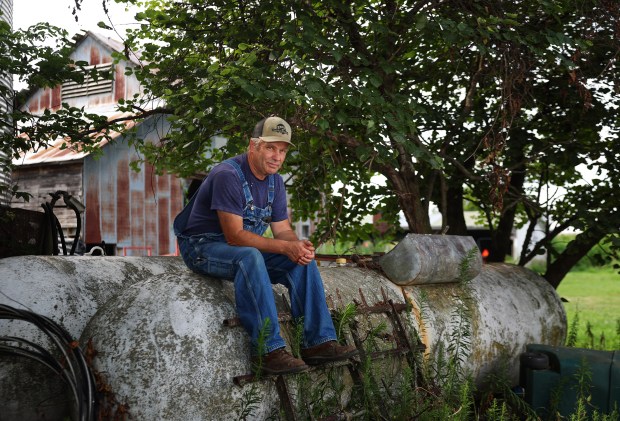
Reagan Hoskin is known for her attention to detail, especially when following instructions. After completing high school in 2018, she spent the summer checking crops for her father by meticulously following his directions: walk in zigzag patterns through soybean fields, scan crops from vantage points, and note any anomalies. On one such day, at the edge of their farm in Pike County, Illinois, Hoskin noticed a cluster of yellow plants, which concerned her. ‘The rest of the field looked fine,’ Hoskin commented, noting her hesitance to inspect the anomaly.
Her training in soybean diseases led her to suspect sudden death syndrome, but the pattern on the leaves was unusual. ‘There was a big patch of yellow crossing the veins,’ she recalled. This was the Midwest’s first confirmed case of ‘red crown rot,’ a fungus known to cut soybean yields by up to 60% in severe cases. This is significant for Illinois, the leading soybean producer in the U.S., especially as trade tensions and tariffs impact profitability.
Illinois, Missouri, and Indiana each have more than 10 counties affected by red crown rot, according to the Crop Protection Network. Minnesota and Wisconsin reported their first cases in August 2025.
Years later, after witnessing red crown rot devastate his soybean plants, Hoskin’s father, Ron, reached out to Matt Montgomery, an agronomy expert. Montgomery, known for his agricultural expertise, met with the family and conducted tests, identifying their farm as ‘patient zero.’ ‘We have never seen a disease hit soybeans like this one,’ Montgomery stated, noting its rapid spread starting in 2025.
Red crown rot’s origin remains uncertain. Though it has affected southern U.S. crops since the 1970s, experts argue that the Midwest variant likely came from another source. Its method of dissemination—whether by air or contaminated soil—remains under investigation.
The disease’s spread coincides with changing climate patterns. Warmer, wetter Midwestern conditions favor such pathogens. As climate shifts, diseases may travel further north, as seen with corn’s tar spot fungus moving into the Midwest from Latin America.
Farmers look to August for red crown rot symptoms, like yellowing leaves and red structures at plant bases. Affected fields remain contaminated, leading to patchy spread patterns, with some areas dead while others appear healthy.
The Hoskin family, having farmed their land for generations, approached the diagnosis with scientific interest. However, when yields dropped dramatically in 2020, the severity became apparent. Efforts to study the disease on their farm initially lacked urgency. Recognition grew as the fungus spread through Illinois and beyond by 2024.
A recent genetic study by the American Phytopathological Society suggested Illinois’ red crown rot strains likely did not originate from the southeastern U.S.
Montgomery noted five years ago the disease reached ‘Corn Belt level.’ He remains hopeful as research trials progress, albeit slowly. Modern seed treatments like Victrato, a chemical coating to protect seeds, represent one of several strategies under investigation. Another is finding resistant soybean varieties, though none are fully resistant yet. Montgomery also stresses the importance of reducing stressors, such as deep planting and proper soil care.
For the Hoskin family, red crown rot has meant reconsidering their crop choices. With substantial financial impact, their next steps could include switching entirely to corn farming. Tillage practices and subsidies further complicate this decision.
As research continues, sophisticated tools like AI models for satellite crop monitoring are introduced. These can assess the severity of infestations without physical inspections. Farmer Calvin Koeller experienced firsthand the economic strain of this disease but plans to use Victrato after positive initial results.
Montgomery advises respect for the disease without panic, emphasizing accurate diagnosis and strategic management.
Hoskin remains cautiously optimistic, planning to plant soybeans next year if conditions stabilize. He sees potential in newer seed treatments, despite current challenges.