Exploring the Abraham Accords and Their Impact
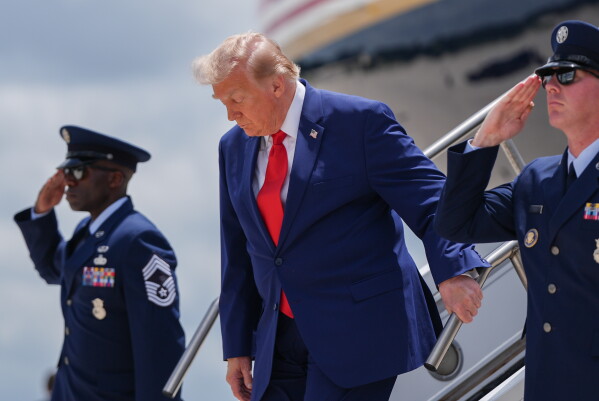
President Donald Trump highlighted the ‘Abraham Accords’ during his Middle East visit, aiming to build on the 2020 agreements that increased the number of Arab states with diplomatic ties to Israel. The term ‘Abraham Accords’ holds religious and cultural significance, referencing a biblical patriarch respected in Christianity, Islam, and Judaism. This figure, known as Abraham in Judaism and Christianity, and Ibrahim in Islam, is often invoked in efforts to bridge faiths. While some faith groups claim him as their own, Abraham is seen as belonging to everyone.
Bruce Feiler, author of “Abraham: A Journey to the Heart of Three Faiths,” notes that disputes over Abraham’s legacy have persisted for millennia. Each group prioritizes its own perspective, yet the story and legacy of Abraham require sharing and mutual respect. The Abraham Accords serve as a template for fostering diplomatic and commercial relations in the Middle East, involving nations like the United Arab Emirates, Bahrain, Sudan, and Morocco, under Trump’s tenure.
“Everybody has tried to claim Abraham as their own, but in fact Abraham belongs to everybody.”
— Bruce Feiler
In the Hebrew Bible’s Book of Genesis, Abraham is introduced as an elderly, childless man promised by God to become the father of a great nation. This journey leads him to today’s Israel and Palestinian lands. Abraham fathered two sons, Ishmael with Hagar, an enslaved woman, and Isaac with his wife Sarah. After Sarah conceives and Ishmael is banished, Ishmael returns to help Isaac bury Abraham. The story of Abraham’s willingness to sacrifice Isaac is commemorated in Jewish tradition, with Isaac and Jacob recognized as ancestors of the Jews.
Christianity venerates Abraham’s faith, while both Islamic and Jewish traditions depict his monotheism. In Islam, Ishmael, or Ismail, is a central figure in the binding story and is considered an ancestor of the Prophet Muhammad. Muslims venerate the rock in Jerusalem’s Dome of the Rock as the site where Abraham offered his son.
Despite divisions, Abraham remains a unifying figure among Christianity, Judaism, and Islam. All three claim heritage from him and are called to dialogue and unity efforts, such as the Abraham Accords. In an iftar dinner after 9/11, then-President George W. Bush acknowledged Islam’s roots in Abraham’s faith, promoting peace.
The term “Abrahamic faiths” intends to foster religious dialogue and inclusiveness. The United Arab Emirates has an Abrahamic Family House comprising a church, mosque, and synagogue, reflecting this inclusivity. In the U.S., this term has gained traction for inter-religious dialogue, aiming to include more faiths than the term “Judeo-Christian.” Yet, current religious tensions, including rising antisemitism and anti-Muslim sentiment, challenge these efforts.
During his speech to the Israeli Knesset, Trump used Jewish expressions of Abraham’s legacy, appreciating the ‘God of Abraham, Isaac and Jacob.’ He preferred the Hebrew pronunciation “Avraham Accords.” Despite his past rhetoric on Muslims during his 2015 campaign, Trump’s administration has engaged with Arab and Muslim leaders involved in the accords. Bruce Feiler emphasizes understanding the long history of Abraham’s story marked by tension and cooperation among different groups, highlighting a reality where coexistence with others is necessary.