George Washington’s Enduring Legacy Captured in Photos
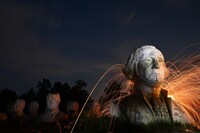
On July 6, 1776, John Hancock, then the president of the Continental Congress in Philadelphia, dispatched a letter and copies of the Declaration of Independence to General George Washington. At that time, Washington was stationed with his army in New York. The congress, according to Hancock, had concentrated intently on a matter of great importance. This matter was the Declaration of Independence from Britain, which Hancock described as a duty owed to both themselves and future generations.
Hancock requested that Washington announce the declaration to his troops in a manner he deemed appropriate. This event cemented Washington’s connection to the nation’s founding. Photographer Matt McClain embarked on a mission to capture these moments leading up to the United States’ 250th birthday, highlighting Washington’s continued significance amid modern divisions.
During May, Doug Thomas portrayed Washington at the Revolutionary War Weekend at Mount Vernon, Washington’s former residence in Virginia. Further, Revolutionary War re-enactors gathered at Mount Vernon to commemorate these historical connections.
On July 9, 1776, Washington, then 44, ordered the Continental Army to gather at parade grounds in Manhattan by 6 p.m. for the reading of the declaration. A general order stated Washington’s hope that the declaration would motivate every officer and soldier, with the future peace and safety of the country relying on their efforts.
The General hopes this important event will serve as a fresh incentive to every officer, and soldier … knowing that now the peace and safety of his country depends (under God) solely on the success of our arms.
During a tour through the U.S. Capitol Rotunda, visitors observed the painting “Surrender of Lord Cornwallis,” which depicts the British surrender after their defeat by Washington at Yorktown, Virginia, in 1781. This marked the conclusion of the last major battle of the Revolutionary War.
The reading was a major event, according to Doug Bradburn, CEO of George Washington’s Mount Vernon. Historian Emily Sneff suggests Hancock likely sent Washington a stack of printed declarations through a courier. Upon hearing the declaration, Washington’s troops responded with enthusiasm.
Washington informed Hancock the following day that his army celebrated with hearty assent. However, as the Americans rejoiced, the British military mobilized over 40 warships and 30,000 soldiers and sailors to challenge Washington’s forces in New York.
At Mount Vernon, re-enactors, including John Williams and Peter Peterson, depicted scenes from the era. Citizens observed historic sites such as Shields Tavern in Colonial Williamsburg, which Washington frequented during his tenure in the Virginia House of Burgesses.
Historically, George Washington was deemed the vital recipient of the Declaration in 1776, as per Sneff’s perspective. The Continental Congress created the document, but Washington had to lead the effort to secure the war victory and independence that it called for.
The ultimate triumph came five years later with the American victory at Yorktown, Virginia, in 1781. Washington and French allies ensured the declaration became reality with this decisive win.
In July 1776, Washington had no foresight of his future role as the leader of the freshly independent country, notes Bradburn. He could not have predicted the honor of cities and monuments bearing his name, the preservation of his Mount Vernon home, or the celebration of his birthday.
Artifacts at Mount Vernon, such as Washington’s dentures, are cherished pieces of American history. Katelyn Brown of Jacksonville, North Carolina, admired these artifacts, which reflect Washington’s lasting legacy.
At the George Washington Birthplace National Monument, visitors can see where Washington’s relatives are interred, including his parents and half-brother. Nearby, George Washington’s Office Museum in Winchester, Virginia, presents a framed image of the space where Washington worked during the French and Indian War.
The historical reflections continue at Mount Vernon, with re-enactors Ashley Gordillo and Nathan Soucy participating in activities. Visitors at the American Revolution Museum at Yorktown also engage with history, highlighted by a display that captures the imagination of children like Ryllin and Kason Rodriguez.
At the U.S. Capitol Rotunda, tourists ponder historical scenes like John Trumbull’s “Surrender of Lord Cornwallis.” These efforts underscore George Washington’s fundamental role in shaping the United States.