Labor Day Weekend: An Engaging Look at the Annual Socialism Conference
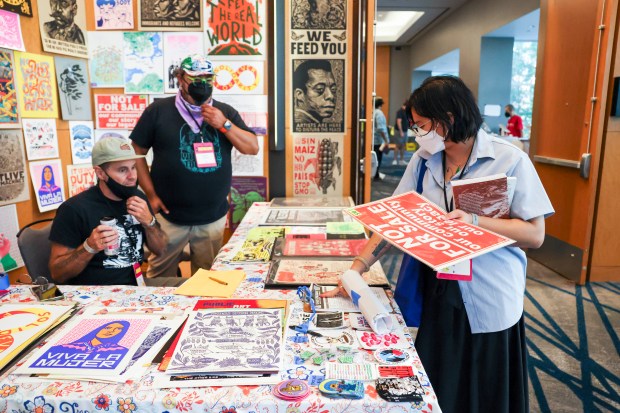
The annual Socialism Conference in downtown Chicago during Labor Day weekend marks its 24th year. While many enjoy the holiday with relaxation, around 3,000 socialists, radical activists, and community organizers gathered at the Hyatt Regency at McCormick Place. Their objective is to develop strategies for American workers to claim control of the means of production and address class struggles. Attendees bear no illusions about immediate success.
Underneath a prominent #TrySocialism banner, Democratic Socialists of America (DSA) leadership perceives victory as an aspiration. The Socialism Conference was initiated by the International Socialist Organization in 2002 and transitioned to Uptown-based Haymarket Books in 2019. It showcases discussions on diverse topics, such as the Midway Blitz, rural organizing, AI protests, ICE journalism, health and fascism, tech oligarchy, Eugene Debs’ legacy, and socialist Zohran Mamdani’s political role.
The resurgence of socialism is evident, with record attendance at the conference and rising interest in its core principles. DSA’s membership has reached unprecedented heights, while socialist candidates are expected to contest major U.S. offices.
Inside the conference, attendees like Ant Smith from Philadelphia’s W.E.B. Du Bois Movement School comment on socialism’s growing prominence. While some see it as a trend, those present aim to create lasting change. They discuss capitalism’s challenges, such as the advancement of AI.
Two Chicago organizers, Asha Barnes and Rakaya Abda, shared their initial hesitance to attend but found inspiration and diversity at the conference. They mentioned speaking engagements like Angela Davis’s, which resonated with them. Both observed an encouraging mix of attendees, countering stereotypes about socialism.
Surveys reveal a mixed American perspective on socialism, divided across generations. Some associate it with economic equality, others with excessive government control.
Concurrently, political tensions surfaced outside the conference, with Darren Bailey, a Republican gubernatorial candidate, addressing socialism’s controversial perception. Inside, socialists acknowledged ideological divides similar to those in major political parties.
Mel Bienenfeld, a retired educator, reflected on socialism’s evolution since Bernie Sanders’s 2016 campaign. He pointed to DSA’s aim of electing public office candidates, yet expressed concern over compromising socialist principles.
The conference embodied philosophical diversity, with varied viewpoints debated. Megan Romer, DSA co-chair, described the event as an educational platform more than a recruitment drive.
Socialism’s re-emergence parallels historical events in Chicago, such as Eugene Debs’ activism and the founding of the DSA by University of Chicago graduate Michael Harrington.
At the conference, attendees represented multiple socialist ideologies and professions. Activities included discussions on union organization, de-escalation training, and cultural workshops.
A music-led spiritual session, facilitated by cultural organizer Steff Reed, encapsulated the conference’s spirit of camaraderie. Attendees engaged in call-and-response singing, experiencing the collective atmosphere that embodies the conference’s ethos.