Observations of a Fast-Moving Star Offer Insights into Black Holes
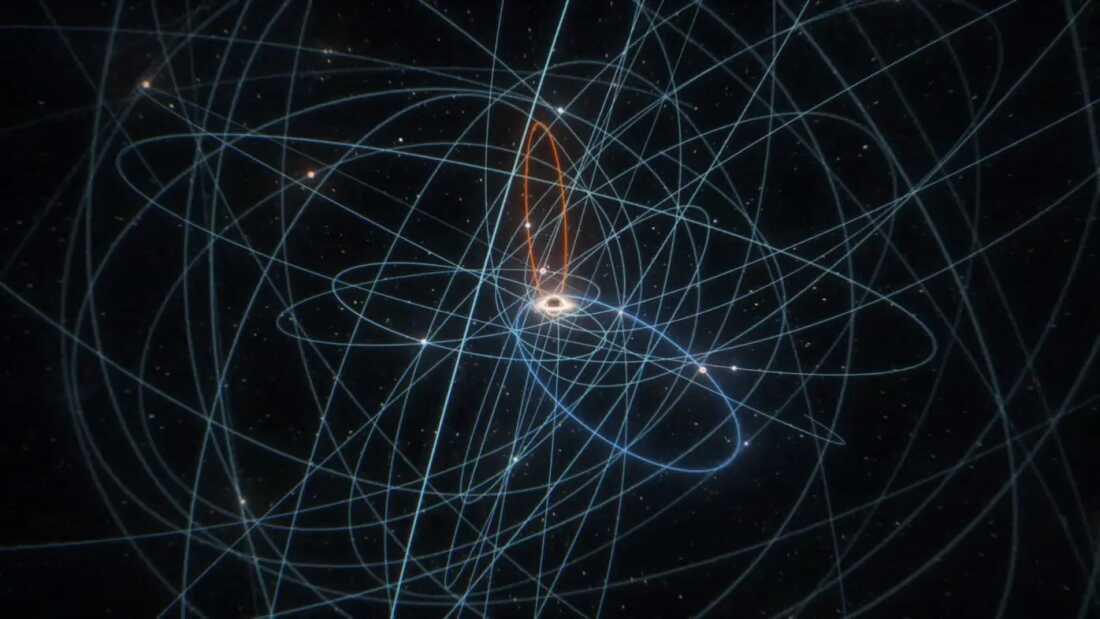
Scientists have been observing the orbital paths of stars surrounding a supermassive black hole at the Milky Way’s center. Among these stars is S301, which closely approaches the black hole while traveling at over 15,000 miles per second. This massive object, estimated at four million times the mass of our Sun, supports the presence of a supermassive black hole, as suggested by calculations made by scientists in 2002.
“This object probably looks like Interstellar,” says Stefan Gillessen, an astronomer at the Max Planck Institute for Extraterrestrial Physics. “You have this dark shadow, this silhouette, where the absolute darkness is, surrounded by a shimmering halo of light.”
Due to their nature, black holes are difficult to observe. However, astronomers may have identified a valuable ally in the form of a fast-moving star. A study published in Nature shows S301 as the quickest star yet discovered, spinning around Sagittarius A*, the Milky Way’s central black hole. Gillessen emphasizes the significance of the star’s proximity to the black hole over its speed.
The Black Hole at the Milky Way’s Center
Even with their gravitational presence, black holes remain largely mysterious. Researchers seek to understand their mechanisms and effects, especially how they influence their surroundings. Gillessen views the Milky Way’s center as a prime site to study these questions. His team utilized four telescopes from the European Southern Observatory in Chile to collect infrared light, enabling visibility through cosmic dust and gas.
“By using infrared light, you can peer into the most central part of the nucleus of the Milky Way,” explains Felix Mang, a Ph.D. student who first spotted the unusual star movement. Noting the star’s high velocity, he tracked its position over several years.
S301: A Stellar Speed Demons
Mang’s analysis showed that S301 traces a super elongated elliptical orbit, influenced by Newton’s gravity laws and corrections from relativity. The star gains speed, nearing 8% of light speed, as it circles the black hole. Afterward, it slows as it moves away, following predictable timing much like a well-scheduled train.
Gillessen believes S301’s orbit reveals key black hole properties and effects. “The star feels how space and time are distorted by the black hole,” he notes, making it a tool for visualizing gravitational influences.
Future Insights
Erin Kara, an MIT astrophysicist, describes the finding as exciting and pivotal for future black hole research. Scientists aim to track the central black hole’s spin, a factor affecting surrounding space-time and providing hints of the galaxy’s formation. Unlike active black holes elsewhere, Sagittarius A* is less active, promising unique measurement opportunities.
Kara appreciates black holes for both their exotic nature and essential role in shaping galaxies. Gillessen, meanwhile, marvels at the concept of S301’s orbit, imagining the potential view from a planet near the star. Such a sight would feature a stunning view of the black hole in the sky every nine years, offering a glimpse into the universe’s deepest mysteries.