Reactions to Trump’s Map and Territorial Ambitions
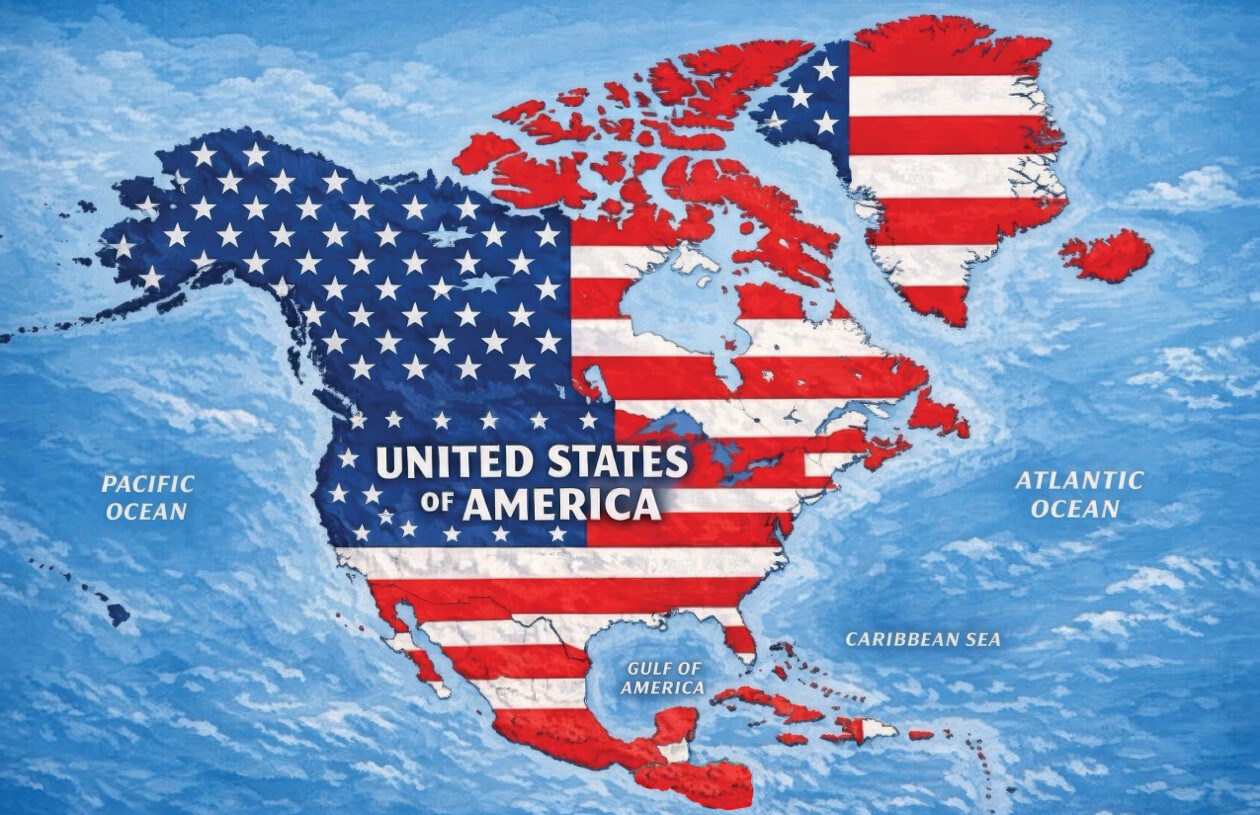
President Donald Trump shared a controversial map on Truth Social that appeared to depict all of North America as part of the United States. This image, generated by AI, has been interpreted by some as a humorous commentary on the White House’s assertive policies known as the “Donroe Doctrine.” However, real-world tensions between the U.S. and Canada have arisen as Trump intensifies an ongoing trade war with its northern neighbor.
Trump has frequently hinted at treating Canada as the 51st state and has previously expressed interest in acquiring territories like Cuba, Greenland, Mexico, and the Panama Canal. His administration renamed the Gulf of Mexico to the Gulf of America and Lake Ontario to Lake America. These decisions reflect his ambitions and have contributed to diplomatic friction.
Beyond these symbolic moves, several territorial disputes with Canada persist. These disputes, predating Trump, remain unresolved amid escalating tensions between the two NATO allies. Rob Huebert, director of the University of Calgary’s Center for Military Security and Strategic Studies, highlighted the threat to the historical collaboration between the U.S. and Canada. He stated that Trump’s administration seems indifferent to the unity that has been a cornerstone of bilateral relations through significant global conflicts.
Huebert warned of the broader implications of such policies, emphasizing Canada’s focus on enhancing its defense capabilities. Canada is committed to responding effectively to any direct territorial challenge posed by the U.S.
“We have always been able to work out agreements that have allowed us to accommodate differing perspectives on these boundary issues to focus on the greater issues,” Huebert told Newsweek.
The Arctic remains a focal point of U.S.-Canada territorial disputes. The primary contention involves a large area of Arctic waters in the Beaufort Sea, believed to be rich in oil and gas reserves. The disagreement stems from differing interpretations of an 1825 treaty between Great Britain and Russia defining the maritime boundary in this region.
In 2024, the U.S. and Canada formed a task force to address the maritime boundary and overlapping claims to the continental shelf. Though initial talks began in late 2024, Canada reported in 2025 that further meetings had not been scheduled.
A separate Arctic dispute centers on the Northwest Passage, a sea route connecting the Atlantic and Pacific via the Canadian Arctic Archipelago. Canada claims it as its internal waters, while the U.S. maintains it should be considered an international strait.
This disagreement over the Northwest Passage, deemed valuable due to climate change and geopolitical attention, highlights concerns shared by the U.S. and Canada over increasing activities by Russia and interest from China. Trump’s rhetoric on asserting control over Greenland has further complicated Arctic security interests.
Adam Lajeunesse, research chair at St. Francis Xavier University’s Brian Mulroney Institute of Government, indicated Canada’s strong capabilities in the Arctic. Yet, he cautioned that a breakdown in cooperation could jeopardize U.S. military access.
Lajeunesse stressed that any misstep might collapse continental defense dynamics with far-reaching consequences. He emphasized the risks of categorizing the Northwest Passage as international, potentially allowing Russian and Chinese usage.
Further, disagreements persist over two features at the Bay of Fundy’s entrance: Machias Seal Island and North Rock. Both nations continue to assert claims based on historical treaties and territory inheritance, maintaining current arrangements despite longstanding unresolved sovereignty.
Additional disputes exist in the Pacific waters linking the U.S. to Alaska. Within the Dixon Entrance, questions over borders set by historical tribunals remain unresolved. Also, the Strait of Juan de Fuca’s boundary into the Pacific remains undefined.
Michael Byers, a sea law and defense policy expert, stated that some issues were well-managed but recognized active disputes over the Beaufort Sea and Northwest Passage. Byers remains confident that good neighbors, like Canada and the U.S., will negotiate solutions.
Canadian Prime Minister Mark Carney has responded vigorously to Trump’s provocations, including imposing tariffs on U.S. products. In a video message, Carney emphasized Canada’s strength in adversity and historical lessons resisting U.S. economic pressure.
Trump’s counter-response included threats involving Canadian aircraft manufacturers and bolstering his “America First” rhetoric.
Mexican President Claudia Sheinbaum and Iceland’s Prime Minister Kristrún Frostadóttir joined other global figures criticizing the map, emphasizing national sovereignty. Denmark has reiterated that Greenland wishes to remain distinct from the U.S.
Foreign leaders and ministers have expressed concerns over Trump’s territorial vision, challenging the implications of his social media post.