Review of Joffrey Ballet’s ‘Liliom’: A Tale of Choices and Character
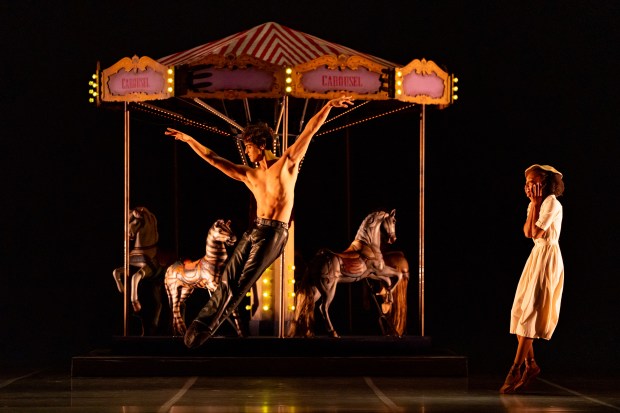
Julie is one of the central figures in the Joffrey Ballet’s season opener, portrayed with innocence and goodwill by prima ballerina Victoria Jaiani. Her journey revolves around her affection for Liliom, a carnival barker played by José Pablo Castro Cuevas, whose charm often leads to his downfall. The ballet explores whether one’s actions stem from character flaws or the circumstances they face. This theme poses a challenging dilemma for Julie as she grapples with Liliom’s imperfections and her own decisions about moving forward.
The ballet, titled ‘Liliom,’ instead of focusing solely on Julie, delves into the male protagonist’s struggle with destiny. Under choreographer John Neumeier, this production marks its Midwest premiere and the first time any North American dance company has staged it. Remarkably, Castro Cuevas delivers a standout performance, surpassing his earlier role as Eugene Onegin.
Neumeier initially created ‘Liliom’ 15 years ago for the Hamburg Ballet. With roots in both Milwaukee and Chicago, Neumeier’s career began at the Lyric Opera. His distinctive style blends classical ballet and modern dance, shaped by his early training with Sybil Shearer in Chicago. His approach to music is unconventional, treating it as a flexible guide, allowing for moments of unexpected choreography.
In ‘Liliom,’ Neumeier’s unique vision is prominent. Evan Boersma, portraying The Balloon Man, acts as a spectral guide for Liliom’s journey. The performance opens in silence, with Boersma carrying a vivid bunch of balloons, accompanied by composer Michel Legrand’s score, beautifully conducted by Nicholas Koo.
The plot unfolds within a carnival setting called Playland, during its vibrant past. The stage design and costumes create distinct social disparities among characters, with Liliom serving as a capable but flawed carnival barker. Castro Cuevas captures Liliom’s contrasting traits—a blend of charisma and insecurity—excellently.
Liliom’s actions lead to violence, turmoil, and a tragic suicide amidst the Great Depression. Inspired by the musical ‘Carousel,’ the story’s climax features the Joffrey Ballet’s male dancers expressing economic despair through a compelling ensemble piece.
The narrative suggests that Liliom had choices, yet his life spirals into hardship, leaving Julie to cope with loss. Despite his flaws, Julie sees Liliom’s vulnerability and retains hope. Her forgiving nature, although seemingly naïve, allows her to embrace her role as a mother.
‘Liliom’ ultimately presents a story of love, acceptance, and resilience. The ballet’s conclusion, aligning with its beginning, highlights Julie’s enduring belief in others’ potential for goodness.
Critique by Lauren Warnecke
Review: ‘Liliom’ (3.5 stars)
When: Through Sept. 27
Where: Joffrey Ballet at Lyric Opera of Chicago, 20 N. Wacker Drive
Running time: 2 hours, 25 minutes with one intermission
Tickets: $39-$214 at 312-386-8905 and www.joffrey.org