S&P 500 Navigates Correction Amid Market Uncertainties
The S&P 500 ended Friday in a correction phase, with a 3.59% decline, bringing it down to 6,918.45. This marked its seventh consecutive losing session, the longest streak since February 2020. Likewise, the Nasdaq Composite dropped 5.28% and is now over 2% lower for the year. According to Goldman Sachs, this index is 12% under its record from October 6. Their strategists have identified three factors essential to a possible market recovery.
Market Dynamics and AI Influence
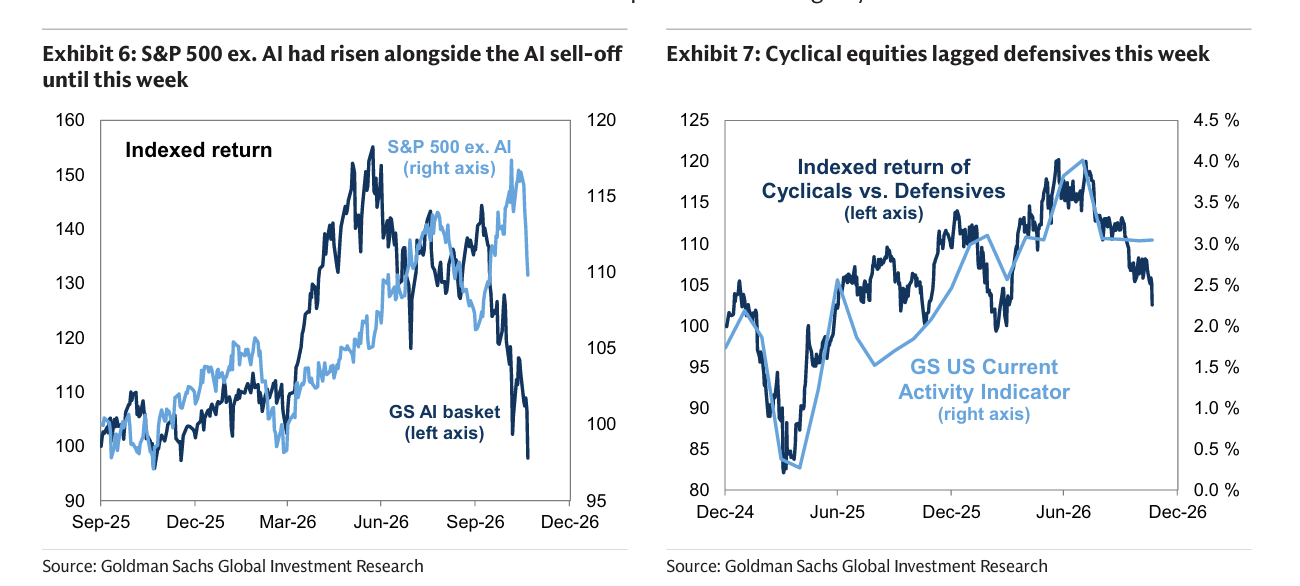
Snider’s note explained that the current sell-off widened from an AI unwind to a broader growth reduction. Previously, excluding AI, the S&P 500 had maintained stability but now stands 6% below its peak. Since October 6, Goldman’s AI stock basket has depreciated by 32%. Over the past ten days, cyclical stocks underperformed defensive stocks by 5 percentage points. Yet, Goldman’s analysis was compiled before Friday’s market upheaval was fully accounted for, suggesting that the current conditions might be more unfavorable than reported.
Goldman’s Conditions for Market Recovery
Goldman outlines three conditions that could indicate a market bottom and inspire recovery:
- Positive news on AI earnings,
- A dovish signal from the Federal Reserve, or
- A significant reduction in investor positioning.
Condition 1: AI Earnings
Investors are closely monitoring AI earnings. Analyst Dan Niles highlighted that a price war between Anthropic and OpenAI negatively affected both companies. Their combined revenue growth from second to third quarter dipped from 75% to 48%, while their losses grew from $7.9 billion to about $8.4 billion. Valuations also indicated a high but precarious level of expected growth.
Condition 2: The Federal Reserve
The likelihood of a Federal Reserve rate hike in December is approximately 95%. They are expected to meet on December 9. Goldman’s economists predict hikes both in December and March, moving the federal funds rate up to a peak of 4.25% to 4.5%. Despite this, a dovish signal remains improbable. On the other hand, Friday saw a significant rally in Treasuries, as investors sought safe havens.
Condition 3: Investor Positioning
A large reduction in investor positioning has historically signaled the end of market downturns. At present, this condition remains unsettled. Anthropic’s IPO, while record-breaking, did not convey stability for the AI segment, reflecting skepticism among investors. The company’s shares initially surged by 17%, but later dropped back, barely above the IPO price.
Hedge Funds and Market Sentiment
Regarding hedge funds, Goldman reports a decrease in their net leverage, at its lowest since April 2025, signalling caution. The most popular hedge fund assets, concentrated in AI stocks, have trailed the S&P 500 by 14 percentage points over the past six months, a notably poor performance period.
The broader sentiment remains above average, supported by substantial inflows into U.S. equity mutual funds and ETFs. Asset managers currently hold significant net equity futures positions.
Goldman estimates that AI investments have inflated S&P 500 earnings by 25% over existing trends. Their research links half of this year’s earnings growth to AI capital spending. Market opinions are mixed on whether this marks a peak. Capital Economics anticipates further declines while Goldman’s projections suggest a potential variation in the S&P 500 ranging from 5,800 to 8,100 by the end of 2027. Such figures imply about 16% downside and 17% upside from current levels.
Historical Performance and Predictions
Following 22 S&P 500 corrections since 1980, the index historically improved by 4% over the next three months, rising in 17 instances. Conversely, E*Trade research warns that of the 14 times since 1983 the index dropped significantly, five resulted in bear markets.