Trump Expresses Support for Irish Unification During Visit
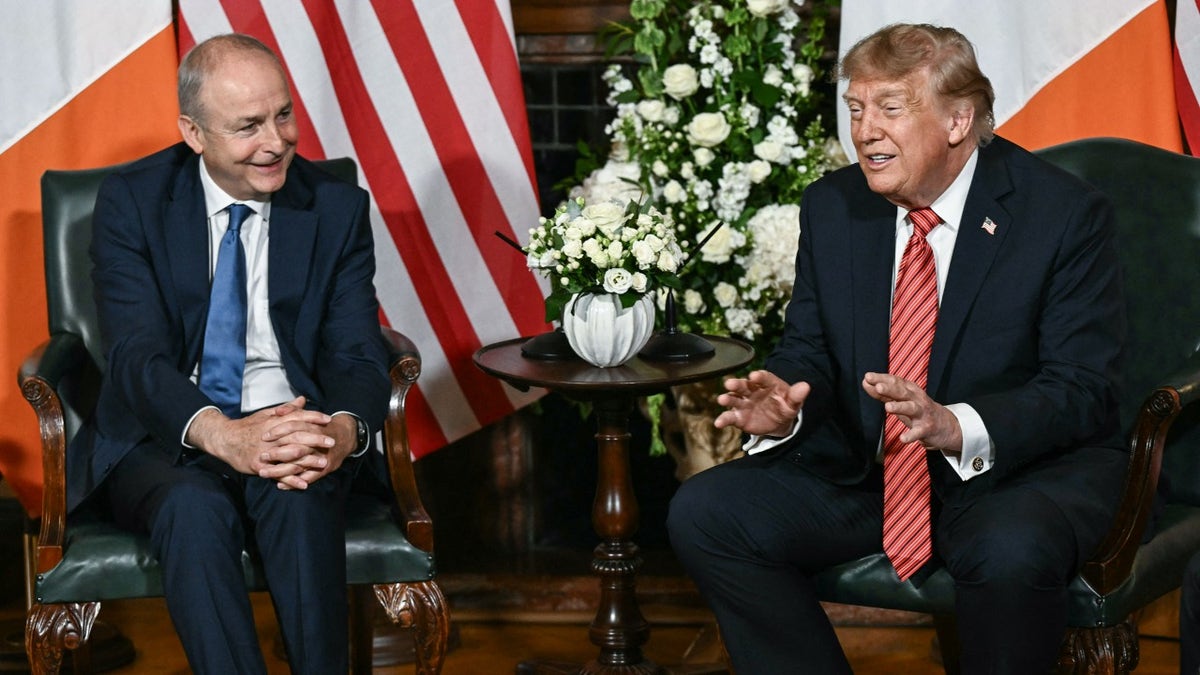
President Donald Trump, while visiting Ireland, expressed his desire to see the country unified. Ireland’s Republic gained independence from the United Kingdom in 1922, while Northern Ireland, formed in 1921, remains part of the UK.
In Dublin, Trump stated, “I don’t want to cause any problems, but I will tell you, I’d love to see it unified. I have friends on both sides, great people. They’re Irish people. How can they be bad, right?” He stood alongside Ireland’s Prime Minister, Micheál Martin, and suggested that unification would be “a great feather in everybody’s cap.” Trump believes unification will eventually occur, acknowledging that the UK “will have something to say about it obviously,” but maintaining that it would be a “great thing.”
President Donald Trump meets with Ireland’s Prime Minister Micheál Martin at Farmleigh House in Phoenix Park in Dublin on Sept. 12, 2026.(Brendan Smialowski/AFP via Getty Images)
Later that day, at Deerfield Residence, the official home of the U.S. ambassador to Ireland, Trump addressed a gathering. U.S. Ambassador Edward S. Walsh introduced Trump, who was welcomed on stage with the song “God Bless the USA” by Lee Greenwood.
Trump revisited the topic of Irish reunification that was raised by a reporter during his earlier meeting with Martin, noting, “That’s one of those questions where no matter what you say, no matter how well you say it, there’s no good answer, right?” He characterized reunification as a “cool thing.”
President Donald Trump delivers remarks to U.S. Embassy personnel and business leaders at Deerfield Residence on September 12, 2026 in Dublin, Ireland.(Anna Moneymaker/Getty Images)
The debate over whether Ireland should be unified has been a major political issue for decades. It extends beyond mere disagreement, with Northern Ireland experiencing sectarian violence known as “the Troubles” from the late 1960s to the late 1990s.
Irish nationalists and republicans, primarily from Northern Ireland’s Catholic minority, advocated for an all-Ireland state. Unionists and loyalists, predominantly from the Protestant majority, wanted to retain Northern Ireland as part of the UK.
During the conflict, over 3,500 individuals lost their lives due to violence involving Irish republican and loyalist paramilitary factions, as well as British security forces.