US Air Travel Disruptions and Calls for System Upgrades
US air travel faced significant disruptions over a three-day period. On Sunday, over 5,200 flights were disrupted. Transportation Secretary Sean Duffy forecasted a recovery by Monday, despite airlines struggling to return to normal schedules following a complete system halt.
Aviation data from FlightAware showed that more than 1,600 flights were canceled and nearly 3,600 delayed on Sunday. The previous day saw over 6,400 flight cancellations and more than 8,000 delays.
Duffy, speaking on ABC’s “This Week,” stated there was no indication of a cyberattack or malicious intent, though the cause was still undetermined. He assured that normal operations would resume by Sunday, reaching full normalcy by Monday, and highlighted the FAA’s commitment to passenger safety.
Specific airlines faced varying impacts. JetBlue canceled 27% of their flights, American Airlines canceled 13%, while Southwest, United Airlines, and Delta reported 3% to 5% of their flights canceled.
The FAA had enforced a nationwide ground stop on Friday, halting nearly all flights for almost five hours, the longest such stop since the September 11, 2001, attacks.
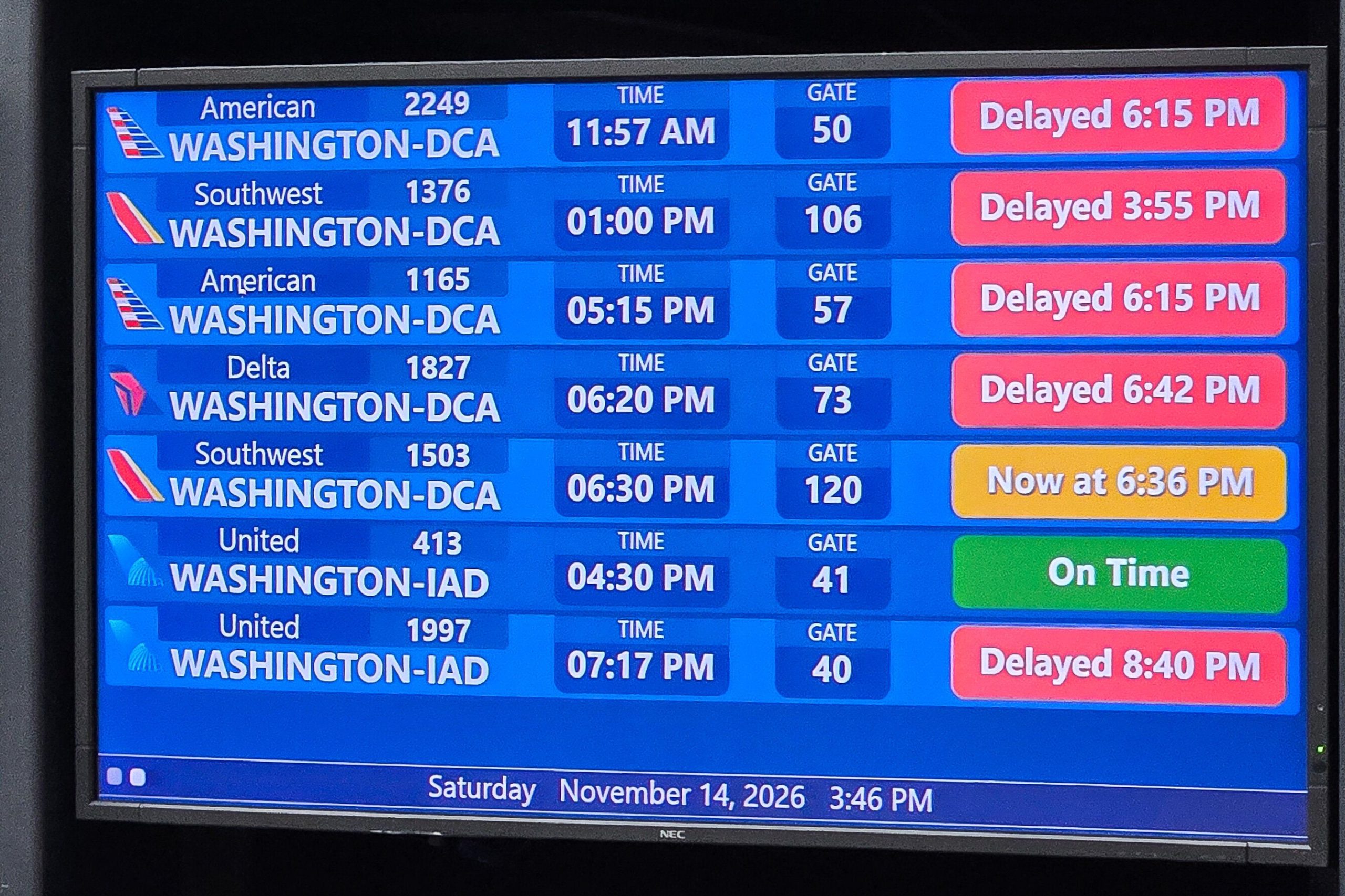
A flight information display showed extensive delays for flights to Washington, D.C., across several airlines at Orlando International Airport on November 14, 2026. This was due to large backlogs after the FAA ground stop caused by system issues. The stoppage was linked to telecommunications and radar problems.
The problem stemmed from installing at least one new router by FAA contractor L3Harris at a remote site, which overloaded data at various air traffic control centers. A replacement router in El Dorado, Arkansas, caused issues in Amarillo, Texas, affecting other centers.
The FAA disabled problematic routers, but the root cause remains unknown. Duffy indicated the worker responsible for the installation was a trusted and reliable individual. The problematic routers, purchased in 2001, became obsolete by 2006. Duffy advocated for $50 billion in funding from lawmakers, up from a previous $30 billion request, to modernize air traffic control systems. Last year, Congress approved $12.5 billion for upgrades.
President Donald Trump called for comprehensive funding in response to the disruptions. He urged Congress for immediate and substantial allocations rather than incremental approaches, emphasizing the need for swift action following Democrats’ control of Congress after the midterm elections.
Critical views emerged from Representatives Rick Larsen and André Carson, who questioned the need for more funds. They pointed out that most of the $12.5 billion allocated in 2025 remained unspent. Duffy defended the request, explaining that previous funds were designated for specific expenditures, excluding new software crucial for airspace management.