Trump Requests Review of FIFA’s Red Card Decision on U.S. Soccer Player
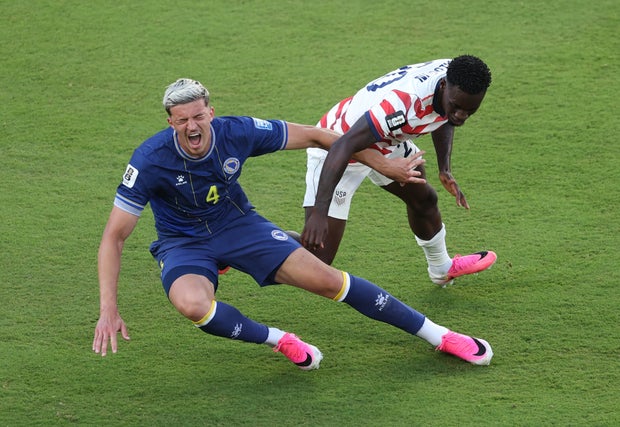
On July 1, 2026, during the FIFA World Cup Round of 32, a match between the United States and Bosnia and Herzegovina took place in Santa Clara, California. U.S. Men’s National Team striker Folarin Balogun received a red card for a foul against Tarik Muharemović. This decision led to Balogun’s suspension for the next game. However, President Trump intervened, asking FIFA president Gianni Infantino to review the decision.
The red card penalty was initially awarded after Balogun was judged to have stepped on Muharemović’s right ankle. Despite the referee’s call and a video assistant referee (VAR) review, Trump argued that Balogun’s action did not constitute a foul. Describing the incident, Trump stated, “Two great athletes got tangled up.” He criticized the referee, suggesting the decision was questionable and indicated others found it lucky.
Though Trump acknowledged he was initially unfamiliar with the red card implications—preventing the player from participating in the subsequent match—he learned of its impact and deemed the ban “very unfair.” He stressed that Balogun did nothing wrong.
Trump confirmed he requested a review by FIFA, communicated through his interaction with Infantino. He asserted he didn’t influence the outcome but believed excluding a top player would harm the game’s integrity. Trump’s request did not include dictating FIFA’s actions.
Infantino explained that FIFA’s judicial bodies are independent, emphasizing the protocol during his communication with Trump. He shared that he often converses with various officials globally regarding football matters. Infantino underscored FIFA’s reliance on its system to make fair and unbiased decisions.
FIFA later reversed Balogun’s one-match suspension, although this decision has attracted criticism and attempts to appeal. The outcome reflects the ongoing debate surrounding the match’s officiating and the influence of external requests.