Camp Cranium Provides Support for Children with Brain Injuries
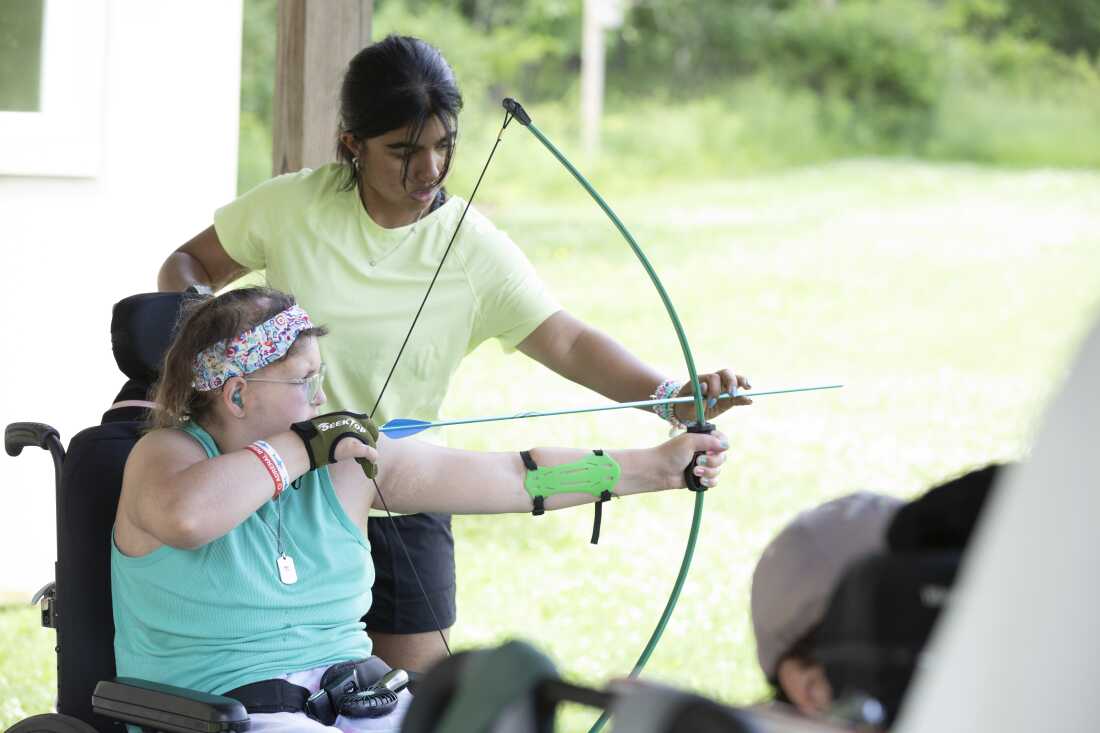
Camp counselor Anvitha Tharra assists Angelica Zander in learning archery at Camp Cranium in Columbia County, Pennsylvania. This weeklong event offers community support and recreation for children with brain injuries.
In the open field, arrows fly through the warm June air, hitting targets with precision. Cheers from campers and counselors fill the air during archery sessions at Camp Cranium in Millville, Pennsylvania. Drew Meyer, the operations director, watches as tears stream from his eyes hidden behind dark sunglasses.
“They surprise you,” he says about the campers who have survived brain injuries. “They practice for hours and eventually hit the target.”
Since 2008, Camp Cranium has provided a space for children aged 10 to 21 with brain injuries to gather in Pennsylvania’s rural Columbia County. Some campers must relearn essential skills like speaking and tying shoelaces. Some use wheelchairs or crutches. Yet, they climb rock walls, swim, and zip down lines through forested areas during their week at camp.
Camp Cranium and similar camps are responses to a national trend spanning decades. More people, including children, now survive after crises leading to brain injuries. This shift stems mainly from better seat belt laws and increased funding for trauma research and centers.
However, recent changes threaten tracking and prevention efforts for traumatic brain injuries. Congress did not renew a key law supporting research, and the Trump administration cut many positions at the Centers for Disease Control and Prevention (CDC), including those tracking these injuries.
“Brain injury can occur to anyone,” says Rebeccah Wolfkiel, executive director of the National Association of State Head Injury Administrators. “This community needs more support.”
Lucas Hardy, 14, beams as he scales a 30-foot rock wall with assistance from a hoist. A traumatic brain injury at age 3 caused by a falling tree branch dramatically changed his life. Annually, about 2.8 million Americans, including 475,000 children, experience traumatic brain injuries (TBIs), the Brain Injury Association of America reports. Yet, these figures might be underestimated.
In 2018, a CDC survey showed that TBIs are likely more common than hospital records show, highlighting them as “hidden” due to internal, invisible damage.
In early 2025, significant personnel changes at the CDC disrupted a team right before launching a national concussion surveillance system. Emily Hilliard, from the Department of Health and Human Services, did not reveal details on employee terminations or replacements. She stated that the Trump Administration supports preventing TBIs and improving related information distribution.
Rebeccah Wolfkiel remains concerned about the future of brain injury research if the CDC’s reduction in staff and federal funding delays persist. “The shortage of resources and information is disturbing,” she said.
Tony Sadowski, Camp Cranium’s executive director, remembers the uncertainty surrounding his son Bryan’s brain bleed and hemorrhagic stroke at age 6. “In the emergency room, the uncertainty about your child’s future is terrifying,” he recalls.
Initiated in 1996, the Traumatic Brain Injury Act funded state research and advocacy, with bipartisan Congressional reauthorization until 2024. Former Secretary of Homeland Security Markwayne Mullin supported continued funding as a senator. Congress is still deliberating funding through 2030.
Despite funding uncertainties, TBI programs receive support from the Consolidated Appropriations Act of 2026, though current funding levels are lower than before.
Camp Cranium and camps like Bright Ideas TBI Camp in Alabama persist without federal funding, relying on private donations. Activities at Camp Cranium like zip lining, archery, and dances offer a support network for families and combat isolation.
Brianna Engleman, 21, reflects on her journey. A hemispherectomy at age 5 ended her seizures but required extensive recovery. Attending the camp since 2018, Engleman plans to return as a counselor. “I’ve grown more confident,” she says. “It showed me there are genuinely good people.”
This narrative results from NPR’s collaboration with WVIA and KFF Health News.