Germany’s Political Shift: AfD’s Surge in Saxony-Anhalt Election
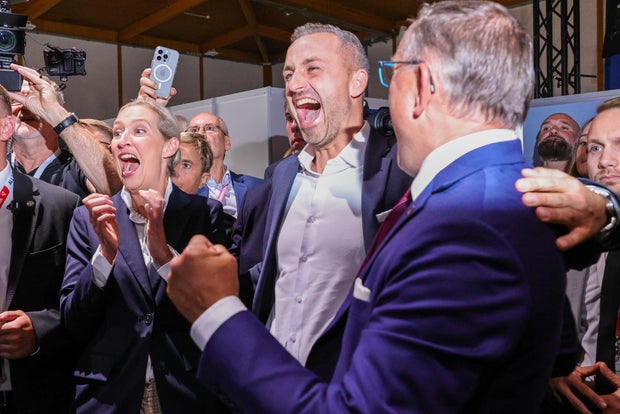
Germany’s AfD party, known for its far-right stance, achieved a remarkable result in Saxony-Anhalt’s recent election. Although the party did not gain automatic control of the state, it won 43.8% of the vote. This marks the highest result for AfD in its 13-year history and represents a significant shift in Germany’s political landscape.
The Christian Democratic Union (CDU), led by Chancellor Friedrich Merz, faced a steep decline, securing only 17.2% of the votes. This drop is considerable compared to the 37.1% the party received in the last election, showing a dramatic change in voter sentiment.
AfD’s Path to Power
In Germany’s system, winning an election does not guarantee formation of a government. AfD’s 43.8% win left it three seats short of the 42-seat majority needed in the state parliament to lead Saxony-Anhalt. The party’s leading candidate, Ulrich Siegmund, faces the challenge of coalition politics.
Major parties, including the CDU, have rejected forming a coalition with AfD, a stance known as a “firewall.” However, the Sahra Wagenknecht Alliance (BSW), which gained 5.3% of the vote and five seats, may influence the outcome by abstaining in crucial votes. This could result in a tie if BSW lawmakers abstain, maintaining the firewall against AfD.
Germany’s Shifting Political Dynamics
The AfD’s rising popularity signals shifting dynamics in Germany. In the 2025 federal election, the party garnered over 20% nationwide. In Saxony-Anhalt, it secured its highest percentage at almost 44%, tracking a trajectory of increased influence.
The CDU grapples with internal debates. Calls for cooperation with AfD grow, but leaders resist, fearing loss of core political boundaries. Chancellor Merz’s leadership faces scrutiny, with internal party figures demanding change.
AfD’s Leadership and Future Prospects
Leading the AfD’s charge is Alice Weidel, co-chair and candidate for chancellor in 2029. Weidel’s background contrasts with her party’s platform. She holds a Ph.D. in economics, worked for Goldman Sachs, and lives openly with her Swiss partner and children. Nevertheless, she spearheads AfD’s anti-immigration and traditional family policies.
These contradictions serve as Weidel’s political strengths. She aims to consolidate AfD’s power, targeting a 40% share of the national vote in the next federal election. This has sparked debates on democracy’s limits in Germany, questioning how growing support for AfD interacts with longstanding political boundaries.