Challenges and Innovations in U.S. Missile Production Amidst Conflicts
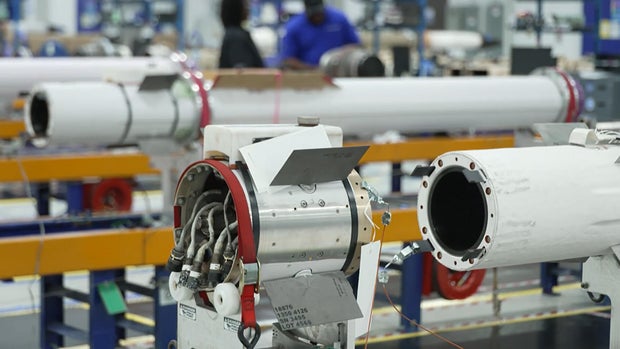
At Lockheed Martin’s facility in Camden, Arkansas, Tim Cahill leads a tour showcasing the Patriot air defense missile. This advanced missile is crafted to neutralize incoming ballistic threats by impact, effectively a scenario of ‘bullet hitting a bullet.’ Cahill notes, ‘It vaporizes whatever it hits.’
Each Patriot missile costs around $4 million. Annually, Lockheed Martin produces 750 units. However, this is insufficient compared to the 1,500 fired in conflicts with Iran. Mark Cancian from the Center for Strategic and International Studies estimates military expenses against Iran reach approximately $25 billion.
Cancian emphasizes reliance on high-end systems for defense against ballistic missiles. The ongoing conflict with Iran exposes a severe shortage of advanced weapons. This shortage gained official attention during the Ukraine conflict, which highlighted inadequate inventories and manufacturing capabilities to sustain prolonged conflicts.
The war with Iran, starting seven months ago, drained weapon stockpiles significantly as noted by Chairman of the Joint Chiefs of Staff, Dan Caine. Over 13,000 targets were struck by April 2026.
Cancian believes U.S. arsenal is adequate against Iran. Yet, confronting China would pose inventory challenges after just one month of conflict. Official statements from the Pentagon claim there is no shortage. However, Defense Secretary Pete Hegseth urges manufacturers to increase production akin to wartime demands.
Lockheed Martin aims to increase Patriot production to 2,000 annually by enhancing assembly automation and increasing shifts. Manufacturing a Patriot takes six weeks, involving a complex supply chain of about 500 to 1,000 suppliers.
Nearby L3Harris manufactures the motors under stringent safety protocols. Company president, Ken Bedingfield, describes a meticulous production process where rocket fuel curing resembles pottery baking, taking days to weeks.
L3Harris nearly doubled motor production and is building a modern, automated plant expected to be ready in 16 months. Supply chain bottlenecks, particularly with critical parts like nozzles and cones, remain a challenge.
While high defense budgets persist, public support is low. The evolving military-industrial complex now includes innovators like CoAspire in Virginia. Led by Doug Denneny, CoAspire develops cost-effective cruise missiles for aircraft deployment. Their Rapidly Adaptable Affordable Cruise Missile (RAACM) is modular, at a fraction of standard costs.
CoAspire’s missile, though less complex, is challenging to intercept in large numbers. The Pentagon plans to procure 10,000 from CoAspire and other emerging companies.
To replenish stockpiles post-Iran war to previous levels could take one to five years, according to Cancian, with extended time required for further buildup suitable for a China conflict.