Theaster Gates Acquires Pickard China Factory
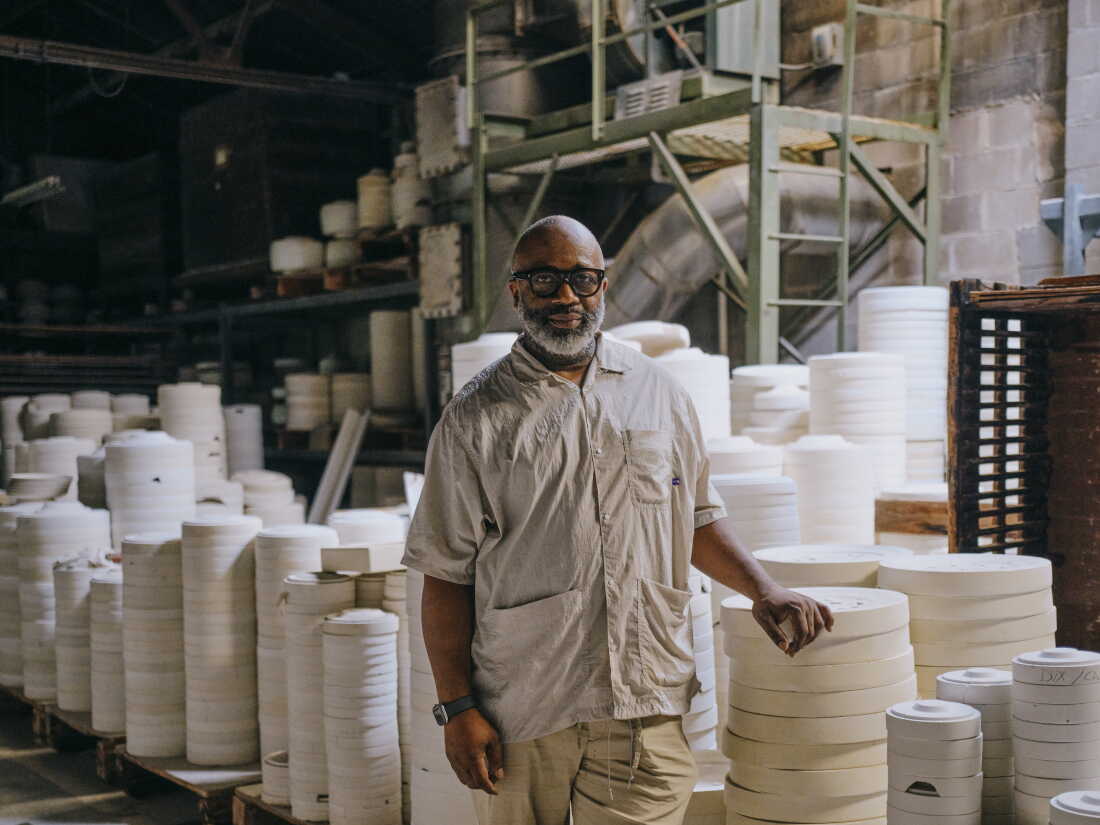
Theaster Gates poses for a portrait at the Pickard China factory in Antioch, Illinois. At 53, this Chicago-based artist has recently acquired the business for an undisclosed sum.
The Pickard China factory, located roughly 50 miles northwest of Chicago, is a large, noisy space filled with clay-covered machinery. The decorating room is dominated by the strong smell of turpentine. This is where the company’s team of gilders mixes the chemical with pigments for hand-painted porcelain items.
Employee Rachael Keeling expertly applies a green band to a spinning porcelain plate during her work. “I don’t even notice the smell,” she commented, showcasing her adaptability. Keeling belongs to a small group of British craftsmen at Pickard. She moved to the U.S. 25 years ago from the prestigious Wedgwood factory in Stoke-on-Trent as Britain’s fine china production began to automate and relocate overseas.
However, Keeling remains worried about her job security. “I came here wondering if we’ll face the same situation again,” she said.
A Long Decline
Once, several companies produced high-end china in the U.S. Today, Pickard is the last one standing. Its clients include the White House, U.S. embassies, luxury hotels, and retailers like Williams-Sonoma.
Michelle Obama’s interior designer, Michael Smith, praised Pickard’s blue-green rimmed dinnerware set, commissioned during President Obama’s second term. Although the company boasts high-profile customers, the fine china industry has faced persistent decline.
Pickard’s factory needs significant repairs and upgrades; its current production is just a fraction of its peak during the 1970s.
Philip Scranton, an emeritus historian at Rutgers University, noted that rising costs and the spread of casual lifestyles since the 1970s led many American china factories to either close or relocate production overseas. “I’m unsure if this market can recover,” he stated.
Yet Pickard endures due to “stubbornness and legacy.” Founded in 1893 by pottery salesman Wilder Pickard, the business stayed within the family until Theaster Gates entered the picture.
Theaster Gates Takes Charge
Theaster Gates connected with Pickard thanks to Illinois First Lady MK Pritzker, a friend of the artist, as are the Obamas. “The idea that Pickard could rejuvenate artisanal manufacturing is exciting,” Gates noted on one of his frequent visits to the factory.
Gates and Andy Pickard Morgan, who led the company since 2006, shared the news of Gates’ acquisition with Pickard’s 12 full-time employees.
“We often saw Theaster visit, and I liked his energy,” remarked David Nosko, part of Pickard’s operations team.
Gates’ contemporary art installations made from salvaged materials are highly revered and expensive, appearing in major museums. A professor at the University of Chicago, he collaborates with brands like Prada and maintains connections with influential figures like the Obamas and MK Pritzker.
As Pickard faced aging infrastructure and no family member willing to continue overseeing the factory, Andy Pickard Morgan sought Gates to preserve the company.
“Finding the right person rather than a quick-profit company was crucial,” Pickard Morgan remarked, referencing competitions like Lenox that moved production offshore.
An Unlikely Match
The unlikely pair of an avant-garde artist and a traditional porcelain business may seem odd, but Gates has a broad vision of art. He’s interested in diverse ceramic traditions and has worked to elevate lesser-known Black potters.
Gates also has a history of revitalizing defunct buildings, archives, and businesses, predominantly on Chicago’s South Side, like a hardware store turned art space and a damaged bank transformed into the Stony Island Arts Bank, a cultural center that houses extensive Black cultural archives.
Linda Johnson Rice, from Johnson Publishing, cited Gates’ purchase of Pickard as an extension of his drive to build and preserve legacy, though warned of the difference between managing static assets and running a dynamic business.
“These businesses and archives are static, while Pickard is ongoing,” she said. “This is Theaster’s entry into the real business world!”
Facing Challenges Ahead
The new role at Pickard China brings numerous challenges for Gates. The factory requires a new roof and HVAC system, alongside other repairs. His priorities include forming a team for daily operations while guiding creative direction. Pickard Morgan plans to remain in an executive capacity.
Despite the daunting task, Gates sees the possibilities. “Most would be intimidated by the scale, but it’s poetically stimulating,” he said. “Adding to the legacy and exploring porcelain is a future I embrace.”
Jennifer Vanasco edited this story’s audio and digital versions, along with Clare Lombard. Chloee Weiner mixed the audio and Danielle Scruggs was the photo editor.