Jaloni’s Journey: Navigating Hospital Stays and Finding Stability
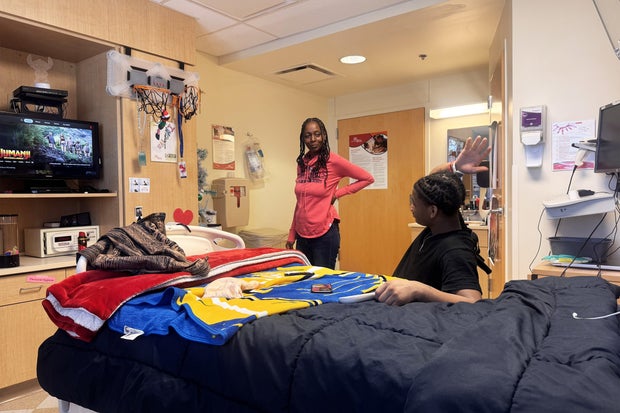
In St. Louis, Jaloni’s long hospital journey commenced in room 3005. Initially, the space lacked the comfort of home, with no personal touches or snacks. Jaloni, then 14, was grappling with severe pain from gunshot wounds, immobilized on his first night there. The medication offered brief escapes into dreamlike flights, yet his reality was a battle for survival.
Among friends, Jaloni had been a daring risk-taker skilled at evading capture. In the hospital, he became the boy relying on his grandmother’s reassurance that life would improve once released. Yet, she couldn’t promise that. Over 475 days stretched across three years, Jaloni’s stays often extended past medical needs, due to a lack of safe transition options.
“I just couldn’t take care of him anymore,” explained Quette, Jaloni’s mother, highlighting the challenge of meeting his needs after his release.
Jaloni’s three extended hospital stays reflect a national issue known as social stays or hospital boarding, where children remain hospitalized beyond medical necessity. Factors like shortages of suitable foster homes cause children with diverse needs to linger in hospitals. A Minnesota study estimated the cost of boarding children with complex medical needs at $3,932 per day. Specific costs of any unnecessary days during Jaloni’s stay remain undisclosed.
Missouri records reveal over $64.7 million spent over five years on hospital boarding for children in state custody. However, spokesperson Dave Dillon suggests the issue may be underrepresented, as hospitals might not log such costs comprehensively. This does not even account for the emotional toll on children like Jaloni.
Jaloni’s journey includes loss and resilience. Gun violence claimed the lives of his older sister, brother, and several cousins. A community conflict turned violent and left Jaloni injured, with a 22-year-old killed and a 16-year-old charged.
“I felt like Superman with my gun,” Jaloni reminisced. “But when you get older, you realize that it’s just stupid.”
After his release, Jaloni’s family struggled with his care due to their own physical limitations and financial constraints. Despite raising alarms, they secured little assistance. This led to his return to Cardinal Glennon Hospital, where allegations of neglect arose, making him a ward of the state rather than allowing a return home.
The issue of hospital boarding is persistent. Illinois similarly reports numerous cases of extended stays. Legislative attempts in Missouri to address the problem have not yielded solutions. Jaloni’s hospitalization became his prolonged home during this crisis.
While in care, he discovered changes in personal relationships, particularly after his grandmother’s death. An eventual placement with his aunt Deborah, who adapted her living arrangements, became a turning point for Jaloni. Hospital staff sought to engage him with gifts and activities, yet to Jaloni, time felt stagnant.
Jaloni’s third hospital stay for a bone infection led him to a shift in outlook. Exploring the hospital, connecting with new people, and musing about his encounters defined his days. The care team provided him educational support, and Jaloni became a sounding board for personal stories shared by staff.
In his realm, Jaloni felt he had gained perspective and had achieved growth despite the difficult circumstances.
By spring, Jaloni’s discharge marked another new chapter. Settling into a new home with his aunt, he began adjusting to independent living chores, maintaining medication schedules, and embracing personal milestones like a celebrated birthday.
Despite the progress, anxiety around community safety remains a concern for Jaloni, who learned a balance of caution and engagement with his surroundings. Aspirations of obtaining a GED, learning trades, and venturing into business reflect his forward-looking goals.
Jaloni’s main aim now is simple: stay out of the hospital and alive.
This narrative was made possible by support from the Association of Health Care Journalists and funding from The Joyce Foundation. KFF Health News explores comprehensive health journalism.