AI Competition and the Data Center Debate: Implications for U.S. Dominance
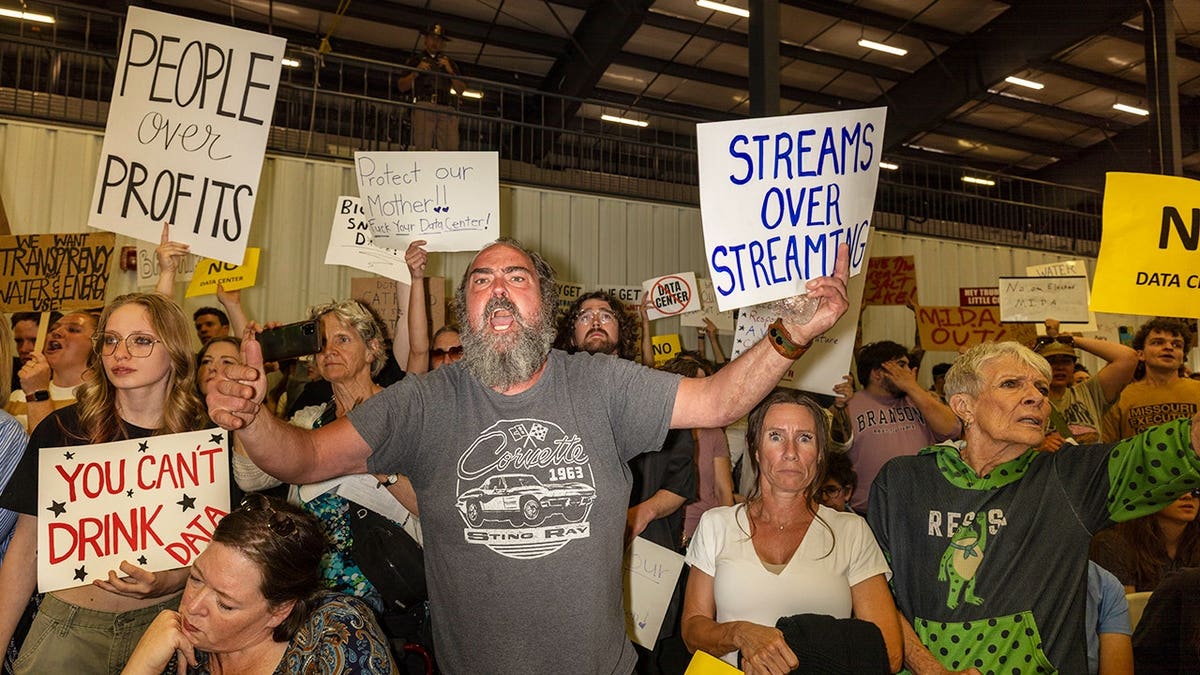
Consider a scenario where, during World War II, individuals protested outside factories producing tanks and planes, aiming to halt operations. Imagine if, just before Pearl Harbor, new plant and shipyard openings faced restrictions, dictating production locations.
Common sense in 1940-1941 suggested that such obstruction would only benefit the nation’s adversaries. This represented one form of warfare. Today, a different battle unfolds — an artificial intelligence (AI) competition with China. Both countries strive for technological dominance, but their goals differ greatly. U.S. companies and the Trump administration view AI as a means to enhance global prosperity, individual freedom, and autonomy. In contrast, China’s objectives focus on using AI to control its population and establish global influence under strict government control.
BLANCHE URGED TO INVESTIGATE ALLEGED FOREIGN INFLUENCE IN FIGHT AGAINST DATA CENTERS
The United States and China are pivotal players in the future of AI, controlling 90% of AI compute capacity. The U.S. holds 75% of this capacity, compared to China’s 15%. While China emphasizes AI in industrial applications and views it as a strategic military asset, the U.S. remains a leader in generative AI and innovation. The U.S. is also making strides in industrial and military AI applications.
However, economic and strategic advancement depends on sufficient power resources. The data center ban movement raises concerns here. Approximately 78 local jurisdictions in the U.S. have implemented temporary bans or moratoriums on new data centers. While New York is the only state with a construction moratorium, 14 other states are considering similar measures, including traditionally conservative states like Florida, Oklahoma, and Georgia.
MARXIST ORGANIZER LEADS CAMPAIGN AGAINST VIRGINIA AI DATA CENTER AS FOREIGN INFLUENCE CONCERNS MOUNT
If this movement gains momentum and receives backing from major political parties, like the Democrats, and temporary bans become permanent, China could be the clear beneficiary. Comparably, banning defense plant construction during World War II would have favored Nazi Germany and imperial Japan.
This issue goes beyond economic concerns. In Georgia alone, a ban could affect 552,000 jobs and $850 million in tax revenue. It also affects national security and, arguably, individual freedom. The ban movement stems from misconceptions.
Contrary to claims, data centers do not significantly raise electricity costs. In fact, they can lower costs by spreading them over increased sales. Additionally, most data centers do not consume excessive drinking water, using none 96% of the time. Golf courses consume far more water than data centers, with national use at over 500 billion gallons yearly, compared to 230 billion gallons for data centers.
Instead of harming local economies, data center construction generates jobs. A Brookings Institution study found that a new data center boosts construction employment by 11% and information sector employment by 22%. Wages also increase by 3%-4% for existing and new workers.
Extending temporary bans could result in China benefiting, much like blocking defense plants during World War II. Far from draining public funds, AI-supporting data centers increase tax revenues through economic growth.
AI’s advantages are not limited to billionaires and tech giants. As a key economic growth driver, AI enables startups and small businesses to compete. It supports a revitalized U.S. manufacturing sector.
AI and its data centers are forecasted to add trillions to the U.S. economy, potentially contributing up to 1.5%-3.7% of annual GDP growth.
Those are the economic benefits. AI, with the data centers supporting its applications, plays a critical role in national security. Militarily, AI advances include autonomous drones and battlefield technology. It aids in detecting cyber threats, analyzing intelligence data, and enhancing military logistics. Furthermore, AI improves efficiency in defense manufacturing, preparing the U.S. to confront China directly.
The decisions surrounding future data centers will significantly impact freedom’s future. U.S. leaders and citizens must make informed choices that favor the country’s long-term interests, not the Chinese Communist Party’s bureaucrats.