Almanacs Release Forecasts as Autumn Approaches
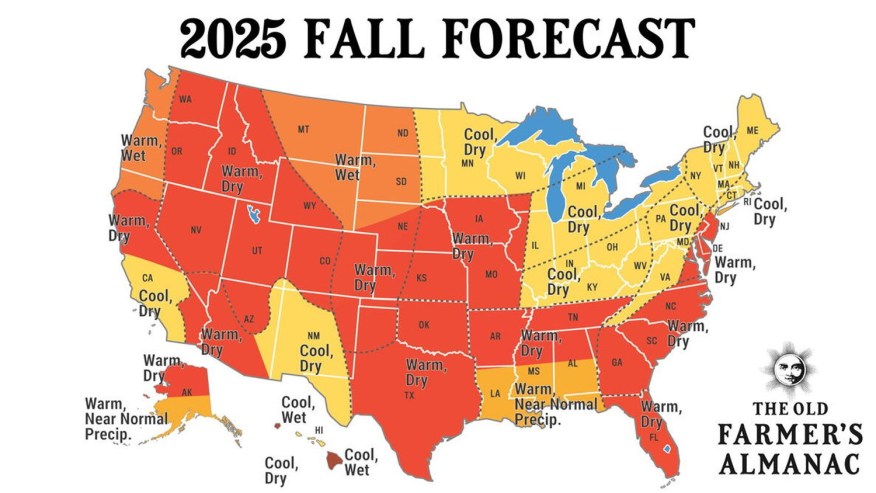
As summer ends, days get shorter, and cooler mornings hint at fall. The autumnal equinox is approaching, and the almanacs have unveiled their seasonal forecasts. The Old Farmer’s Almanac and the Farmers’ Almanac are two distinct publications, each offering extended weather predictions, gardening tips, and skywatching advice.
Fall Predictions
The Old Farmer’s Almanac predicts a “warmer than average” fall. The Pacific Northwest and northern New England may expect a “cool, wet” season. The Plains and Rocky Mountains might have a warm, dry fall. Similar conditions could occur in some states in the central Gulf region. The Midwest, Ohio Valley, and East Coast could experience a cool, dry autumn. This forecast resembles last year’s predictions.
Looking Toward Winter
The Farmers’ Almanac has released its winter weather predictions, mentioning “snow, sleet and surprises.” They forecast precipitation across the U.S., with “snowy” conditions in the upper Plains and Midwest, a “wet” Gulf and southern East Coast, a “wetter” South, and “coastal storms” in New England. This differs slightly from last year’s outlook.
“There are those who believe [them] and those who don’t,” said meteorologist Rich Segal.
Both almanacs claim around 80% accuracy for their long-range forecasts, using secret formulas. However, research indicates only about half of the Farmers’ Almanac forecasts are correct. The Old Farmer’s Almanac’s formula, created in 1792, includes solar science, climatology, and meteorology. They compare “solar patterns and historical weather conditions with current solar activity.” The Farmers’ Almanac, established in 1818, factors in the moon’s influence and compares previous weather patterns with current conditions. Despite the long-term foresight, Segal notes these forecasts can feel uncertain, like “a crapshoot.”
NOAA’s Insights
NOAA will release its winter weather forecast in mid-October. Current NOAA projections favor a warmer-than-average September to November in the upper Pacific Northwest. The southern Midwest and Ohio Valley have equal chances for warmer or cooler falls. NOAA’s outlook considers a potential “super” El Niño, likely the strongest since 1950. This pattern may affect the winter season and influence the quiet hurricane season in the Atlantic. Typically, El Niño leads to a warmer, drier north and a wetter south.
The exact impact of El Niño remains uncertain, leaving the value of almanac predictions up for interpretation. “It has its value to those who believe in it,” Segal said. NOAA’s detailed winter outlook will be available in mid-October, covering December through February.
Sandi Duncan of the Farmers’ Almanac notes, “While no forecast can claim perfect accuracy, our predictions have proven useful for generations.” Despite ongoing refinements, Mother Nature remains unpredictable.