Aurora Residents Debate Orchard Road Sound Wall Plans
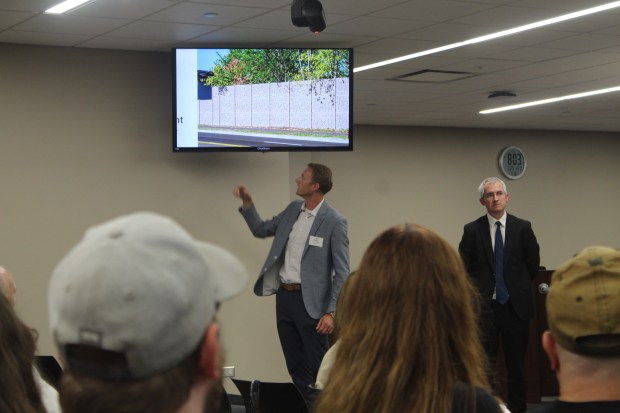
After over a decade of delays, Aurora considers plans to reduce vehicle noise along Orchard Road. Residents living in the area might see improvements by next summer. However, details of the sound wall design remain uncertain. Concerns remain regarding safety, wall height, and building material, as voiced at a recent meeting in Aurora City Hall.
City engineers proposed constructing a wall using noise reduction materials on both sides of Orchard Road from Prairie Street to Indian Trail. The suggested height is between 13 to 14 feet, replacing the current wooden wall that ranges from 10 to 12 feet. This differs from the earlier plan to use concrete, as studies indicate the wooden wall doesn’t significantly reduce noise.
The designs stem from a five-month study by Thomas Engineering Group, LLC, under a contract worth nearly $169,000 approved last February. The city aims to finalize the design for bidding later this year, as mentioned by Ian Wade from the city’s engineering division. Construction is expected to start before the end of 2026.
“Long story short, we’re on the cusp right now,” Wade remarked. “I think we’ve got a pretty good product, and we’ve got a lot of information.”
Officials stress urgency with winter approaching, as they plan to dismantle the existing wall before construction begins. The aim is to avoid leaving nearby homeowners without any barrier for an extended period.
“This is kind of why we want to start it relatively soon,” said Ald. Carl Franco, who represents the area affected by the new sound wall. “You take it down, you’ve got to put something up.”
Thomas Engineering Group, LLC recommended three materials: precast concrete, linear low-density polyethylene plastic, or fiberglass composite. Each varies in construction time, lifespan, costs, and other factors.
Initially, residents preferred concrete for its durability. However, after discussions, support shifted to a wall using linear low-density polyethylene plastic at either 12 or 16 feet, based on distribution reasons. Despite the initial safety expectations with concrete, engineers clarified it wouldn’t act as a road barrier, separating safety efforts into a different project.
Concrete construction presents challenges, including relocating power lines underground, making it the longest and most expensive option. Residents expressed strong opposition to fiberglass composite due to its hollow nature, which might reflect sound rather than absorb it. Disapproval grew after examining a sample at the meeting.
Most residents also desire a taller wall than proposed, with access doors included. Franco urged compromise. He prioritizes completing a design within the $6 million budget by next summer.
Residents voiced their opposition to using a special service area property tax for funding. The project will receive $800,000 in state grants, according to the 2026 city budget. A 2024 agreement with Kane County secures over $1 million from the county. Franco contributes roughly $600,000 from his aldermanic funds. The remainder of the $3.6 million would come from Aurora’s capital improvement fund.
Kane County bears responsibility for any capital maintenance, while Aurora will manage basic upkeep. Residents consistently emphasized the importance of addressing safety concerns on Orchard Road, alongside noise reduction efforts.
Several residents shared stories of vehicles causing property damage. Brittany Charmelo, a local resident, expressed her concern over safety on their properties, highlighting the obligation of the city and county to address these issues with tax contributions in focus.