Debating the Christian Nation Concept in America
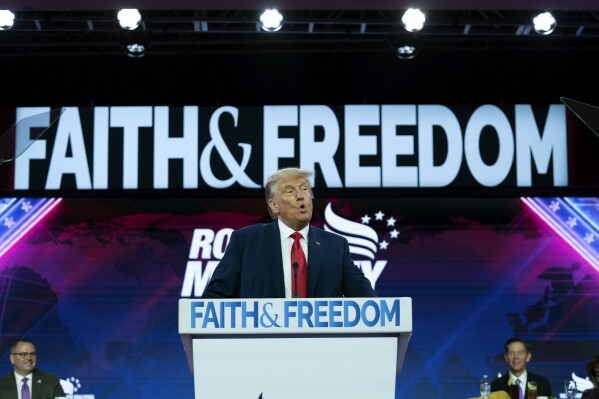
The U.S. Constitution does not mention Christianity or any specific religion. While the Declaration of Independence suggests that rights come from a ‘Creator’ and ‘Nature’s God,’ it does not specify who these entities are. Despite this, many Americans hold the belief that the founders intended for the U.S. to be a Christian nation, a sentiment strong among Republicans and white evangelicals.
This view is visible among supporters of Donald Trump, who hope to see him return to the presidency. The concept of a Christian America varies widely in interpretation. Pollsters have identified a broad group of Americans with general God-and-country sentiments. Within this group is a smaller segment that believes the U.S. Constitution is divinely inspired and advocates for declaring the U.S. a Christian nation.
Among this hardcore group, there is often a tendency to hold unfavorable views toward immigrants, downplay anti-Black discrimination, and view Trump favorably, according to a 2021 Pew Research Center survey. This ideological package is part of what is known as Christian nationalism, intertwining American and Christian values while seeking to give Christianity preferential status in public life.
Eric McDaniel, an associate professor at the University of Texas, suggests that Christian nationalism provides a sense of national innocence, allowing adherents to resist acknowledging darker aspects of U.S. history. This belief ties into past ideas like Manifest Destiny and modern slogans like ‘America First’ used by Trump.
Trump has echoed these views, proposing policies such as barring immigrants who disapprove of U.S. religion. Meanwhile, Republican figures like House Speaker Mike Johnson have claimed America was founded as a Christian nation. Associated organizations, like WallBuilders, have faced criticism for promoting historically dubious claims about America’s Christian origins.
Amid political discourse, figures such as the Rev. Robert Jeffress from First Baptist Church of Dallas argue that, although not all founders were Christians, the nation’s principles stem largely from Judeo-Christian values. He cites John Jay’s assertion about preferring Christians for rulers as reflecting this sentiment.
However, Anthea Butler, chair of religious studies at the University of Pennsylvania, argues against the idea of a Christian nation, pointing out such views exclude groups like enslaved Blacks and Native Americans. This concept, she notes, centers American history on white Anglo-Saxon Protestants as the nation’s leaders.
John Fea, author of ‘Was America Founded as a Christian Nation?’ and a professor at Messiah University, states that arguments for a Christian America are not historically grounded. Political agendas often rely on a skewed interpretation of history.
Pew Research Center data indicates a significant portion of the population believes in the idea of America’s Christian origins. Democratic President Joe Biden, while emphasizing his Catholic faith, acknowledges shared values among different faiths.
Despite various interpretations, the Constitution explicitly prohibits religious tests for office and ensures freedom of religion. While defenders may cite early state practices of funding Protestant churches, key figures like Thomas Jefferson, John Adams, and Benjamin Franklin did not align with orthodox Christian beliefs.
Fea cautions against simplifying the nuanced and complex historical context of the 18th century when discussing religious influence in America’s founding.
Associated Press religion coverage receives support through the AP’s collaboration with The Conversation US, with funding from Lilly Endowment Inc. The AP is solely responsible for this content.