Democratic Voter Turnout Rises in 2026 Primaries
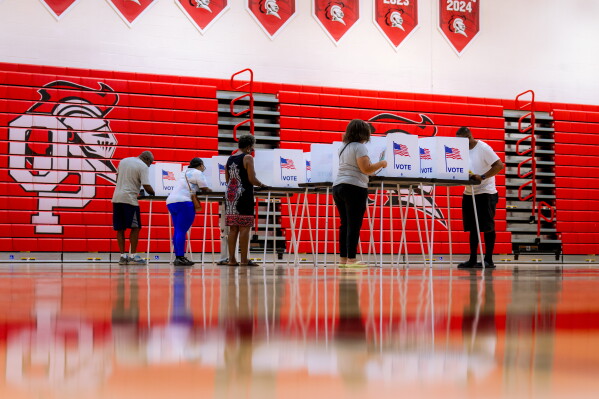
Democratic voters are participating in the 2026 primaries in numbers not seen in decades. This trend is evident across several states and gives the party hope for the upcoming November elections when control of Congress is at stake.
Record-Breaking Numbers in Key States
During the recent primary, Wisconsin Democrats cast nearly 800,000 ballots, marking their highest midterm total in over 20 years. In Michigan, 1.5 million Democratic voters participated in the prior week’s primary, setting a midterm record for the state.
The increase in Democratic participation extends beyond the Midwest. Earlier this year, states like Texas and Georgia also experienced a surge in Democratic turnout. This pattern is promising for the party as they approach the midterms, a time when the president’s party often faces challenges.
President Donald Trump’s low approval ratings, economic inflation, and the unpopular conflict with Iran add to these challenges. According to David Axelrod, a former advisor to Democratic President Barack Obama, the significant Democratic turnout is noteworthy and consistent throughout this period.
Impact of Competitive Primaries
Competitive Democratic primaries are driving this surge in voter participation. However, Republican turnout in states like Michigan has remained close to historical norms, despite competitive contests.
“Primary turnout doesn’t win general elections,” said Mike Marinella of the National Republican Congressional Committee. He emphasized the GOP’s focus on driving voter turnout through a robust funding advantage and active campaigning.
Diverse Patterns Across States
In Wisconsin, over 790,000 people voted in the Democratic primary for governor, with a turnout rate of about 22% of registered voters. Michigan saw more than 1.5 million Democratic primary voters, accounting for 18% of registered voters. In Minnesota, turnout matched the high levels seen in the 2018 midterms.
Republican turnout in Wisconsin and Michigan reflected previous midterm performances, with 11% voter participation in Michigan’s Republican governor race and an anticipated 14% in Wisconsin.
Ted Goodman, a Michigan GOP spokesperson, emphasized the efforts to bridge the enthusiasm gap by focusing on the stark contrasts between Republican nominees and their Democratic opponents.
High Turnout in Southern States
Earlier elections in states like Georgia and Texas also showed significant Democratic voter engagement. In Georgia, over 1 million people participated in the Democratic governor’s race, while approximately 2.3 million voted in Texas’s Democratic Senate primary.
“The robust primary turnout is a positive indicator for Democrats,” said Corwin Smidt, a political science professor at Michigan State University. Although voter enthusiasm is evident, it is not an assured predictor of November results.
Challenges in Maintaining Unity
High-profile contested races in Michigan, Wisconsin, and Minnesota have drawn media attention and public interest. In Michigan, significant spending in the Democratic Senate primary highlighted the competition between candidates like Abdul El-Sayed and Haley Stevens.
Post-primary, both Wisconsin and Michigan Democrats organized unity events to bridge intra-party divides. Senator Bernie Sanders expressed confidence that Democratic voters will come together against Trump in the upcoming general elections.
A Tough Electoral Map Awaits
The enthusiasm seen in the primaries might carry into the general election. Historically, the president’s party struggles in midterms, and with Trump’s popularity waning amid economic concerns and war, Democrats see this as an opportunity.
However, overcoming obstacles like a congressional map favoring Republicans remains a challenge. Despite favorable conditions, Democrats require high turnout levels to address the shrinking number of competitive House races, exacerbated by new district maps.
Republicans hold a slight Senate majority at 53-47, leaving Democrats aiming to flip four seats for control. As political scientist Smidt noted, achieving voter energy akin to 2024’s national tide could alter the electoral landscape.
Pamela Jo Martin and Samuel Jens from The Associated Press Election Services contributed to this report from Washington.