Devastating Flash Floods Hit Northern Nepal and Tibet
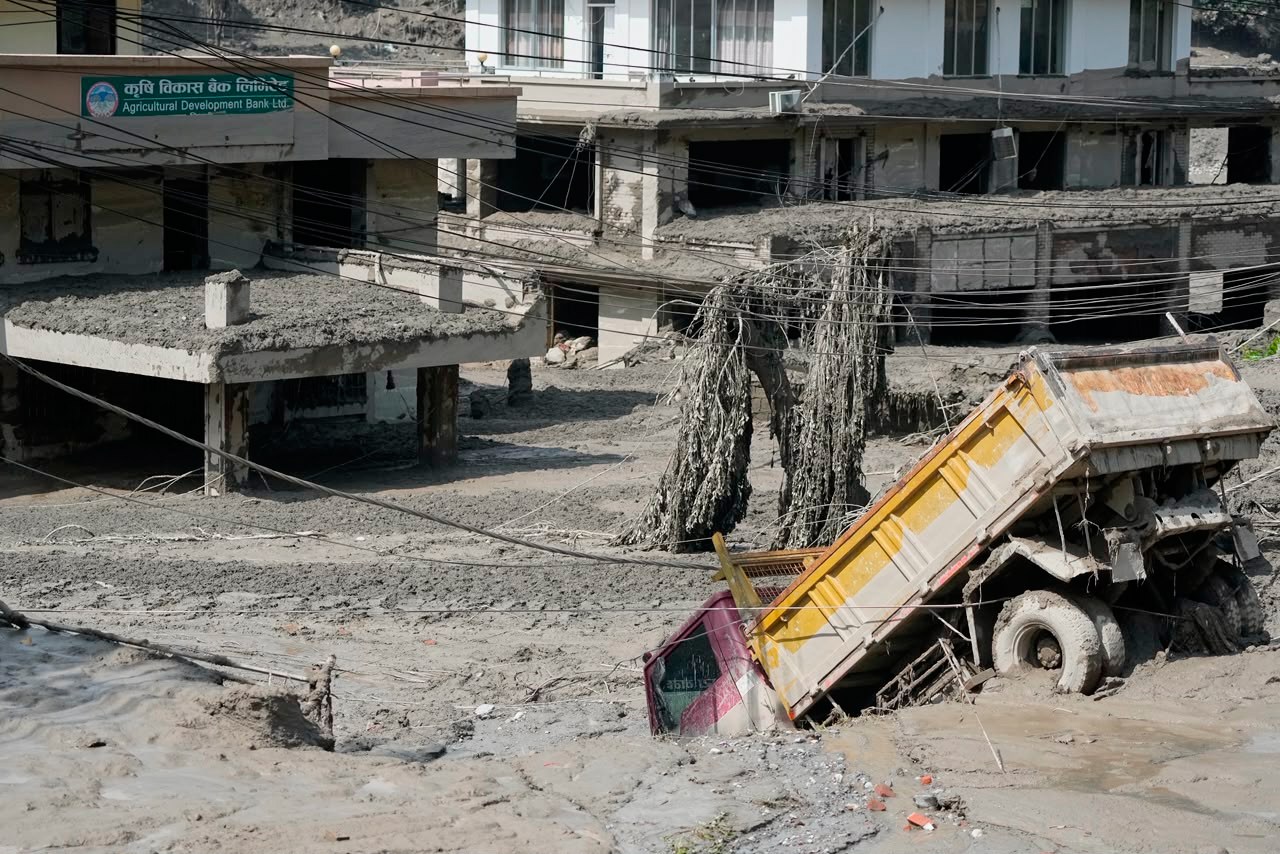
A towering surge of muddied water thundered through the Himalayan border-crossing at Gyirong Port, engulfing structures as deadly flash floods ravaged communities in northern Nepal and Tibet on Wednesday.
Surveillance footage from Resuo Bridge captured images of people fleeing for safety as a brown cascade of mud, rocks, and water swept through the canyon from the Nepalese side, consuming buildings at the port.
At least eight people were killed and hundreds remain missing after an avalanche of ice and rock obstructed a river, triggering a sudden deluge downstream, according to officials and climate experts consulted by The Associated Press.
The flooding obliterated villages, roads, and hydropower projects in Nepal’s Rasuwa district before impacting the Chinese border side, leading to power outages and disrupted communications as rescue operations began.
Authorities reported 384 tourists missing, including 291 foreign nationals from various countries such as India, the United States, the United Kingdom, and Malaysia. Newsweek reached out to the U.S. embassy in Nepal and the U.S. State Department for comments.
Nepal has sought assistance from neighboring countries India and China to bolster the rescue efforts amid challenging conditions.
“We have asked both India and China to help us with the rescue efforts,” stated Sasmit Pokharel, spokesperson for the Nepalese government, speaking to the AP.
History of Recent Flooding
Rasuwa district experienced similar flooding back in August 2025, when a glacial lake in adjacent Tibet overflowed amid elevated temperatures in the region, culminating in nine fatalities and significant damage to infrastructures including the crucial bridge linking Nepal and China.
What Caused the Flash Flood?
An avalanche consisting of ice and rocks from a glacier on the Nepalese border reportedly obstructed the Lhende Khola River before unleashing a rapid rush downstream, as per insights from climate specialists at the International Centre for Integrated Mountain Development.
“The Lhende Khola has flooded twice in 14 months, the latest event triggered by an ice rock avalanche from a glacier on the Nepal side that blocked the river and released a sudden surge downstream,” noted Saswata Sanyal, disaster risk reduction expert at the organization.
Sanyal accentuated the necessity for warning systems in an increasingly vulnerable Himalayan region exposed to climate-induced hazards.
“In a warming Himalaya, early warning is the first line of adaptation,” he asserted.
The Himalayan region faces heightened susceptibility to floods, landslides, and heavy rainfall, driven by accelerated warming compared to the global average due to anthropogenic climate change.
Research from the Kathmandu-based organization highlights that glacier ice loss rates across the Hindu Kush Himalaya have intensified since 2000, primarily due to escalating global temperatures.
China’s Response to Flash Flood
Chinese President Xi Jinping mandated exhaustive efforts in locating individuals missing after the mudslide inflicted casualties at Gyirong Port, as conveyed by China’s state-run Xinhua News Agency.
Xi emphasized the evacuation of at-risk residents and timely medical treatment for the injured populace. He also instructed officials to reinforce monitoring and early-warning systems, execute rescue procedures cautiously, and guard against further disasters.
Chinese Premier Li Qiang tasked authorities with verifying the numbers of missing and impacted persons and directed the Foreign Ministry to liaise with other nations and share pertinent information.
Vice Premier Zhang Guoqing journeyed to the affected locale to supervise rescue and disaster-response operations, according to Xinhua.
A deployment of 145 officers and soldiers from the Xigaze detachment of the People’s Armed Police were dispatched to Gyirong Port, reported by the state-run Global Times citing the force’s Xizang Corps. Drone footage revealed buildings at the port engulfed by debris.
China’s Ministry of Finance and Ministry of Emergency Management allocated funds totaling 120 million yuan (approximately $17.9 million) to bolster rescue and relief operations subsequent to the catastrophe, as reported by state broadcaster CGTN.
This article encompasses reporting by The Associated Press.