Financial Struggles of Northwest Indiana: An Analysis of the ALICE Report
In Northwest Indiana, 39% of households are facing significant challenges in affording six basic needs: housing, childcare, food, transportation, healthcare, and technology. According to the latest ALICE report, this translates to 114,782 households struggling to meet these needs. Across Indiana, 38% of households, totaling over one million, are grappling with similar financial difficulties.
ALICE households have incomes that fall below the cost of living necessities but remain above the federal poverty threshold. This disqualifies them from receiving governmental assistance. Jobs commonly occupied by ALICE individuals include childcare workers, nursing assistants, and cashiers.
From 2007 to 2024, Indiana’s ALICE essentials index rose by more than 61%. This increase surpasses the 52% rise of the broader Consumer Price Index, which measures inflation over more than 200 categories. United Way Northwest Indiana President and CEO Chris White addressed this issue, highlighting that although wages have risen, the cost of living increases at a much faster rate. White raised a pertinent question about consumer inflation rates reaching 4% in May, asking, “Well, whose paycheck got 4% bigger last month?” This sentiment reflects struggles seen across urban, rural, and all regions of Indiana.
The 2024 report outlined that the minimum living cost for an adult in Indiana is $28,764, while a family of four needs $74,028. These figures are nearly double the federal poverty levels of $15,060 for a single adult and over $31,200 for a family of four. Northwest Indiana, encompassing Lake, Porter, Jasper, Newton, and Starke counties, reports 27% of households below the ALICE threshold yet above the federal poverty line, while 12% remain below the federal poverty level.
Lake County, with 82,388 households, and Porter County, with 22,396 households, report significant figures of families living under the ALICE income bracket. The report disclosed racial disparities with 57% of Black households and 41% of Hispanic households living below the ALICE threshold or in poverty.
Statewide findings show 72% of households led by single women and 49% led by single men fall below the ALICE threshold. Racial disparities persist across Indiana, with 55% of Black households, 43% of Hispanic and multiracial households, and 36% of white households under the ALICE threshold.
Addressing the challenge requires diverse approaches, as each ALICE household faces unique financial difficulties. Comprehensive strategies must be deployed to improve long-term financial stability. This approach includes interventions at various levels—household, community, employer practices, and public policy—to tackle conditions contributing to ALICE hardships.
State-led measures such as Gov. Mike Braun’s temporary gas tax holiday aimed to reduce costs; however, expenses like rent, groceries, utility bills, and healthcare remain significantly high. Salaries have increased over the years, but costs continue to rise, presenting a challenge even for those earning substantial amounts.
Federal funding cuts have affected programs intended to support families not residing below the poverty level. About 12% of households remain under the federal poverty line, while around 27% are above the threshold yet lack sustainable income.
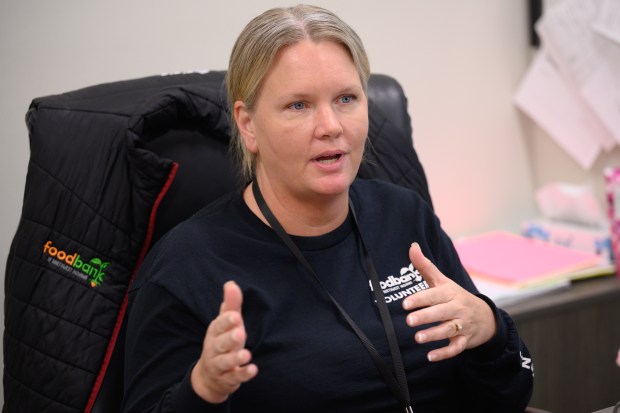
“Once you’ve crossed over the poverty line, the benefits start disappearing,” White explains. “You make a dollar more and lose everything.” Addressing food insecurity, the Food Bank of Northwest Indiana serves approximately 60,000 people monthly, working to distribute food regardless of income levels.
The bank received fluctuations in federal grant funding over the last year and a half, relying more heavily on donations from businesses and grocery chains such as Walmart, Target, and Costco. Additional measures like smart food lockers have been implemented for efficient distribution.
According to CoAction’s Lauren Zurbriggen, ALICE households often don’t seek luxuries, instead focusing on stability and basic necessities. With growing affordability challenges, CoAction has observed an increase in assisted households and rising loan applications within its community loan center.
The North Township Trustee’s Office reports helping more families with utility bills between January and June 2025 compared to last year. Assistance for rent, mortgages, food, and utilities has increased by over $200,000 in the first half of 2026. The office advises that more community assistance is recognized, but elderly individuals reliant on fixed incomes are increasingly seeking help.
The St. John Township Trustee’s Office tracks similar patterns, witnessing a rise in assistance needs for housing payments, food, and utility bills. Trustee Cathy Lareau emphasizes that the office strives to help families find long-term solutions amidst pervasive financial struggles.