Funding Cuts and Reorganization Threaten Critical Wildfire Research
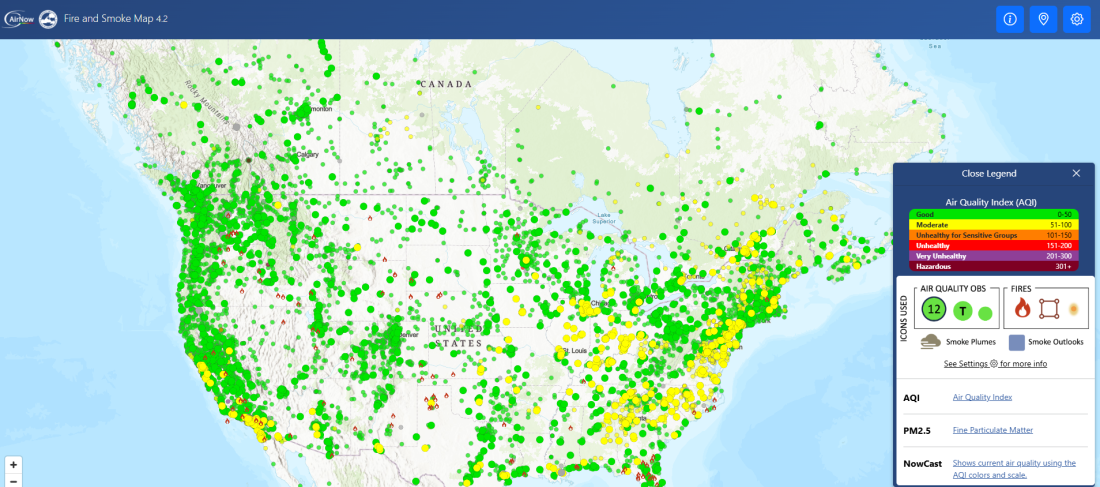
Wildfire and smoke maps available on the federal site fire.airnow.gov are partially the result of research supported by the U.S. Forest Service. This initiative illustrates the collaboration between technology and environmental sciences.
At the University of Washington, a top recipient of federal research funding, there is growing unease. President Trump’s budget cuts, including a significant reduction for the National Science Foundation and National Institutes for Health, have heightened concerns. Even the School of Environmental and Forest Sciences, usually insulated from political shifts, faces potential impacts from proposed funding cuts to the U.S. Forest Service. This situation emerges as the West braces for a significant wildfire season.
Ernesto Alvarado, a fire ecologist at the University of Washington, emphasizes the urgency of the situation. Examining a detailed map of the United States, Alvarado points to wildfire smoke forecasts and particulate concentrations. He focuses on a fire in New Mexico, noting the potential health risks for immunocompromised individuals. “If someone is living in Ruidoso, New Mexico, they can go and see where the smoke is going to,” he explains, demonstrating the map’s functionality.
The research and development underway at the Pacific Wildland Fire Sciences Lab involve a collaborative team of professors, students, and IT professionals. “We need to bring new technology fast,” Alvarado asserts. This advanced system, funded by taxpayer money, supports governmental bodies, elite firefighting units, and widely-used commercial applications.
The longevity of the Forest Service’s research contrasts with typical university grants. “You are integrating the knowledge and the science available for decades by one team, in Seattle,” Alvarado explains, emphasizing the depth of knowledge cultivated over time.
Despite these efforts, the Seattle smoke lab is marked for potential closure on a list of 90 research stations. This is part of a broader reorganization plan that would relocate the headquarters of the U.S. Forest Service. The changes prompt concern from scientists like Morgan Varner, who doubts that current staff would relocate after such a shift.
Forest Service Chief Tom Schultz is defending these organizational changes from his office in Washington, D.C., which is due to relocate. Schultz clarifies, “Okay so I need you to help me change the narrative, we aren’t closing research.” However, financial pressures and a $3 billion maintenance backlog are driving consolidation plans. “We involve the employees in so much of our discussions. But we’ve got to get our budget into control,” Schultz adds.
President Trump’s budget eliminates all research and development funding for the Forest Service, but Congressional decisions will ultimately shape the agency’s operations. Bipartisan opposition to proposed cuts suggests potential revisions.
Across the country, there is unease about the impact of reduced research capabilities amidst increasing wildfire threats. Washington’s public lands commissioner, Dave Upthegrove, acknowledges the vital role local research plays in managing wildfires. Nevertheless, he notes a communication breakdown with federal counterparts, leading to uncertainty about future cooperation.
These developments hold consequences for those dependent on the Forest Service for employment, fire monitoring, and safety measures. Upthegrove voices concerns that the changing climate may soon render the seemingly immune Pacific Northwest vulnerable to wildfires and smoke.